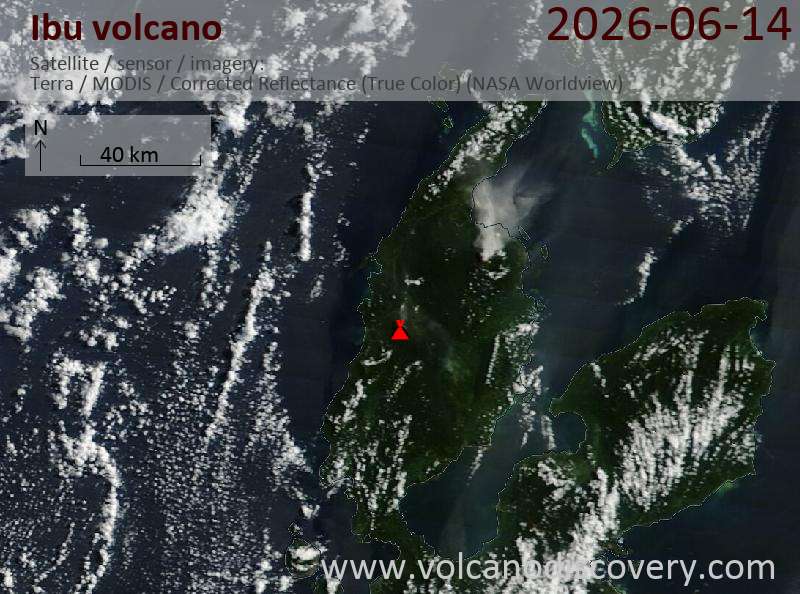
Ibu Volcano Volcanic Ash Advisory: VA TO FL070 REP AT 14/1344Z MOV NW EST VA DTG: 14/1620Z to 7000 ft (2100 m) – Volcano Discovery
According to data from Volcano Discovery, the Ibu Volcano issued a volcanic ash advisory on the 14th at 1344Z, reporting an ash cloud reaching flight level 070 (7,000 feet). The ash is moving northwest, with an estimated duration through 1620Z, posing a potential risk to regional aviation and local air quality.
What is the current status of the Ibu Volcano ash cloud?
The most recent report from Volcano Discovery indicates that volcanic ash (VA) reached an altitude of 7,000 feet (approximately 2,100 meters) as of 1344Z on the 14th. This altitude is designated as Flight Level 070 (FL070). The ash cloud is currently drifting in a northwest (NW) direction.
Experts monitor these movements to establish the Estimated Volcanic Ash Duration (DTG), which for the latest event is projected to last until 1620Z on the 14th. This specific advisory, Ibu Volcano Volcanic Ash Advisory: VA TO FL070 REP AT 14/1344Z MOV NW EST VA DTG: 14/1620Z to 7000 ft (2100 m) – Volcano Discovery, signals a continuation of intermittent eruptive activity that has persisted over several days.
Key details of the current event include:
- Peak Altitude: 7,000 feet (FL070).
- Movement: Northwest.
- Reporting Time: 1344Z.
- Estimated Duration: Until 1620Z.
When did the recent eruptions occur?
Ibu Volcano has shown a pattern of repeated activity between the 12th and the 14th. Reports from Volcano Discovery show that the volcano did not produce a single event, but rather a series of eruptions and ash emissions. On the 12th, an eruption was reported at 0442Z with an estimated duration through 0600Z.
Activity intensified on the 13th. An initial report at 0515Z noted ash with a duration estimated to 0530Z. Later that day, at 1232Z, another eruption sent ash up to FL070. By 2230Z on the 13th, observers noted ash again reaching 7,000 feet, though the movement at that time was recorded as North (N) rather than the Northwest (NW) trajectory seen on the 14th.
| Date/Time (Z) | Event Type | Altitude (FL) | Movement/Duration |
|---|---|---|---|
| 12/0442Z | Eruption Reported | Not Specified | DTG: 12/0600Z |
| 13/0515Z | VA Reported | Not Specified | DTG: 13/0530Z |
| 13/1232Z | VA Eruption | FL070 | Reported at 1232Z |
| 13/2230Z | VA Observed | FL070 | Moving North |
| 14/1344Z | VA Reported | FL070 | Moving Northwest |
How does volcanic ash at 7,000 feet affect aviation?
Ash reaching 7,000 feet creates a hazardous environment for aircraft operating in the lower atmosphere. While long-haul commercial jets typically cruise at 30,000 feet or higher, regional flights, turboprops, and general aviation aircraft often operate within the FL070 range.
Volcanic ash consists of tiny fragments of jagged glass, minerals, and rocks. According to aviation safety standards, these particles cause several critical failures if ingested by a jet engine:
- Engine Flameout: Ash melts in the high-temperature environment of a jet engine, coating the turbine blades in glass and choking the airflow, which can lead to total engine failure.
- Abrasion: The glass-like particles act as an abrasive, scouring windshields and reducing visibility to near zero.
- Sensor Failure: Ash can clog Pitot tubes, which provide essential airspeed data to pilots, leading to dangerous instrument malfunctions.
Because the ash from Ibu Volcano is moving northwest and north, flight dispatchers must reroute aircraft to avoid these corridors. Even low concentrations of ash can cause significant wear and tear on aircraft skins and engines.
Why is the direction of the ash cloud changing?
The reports from Volcano Discovery show a shift in the ash trajectory. On the 13th at 2230Z, the ash moved North. By the 14th at 1344Z, the movement shifted to the Northwest. This change is driven by upper-level wind patterns and atmospheric pressure systems.
Volcanic ash is a passive tracer of the wind. At 7,000 feet, the ash is subject to the prevailing winds of the troposphere. A shift from North to Northwest suggests a change in the regional wind vector, likely caused by shifting weather fronts or local topographic influences on the Halmahera island chain.
This variability makes real-time advisories critical. A flight path that was safe on the 13th may become hazardous on the 14th as the ash plume pivots. related explainer on volcanic wind patterns
What are the technical terms in these advisories?
The language used in the Ibu Volcano Volcanic Ash Advisory: VA TO FL070 REP AT 14/1344Z MOV NW EST VA DTG: 14/1620Z to 7000 ft (2100 m) – Volcano Discovery is standardized for international aviation. Understanding these terms is essential for interpreting the risk.
“VA” stands for Volcanic Ash. “FL” refers to Flight Level, where FL070 equals 7,000 feet above sea level. “Z” denotes Zulu time, which is Coordinated Universal Time (UTC).
Other key terms include:
- MOV NW: Indicates the ash is moving in a Northwest direction.
- EST VA DTG: The Estimated Volcanic Ash Duration/Date-Time Group. This tells controllers how long the ash is expected to remain a threat in a specific area.
- REP/OBS: “REP” means reported (often by a pilot or ground station), while “OBS” means observed (often via satellite or visual confirmation).
Regional context: The activity of Ibu Volcano
Ibu is one of Indonesia’s most active volcanoes, located on the island of Halmahera. The region sits on the “Ring of Fire,” a zone of intense seismic and volcanic activity caused by the subduction of tectonic plates.
The frequent, low-altitude eruptions seen in the recent reports are characteristic of Ibu’s current phase. Unlike massive Plinian eruptions that can send ash into the stratosphere (above 40,000 feet) and affect global temperatures, these FL070 events are primarily regional threats. However, the persistence of these events—occurring daily from the 12th to the 14th—indicates a sustained period of unrest.
Local communities often face “ash fall,” where the particles settle on crops and rooftops. This can contaminate water sources and cause respiratory issues for residents. The shift in wind direction (North to Northwest) determines which villages are most affected by the fallout.
Common misconceptions about volcanic ash advisories
A common mistake is assuming that if an aircraft is flying “above” the reported flight level, it is entirely safe. While FL070 is the reported peak, ash clouds are not solid blocks; they are plumes with varying densities. Turbulence can push pockets of ash higher or lower than the reported average.
Another misconception is that ash is like smoke. Smoke is composed of gases and organic particles that dissipate or burn. Volcanic ash is pulverized rock. It does not “dissolve” in the air; it remains abrasive and hazardous until it settles on the ground or is washed away by rain.
Finally, some believe that a “reported” (REP) event is less reliable than an “observed” (OBS) event. In aviation, a pilot report (PIREP) is often the most valuable piece of data because it provides first-hand confirmation of ash visibility, which satellite imagery sometimes misses due to cloud cover.
Frequently Asked Questions
What does FL070 mean in the Ibu Volcano advisory?
FL070 stands for Flight Level 070, which represents an altitude of 7,000 feet above mean sea level. This is the height the volcanic ash has reached according to the Volcano Discovery report.

Is the Ibu Volcano ash cloud dangerous to commercial flights?
Yes, if the aircraft flies through the plume. While most long-haul jets fly much higher, regional aircraft and those ascending or descending in the area are at risk of engine damage and visibility loss.
How long does the volcanic ash last?
The duration varies by event. For the report on the 14th, the estimated duration (DTG) was through 1620Z. Ash remains hazardous until it settles or is dispersed by atmospheric winds.
Why is the ash moving northwest?
The movement of volcanic ash is determined by the wind direction at the altitude of the plume. Current atmospheric conditions at 7,000 feet are pushing the Ibu Volcano ash toward the northwest.
Where is Ibu Volcano located?
Ibu Volcano is located on Halmahera Island in Indonesia, a region known for high volcanic activity due to its position on the Pacific Ring of Fire.
