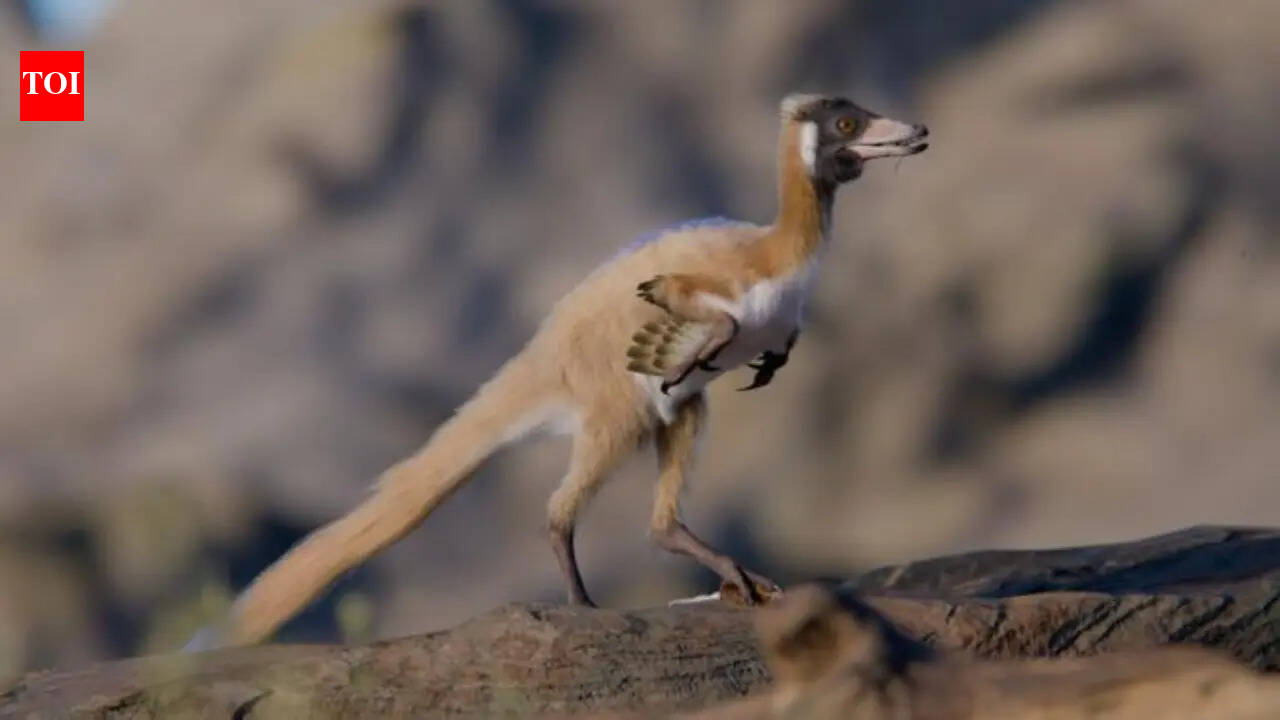
Not just giants: Fossil of the smallest dinosaur, about the size of a crow, found – The Times of India
When the general public envisions the Mesozoic Era, the mind immediately conjures images of towering behemoths: the thunderous footsteps of a Brachiosaurus, the terrifying jaw of a Tyrannosaurus Rex, or the armored bulk of an Ankylosaurus. For decades, the cultural narrative surrounding dinosaurs has been one of extreme scale. However, a groundbreaking paleontological discovery is shifting this paradigm, proving that the prehistoric world was just as populated by the miniature as it was by the massive. The recent uncovering of a fossil belonging to one of the smallest dinosaurs ever recorded—roughly the size of a modern-day crow—serves as a poignant reminder that evolutionary success is not always measured by size.
This discovery, often discussed under the headline “Not just giants: Fossil of the smallest dinosaur, about the size of a crow, found – The Times of India,” challenges the “giant-centric” view of paleontology. By analyzing the skeletal remains of this diminutive creature, scientists are gaining unprecedented insight into the diversity of dinosaurian life and the complex evolutionary pressures that led some species to shrink while others grew to mountainous proportions. The find suggests a highly nuanced ecosystem where small, agile hunters occupied niches that the giants simply could not reach.
The Anatomy of a Miniature Marvel
The fossil in question represents a significant departure from the typical dinosaur specimens that grace museum halls. While large fossils are often easier to locate due to their sheer mass, the recovery of a crow-sized skeleton requires a level of precision and patience akin to forensic archaeology. The specimen is remarkably well-preserved, allowing researchers to examine the delicate architecture of its bones, which provides clues about its movement, diet, and social behavior.
Preliminary analysis indicates that this small dinosaur likely belonged to a lineage of theropods—the group of bipedal, mostly carnivorous dinosaurs that also gave rise to modern birds. The lightness of the bone structure suggests an adaptation for speed and agility. Much like today’s corvids (crows and ravens), this creature likely relied on its intelligence and quick reflexes to survive in a world dominated by predators hundreds of times its size.
“The discovery of such a small specimen is a critical piece of the evolutionary puzzle. It demonstrates that miniaturization was a viable and successful strategy during the Cretaceous period, allowing certain species to exploit food sources and habitats that were inaccessible to their larger cousins.”
Key Physical Characteristics
- Dimensions: Roughly equivalent to a large crow, making it one of the smallest non-avian dinosaurs ever documented.
- Skeletal Structure: Hollow, lightweight bones indicative of high mobility and potentially a precursor to avian flight mechanisms.
- Dentition: Small, sharp teeth designed for a diet of insects, small lizards, or early mammals.
- Limb Proportion: Elongated hind legs suggesting a cursorial (running) lifestyle.
The Science of Miniaturization: Why Get Small?
In evolutionary biology, the trend toward smaller body sizes is known as miniaturization. While the “arms race” of the Jurassic and Cretaceous often pushed dinosaurs toward gigantism to deter predators or reach high vegetation, there were distinct evolutionary advantages to staying small. This discovery highlights several key reasons why a dinosaur would evolve to be the size of a crow.
1. Niche Partitioning
In any ecosystem, competition for resources is fierce. If every dinosaur were a giant, the environment would quickly be depleted of food. Small dinosaurs practiced “niche partitioning,” occupying the “undergrowth” of the prehistoric world. While the giants grazed on the canopy or hunted megafauna, the crow-sized dinosaur hunted in the leaf litter, feeding on invertebrates and small vertebrates.
2. Metabolic Efficiency
Smaller animals generally require less total caloric intake than giants. In times of environmental stress or food scarcity, a smaller body size is an insurance policy. A crow-sized dinosaur could survive on a handful of insects, whereas a larger predator would require kilograms of meat daily to maintain its basal metabolic rate.
3. Predator Avoidance
Being small is a primary defense mechanism. By remaining diminutive, these dinosaurs could hide in dense foliage, burrows, or rocky crevices, making them virtually invisible to the apex predators of their time. Their agility allowed them to navigate complex terrains—such as thick forests—where a larger dinosaur would be hindered by its own bulk.
| Feature | Giant Dinosaurs (e.g., Sauropods) | Miniature Dinosaurs (e.g., Crow-sized) |
|---|---|---|
| Primary Advantage | Defense via size; access to high foliage | Stealth; agility; low caloric needs |
| Dietary Focus | Massive quantities of plants/meat | Insects, small reptiles, seeds |
| Habitat | Open plains, forest edges | Dense underbrush, forest floors |
| Survival Strategy | Intimidation and power | Camouflage and speed |
Taphonomy: The Challenge of Finding Small Fossils
One of the most frequent questions regarding this discovery is: If small dinosaurs were so common, why are we only now finding them in significant numbers? The answer lies in taphonomy—the study of how organisms decay and become fossilized.
Large bones are robust and more likely to survive the crushing pressure of sedimentary layers over millions of years. In contrast, the bones of a crow-sized dinosaur are fragile. They are more susceptible to being crushed, weathered away by acidic soil, or consumed entirely by scavengers before they can be buried. This creates a “preservation bias” in the fossil record, where the giants are overrepresented and the miniatures are underrepresented.

The discovery of this particular fossil suggests that the conditions of the burial site were exceptional. Whether it was a sudden mudslide or a low-energy aquatic environment, the specimen was shielded from the elements, preserving a level of detail that is rarely seen in small-bodied theropods. This find encourages paleontologists to look closer at “micro-sites”—areas previously ignored because they lacked the massive bones of the giants.
For those interested in how these processes work, a related explainer on fossilization and taphonomy provides a deeper dive into the chemistry of bone preservation.
Connecting the Dots: The Link to Modern Birds
The discovery of a crow-sized dinosaur is not just a curiosity of scale; it is a vital piece of evidence in the transition from dinosaurs to birds. The lineage of Maniraptora, which includes these small theropods, shows a clear progression toward the avian form.
Many of these small dinosaurs possessed feathers, not for flight initially, but for thermoregulation or mating displays. As they became smaller, the physics of their environment changed. A smaller body mass made the prospect of gliding or flapping more viable. By studying the skeletal proportions of this latest find, scientists can better understand the “scaling laws” that allowed dinosaurs to eventually take to the skies.
The Evolutionary Bridge
- Phase 1: Large theropods develop hollow bones for efficiency.
- Phase 2: Miniaturization occurs to fill new ecological niches.
- Phase 3: Development of proto-feathers for warmth and display.
- Phase 4: Adaptation of forelimbs into wing-like structures.
- Phase 5: Emergence of true avian flight.
Correcting Common Misconceptions
The narrative of the “terrible lizards” has led to several persistent myths that this discovery helps debunk.
Myth: All dinosaurs were slow and lumbering.
The crow-sized dinosaur proves the opposite. These animals were likely hyper-active, with fast metabolisms and rapid movement, more akin to modern birds or mammals than to the slow-moving reptiles we often see in older movies.
Myth: Small dinosaurs were “failures” or “primitive.”
In biology, “primitive” does not mean “inferior.” Miniaturization is often a highly advanced evolutionary adaptation. These small dinosaurs were perfectly engineered for their specific environment, proving that being small was a strategic choice for survival, not a biological shortcoming.
Myth: They were just “small versions” of T-Rex.
While they share a common ancestor, small dinosaurs evolved entirely different physiological traits. Their sensory organs, particularly their eyesight and hearing, were likely far more acute to compensate for their vulnerability, making them the “special ops” of the dinosaur world.
The Broader Impact on Paleontology
This find is a catalyst for a shift in how paleontological expeditions are conducted. For too long, the “big game” mentality dominated the field—the search for the next largest skull or the longest neck. However, the realization that an entire world of “micro-dinosaurs” existed is prompting researchers to employ new technologies, such as high-resolution CT scanning and screen-washing of sediments, to find the smallest fragments of bone.
By reconstructing the “small-scale” world of the Cretaceous, we get a more honest and complete picture of Earth’s history. We begin to see a world that looks less like a monster movie and more like a complex, layered forest, where a giant titan might have stepped over a thousand crow-sized hunters without even noticing they were there.
this discovery has implications for our understanding of the K-Pg extinction event. It is well-documented that smaller animals had a higher survival rate during the asteroid impact because they required less food and could find shelter more easily. Understanding the diversity of small dinosaurs helps us understand why certain lineages survived to become the birds we see today while the giants vanished forever.
Summary of the Discovery’s Significance
- Biodiversity: Proves that dinosaur sizes spanned a much wider spectrum than previously emphasized.
- Ecological Insight: Reveals the importance of insect-eating and small-prey niches in the Mesozoic.
- Avian Link: Strengthens the morphological bridge between non-avian dinosaurs and modern birds.
- Methodological Shift: Encourages the study of micro-fossils and higher-precision excavation.
Frequently Asked Questions
Is this the smallest dinosaur ever found?
While it is one of the smallest, the “smallest” title often fluctuates as new fossils are discovered. However, this specimen is among the most complete of the miniature dinosaurs, providing more usable data than many other tiny fragments found in the past.

Did this dinosaur have feathers?
While fossilized feathers are rare, most paleontologists believe that small theropods of this size and lineage possessed some form of plumage for warmth or display, as is seen in related species like the Microraptor.
How does “crow-sized” compare to other small dinosaurs?
Many people are familiar with the Compsognathus, which was also small. This new find sits in a similar size class, but its specific skeletal features may indicate a different evolutionary branch or a different regional adaptation.
Where was this fossil found?
The specifics of the site are often kept confidential until full peer-reviewed publication to protect the site from looters, but it is typically found in sedimentary rock layers dating back to the Late Cretaceous period.
Can we determine what it ate?
Yes, by examining the shape and spacing of the teeth (dental morphology) and using geochemical analysis of the tooth enamel, scientists can infer that it primarily targeted insects and small vertebrates.
The revelation that the prehistoric world was home to creatures as small as a crow reminds us that nature rarely follows a single path. The story of the dinosaurs is not just a story of giants, but a story of adaptability, diversity, and the enduring success of the small. As we continue to uncover these fragile remains, the image of the Mesozoic Era becomes clearer, more colorful, and far more complex than the giants alone could ever tell us.
