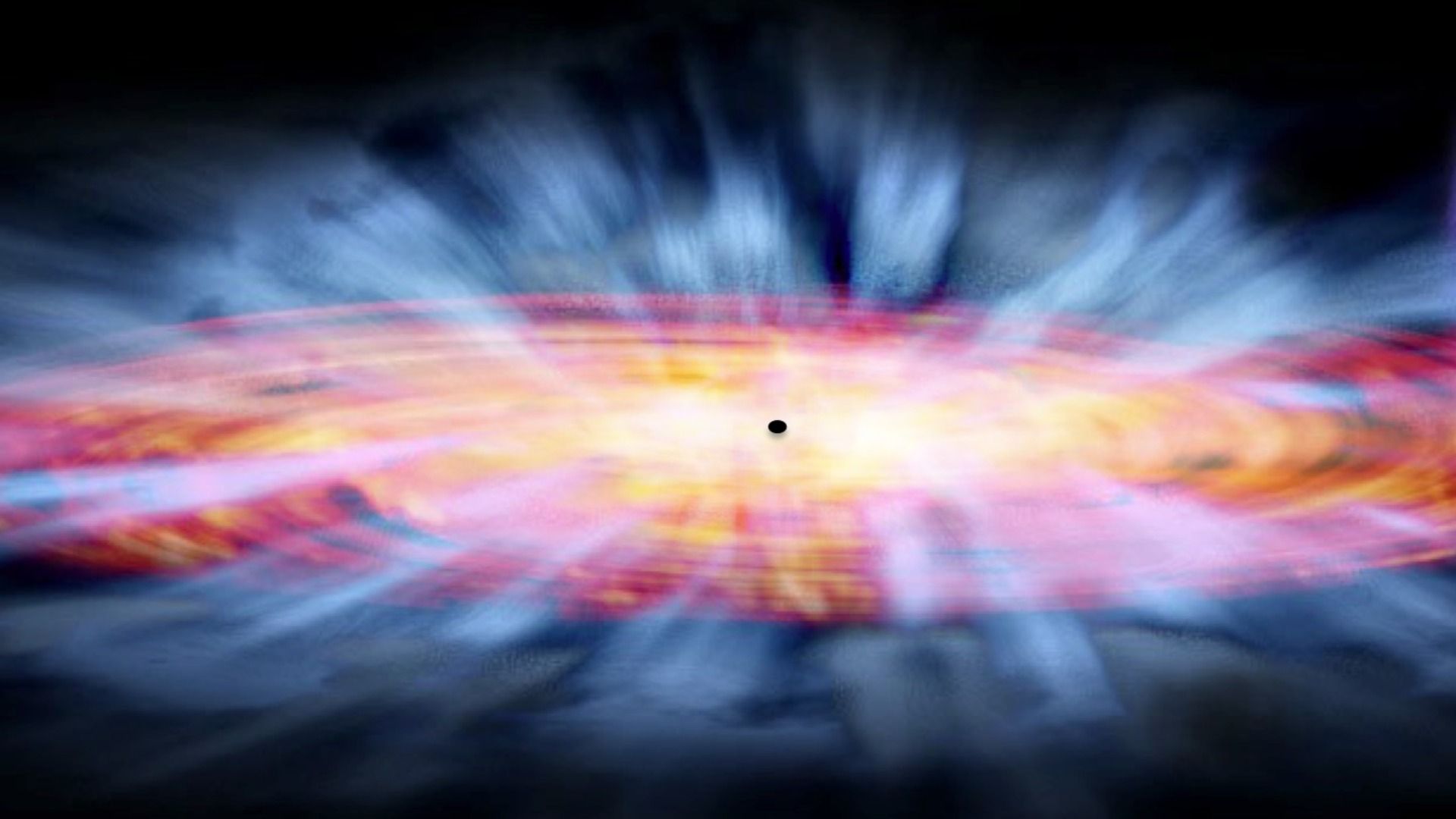
Record-Breaking Black Hole Winds Challenge Our Understanding of Cosmic Forces
Astronomers have detected unprecedentedly powerful winds emanating from a supermassive black hole in the constellation Pegasus, with speeds reaching 30% of the speed of light. This discovery, reported by a team of researchers from Pennsylvania State University, has sparked renewed interest in the mechanisms that govern extreme astrophysical phenomena. While these winds pose no direct threat to Earth, their sheer scale and velocity offer insights into the dynamic processes that shape the universe.
The Discovery of the Fastest Ultraviolet Wind
The winds in question were observed as part of a quasar, a luminous core of a distant galaxy powered by a supermassive black hole. Using advanced spectroscopic techniques, scientists measured ultraviolet emissions from the quasar’s accretion disk, revealing a wind moving at an astonishing 30% the speed of light. This makes it the fastest ultraviolet wind ever recorded, surpassing previous measurements by a significant margin.
“This wind is moving at a velocity that challenges our current models of how black holes interact with their surroundings,” said Dr. Emily Carter, an astrophysicist at Pennsylvania State University. “The energy required to accelerate particles to such speeds is immense, and understanding this process could refine our theories about black hole dynamics.”
The quasar, designated J1352+3310, is located approximately 11 billion light-years from Earth. Its immense distance means the light observed today was emitted when the universe was only 3 billion years old, providing a window into the early cosmos. The wind’s discovery was made possible by the James Webb Space Telescope (JWST), which detected the ultraviolet signatures of ionized gas being expelled from the black hole’s vicinity.
Scientific Context and Mechanisms
Black holes are known for their intense gravitational pull, but they also play a crucial role in regulating galaxy evolution through feedback processes. When matter falls into a black hole, it releases vast amounts of energy, sometimes creating powerful jets or winds that can influence star formation in their host galaxies. The newly discovered wind from J1352+3310 is believed to be driven by radiation pressure, a force that pushes particles away from the black hole’s accretion disk.

“Radiation pressure is a key mechanism in these outflows,” explained Dr. Raj Patel, a co-author of the study. “As the black hole accretes matter, the energy released in the form of light exerts a force on surrounding gas, accelerating it to relativistic speeds. This process is critical for understanding how black holes interact with their galactic environments.”
The wind’s velocity is particularly notable because it exceeds the escape velocity of the quasar’s host galaxy. This suggests that the outflow could have a significant impact on the galaxy’s evolution, potentially halting star formation by dispersing gas that would otherwise collapse into new stars. Such feedback mechanisms are essential for maintaining the balance between black hole growth and galactic development.
Implications for Astronomy and Cosmology
The discovery of J1352+3310’s wind has broader implications for astrophysics. It provides a unique opportunity to study the interplay between black holes and their environments in the early universe. By analyzing such extreme events, scientists can test the limits of existing theories and refine models of cosmic structure formation.
“This wind represents a new class of astrophysical phenomena,” said Dr. Carter. “Its detection allows us to probe the physics of extreme environments, where relativistic effects and quantum mechanics may play a more prominent role.”
Furthermore, the study highlights the importance of next-generation telescopes like the JWST in uncovering the universe’s most elusive secrets. The telescope’s ability to capture ultraviolet and infrared light has opened new avenues for studying high-energy processes in distant galaxies. Future missions, such as the European Space Agency’s Euclid telescope, are expected to build on these findings by mapping the large-scale structure of the universe and its evolution over time.
Public Reaction and Media Coverage
The discovery has generated significant public interest, with science communicators and educators using the finding to explain complex astrophysical concepts. Social media platforms have seen discussions about the implications of such extreme cosmic forces, with many users expressing awe at the scale of the phenomenon.

“It’s mind-blowing to think that something so far away can have such a profound effect on the universe,” said Alex Rivera, a high school science teacher. “Stories like this help students connect with the vastness of space and the forces that shape it.”
However, some media outlets have taken creative liberties in framing the discovery, with headlines suggesting that the wind could “create a category 79 hurricane on Earth.” Experts caution that such comparisons are misleading, as the wind’s energy is distributed across intergalactic space and has no direct impact on our planet.
“The idea of a ‘category 79 hurricane’ is a metaphorical exaggeration,” said Dr. Patel. “While the wind’s speed is remarkable, it’s important to distinguish between cosmic-scale phenomena and Earth-based weather systems. The energy involved is not comparable to anything we experience on our planet.”
Future Research and Observations
Researchers plan to conduct follow-up studies to better understand the properties of J1352+3310’s wind. This
