
Australia’s Economic Outlook 2026: Navigating the Prime Minister’s Vision for Growth and Stability
As Australia steers through a period of global volatility and internal structural shifts, the roadmap toward 2026 has become a focal point for investors, policymakers, and citizens alike. The discourse surrounding Australia’s economic outlook 2026 – Prime Minister of Australia centers on a delicate balancing act: curbing stubborn inflation while simultaneously funding a massive transition toward a green energy superpower status. The government’s strategy is not merely about maintaining the status quo but about fundamentally redefining the nation’s competitive advantage in a decarbonizing world.
The current economic climate is characterized by a “soft landing” ambition. While the Reserve Bank of Australia (RBA) has utilized aggressive monetary tightening to tame price growth, the Prime Minister’s office is tasked with the fiscal side of the equation. The goal for 2026 is to emerge from the cost-of-living crisis with a more diversified export base, a stabilized housing market, and a workforce equipped for the digital and green revolutions. This transition is fraught with risk, yet the administration views the next two years as a critical window to secure long-term prosperity.
The Strategic Pillars of the 2026 Economic Roadmap
The Prime Minister’s vision for the economy by 2026 rests on several strategic pillars designed to move Australia beyond its traditional reliance on raw commodity exports. While iron ore and coal remain vital, the government is pivoting toward “value-adding” industries.
The ‘Future Made in Australia’ Initiative
Central to the outlook is the concept of sovereign capability. The government is increasingly focusing on domestic manufacturing, particularly in the realm of renewable energy technologies. By 2026, the administration aims to have established a robust ecosystem for the production of green hydrogen, solar components, and battery storage. This is not just an environmental goal but a calculated economic move to insulate Australia from global supply chain shocks and create high-skilled employment.
Critical Minerals and Global Trade Diversification
Australia possesses some of the world’s largest reserves of lithium, cobalt, and rare earths—materials essential for the global energy transition. The Prime Minister has emphasized that by 2026, Australia should not just be a “quarry” for the world but a hub for processing these minerals. By moving up the value chain, the nation can capture more profit and create a more resilient trade profile.
- Strategic Partnerships: Strengthening ties with the US, Japan, and India to reduce over-reliance on any single trading partner.
- Trade Liberalization: Leveraging existing free trade agreements to open new markets for agricultural and professional services.
- Investment Attraction: Creating a stable regulatory environment to lure foreign direct investment (FDI) into the green energy sector.
Managing the Inflationary Pressure and Monetary Policy
A significant portion of the conversation regarding Australia’s economic outlook 2026 – Prime Minister of Australia involves the tension between fiscal spending and monetary restraint. The RBA’s mandate to return inflation to the 2-3% target range has put immense pressure on households, particularly those with floating-rate mortgages.
The government’s approach is to provide targeted relief rather than broad-based stimulus, which could potentially fuel further inflation. By 2026, the expectation is that inflation will have stabilized, allowing the RBA to pivot toward a more neutral interest rate environment. However, the timing of this pivot remains a point of intense debate among economists.
“The path to 2026 requires a disciplined approach to spending. We cannot solve the cost-of-living crisis by adding to the inflationary fire, but we can solve it by increasing productivity and supply.”
The Productivity Puzzle
For decades, Australia has struggled with a “productivity puzzle”—a slowdown in the growth of output per hour worked. The Prime Minister’s economic team is betting that the integration of AI and automation in the services and mining sectors will provide the necessary spark. By 2026, the goal is to see a measurable uptick in productivity, which would allow for wage growth without triggering a price-wage spiral.
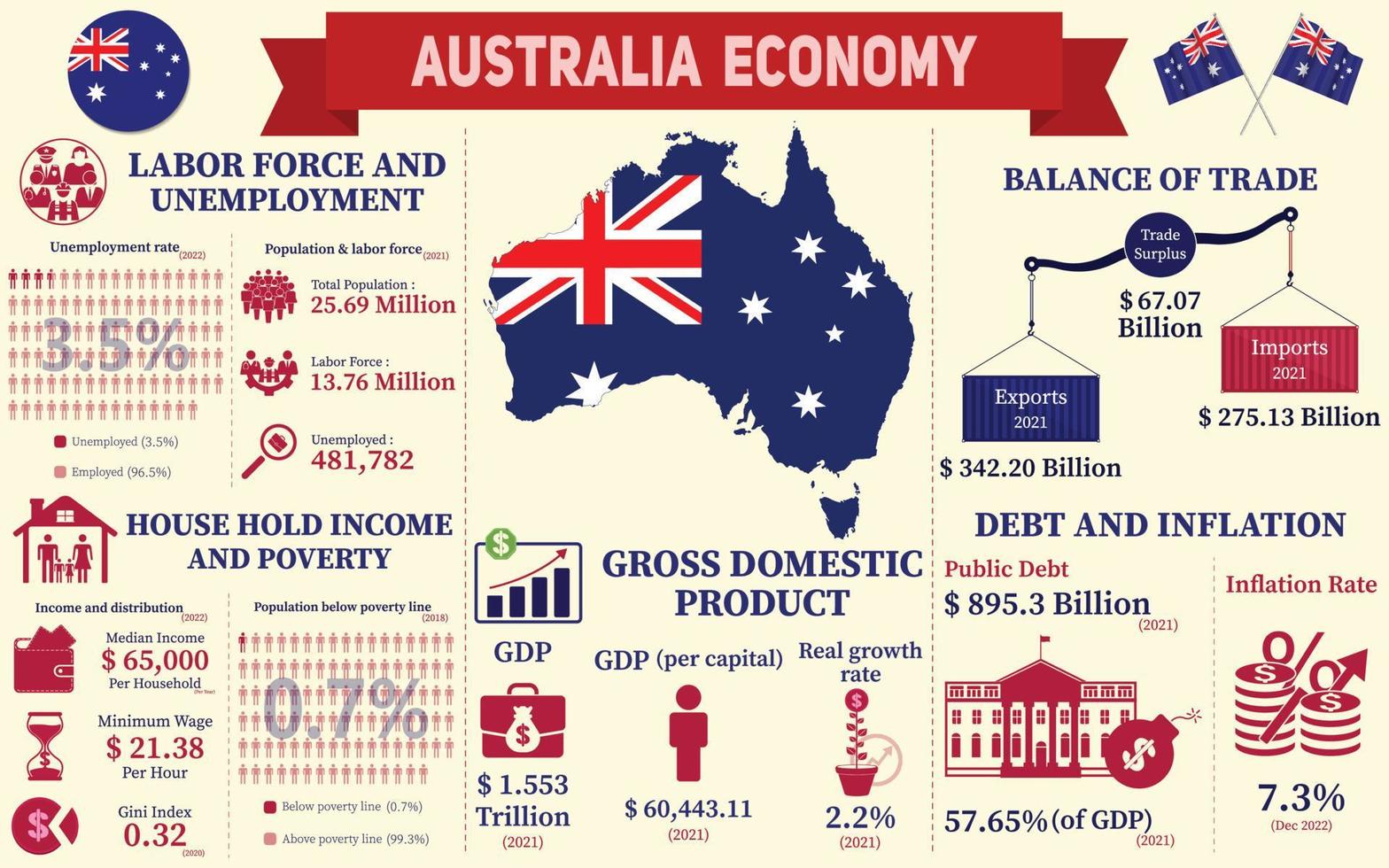
| Economic Indicator | 2023-2024 Trend | 2026 Target/Outlook | Primary Driver |
|---|---|---|---|
| GDP Growth | Moderate/Slowing | Stable 2.0% – 2.5% | Green energy investment |
| Inflation (CPI) | Elevated | 2.5% (Target Range) | RBA Monetary Policy |
| Unemployment | Historically Low | 4.0% – 4.5% | Labor market rebalancing |
| Trade Balance | Surplus | Diversified Surplus | Critical minerals processing |
The Housing Crisis: A Structural Barrier to Growth
No analysis of the 2026 economic outlook is complete without addressing the housing market. The Prime Minister has acknowledged that housing affordability is not just a social issue but a systemic economic risk. High rents and property prices are limiting labor mobility, as workers cannot afford to move to where the jobs are.
The strategy leading into 2026 involves a multi-pronged approach to increase housing supply. This includes federal funding for social housing and incentives for private developers to build high-density residential units near transport hubs. If the government fails to significantly increase the supply of dwellings by 2026, the resulting “cost-of-living” pressure will likely act as a drag on overall consumption and GDP growth.
For those interested in how urban planning affects national wealth, a related explainer on Australian infrastructure investment provides further context on the government’s broader spending priorities.
Geopolitical Risks and the Indo-Pacific Context
Australia’s economy is inextricably linked to the stability of the Indo-Pacific. The Prime Minister’s economic strategy for 2026 is heavily influenced by the “de-risking” trend—reducing economic vulnerability to geopolitical tensions, particularly between the US and China.
The China Relationship
China remains Australia’s largest trading partner. After several years of trade frictions and sanctions on various Australian exports, the relationship has entered a phase of stabilization. The outlook for 2026 assumes a continued pragmatic engagement with Beijing, focusing on trade in commodities while maintaining security alliances with the West.
The Impact of Global Energy Shifts
As the world moves away from fossil fuels, Australia faces a paradoxical challenge. This proves one of the world’s largest exporters of LNG and coal, yet it is striving to be a leader in renewables. The 2026 outlook anticipates a gradual transition where the revenues from traditional energy exports are used to fund the infrastructure for the next generation of energy exports, such as green ammonia and hydrogen.
Stakeholder Perspectives: Divergent Views on the 2026 Path
While the Prime Minister’s office presents a cohesive vision, various stakeholders hold differing views on the likelihood of these goals being achieved.
- Business Councils: Generally supportive of the “Future Made in Australia” initiative but express concern over the pace of regulatory approvals for new mining and energy projects. They argue that “red tape” could hinder the 2026 targets.
- Labor Unions: Focus on “real wage growth.” They argue that the 2026 outlook must include strong protections for workers in the transition from coal to renewables to avoid “rust belt” scenarios in regional Australia.
- International Investors: View Australia as a safe haven but are looking for clearer timelines on the hydrogen economy. They want to see concrete legislation and subsidies before committing massive capital for 2026 and beyond.
- The General Public: Primarily concerned with the immediate term. For the average citizen, the “economic outlook 2026” is measured by the cost of groceries and the monthly mortgage repayment.
Common Misconceptions About Australia’s Economic Future
In the public discourse, several oversimplifications often arise regarding the nation’s economic trajectory. It is important to clarify these to understand the actual complexity of the situation.
Misconception 1: “The end of coal means an economic crash”
Some argue that moving away from coal will devastate the economy. In reality, the 2026 outlook is based on diversification, not an overnight shutdown. The goal is to replace coal revenue with critical minerals and green energy, ensuring the economy evolves rather than collapses.
Misconception 2: “Interest rate cuts are guaranteed by 2026”
While many hope for lower rates, the RBA operates independently of the Prime Minister. If global inflation remains sticky or if domestic wage growth accelerates too quickly, rates could remain higher for longer than the government would prefer.
Misconception 3: “Australia can become a green superpower alone”
The vision for 2026 relies heavily on global demand. Australia can produce the green hydrogen, but it needs the world (specifically Japan, Korea, and Europe) to build the infrastructure to import and use it. The outlook is dependent on global policy synchronization.
Analyzing the Potential Long-Term Implications
If the Prime Minister’s strategy succeeds by 2026, Australia will have transitioned from a “dig and ship” economy to a “process and innovate” economy. This would result in a more stable GDP, less susceptibility to commodity price crashes, and a more resilient middle class.
However, the risks are significant. A failure to solve the housing crisis could lead to social instability and a stunted workforce. Similarly, if the “Future Made in Australia” initiative is seen as mere protectionism, it could trigger trade disputes or lead to inefficient industries that cannot compete globally without permanent subsidies.
To understand the broader trends in global trade that affect this outlook, readers may find a related explainer on global supply chain diversification useful for comparing Australia’s approach with other OECD nations.
Frequently Asked Questions
What is the primary focus of Australia’s economic outlook for 2026?
The primary focus is a transition toward a green energy economy, reducing inflation to the 2-3% target, and increasing domestic manufacturing through the “Future Made in Australia” initiative, all while managing the cost-of-living crisis.
How does the Prime Minister’s plan address the cost of living?
The government is focusing on targeted relief measures and long-term supply-side solutions, particularly in housing and energy, to lower costs for households without fueling further inflation.
Will interest rates be lower by 2026?
While the government hopes for a return to lower rates, this depends entirely on the Reserve Bank of Australia (RBA) and whether inflation returns to the target range. Most analysts expect a gradual easing, but it is not guaranteed.
What role do critical minerals play in the 2026 outlook?
Critical minerals like lithium and cobalt are seen as the new “iron ore.” The strategy is to move from simply exporting these raw materials to processing them domestically, adding value and creating high-tech jobs.
How is the housing crisis affecting the overall economic forecast?
Housing is viewed as a major structural risk. Lack of affordability restricts labor mobility and reduces disposable income, which can slow overall economic growth and productivity.
As the nation moves toward 2026, the success of the Prime Minister’s economic vision will be measured by more than just GDP figures. The true test will be whether the benefits of the green transition reach the average household and whether Australia can maintain its standard of living while fundamentally altering its economic engine. The next 24 months will likely determine the nation’s trajectory for the rest of the decade, making the monitoring of fiscal policy and RBA decisions more critical than ever.
