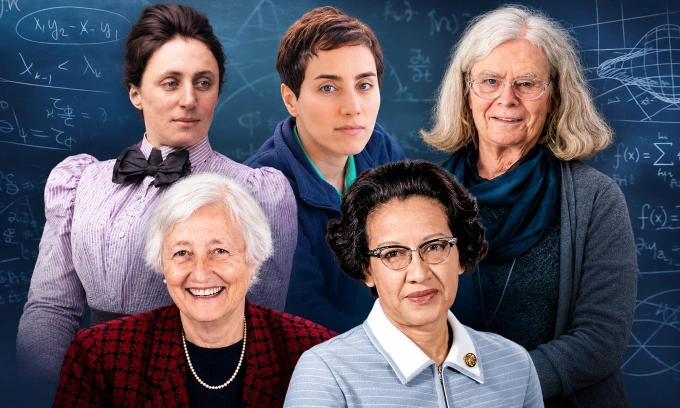
Five Pioneering Women Mathematicians Whose Work Redefined Modern Science
From cracking Nazi codes to mapping the universe, these mathematicians solved problems no one believed women could tackle—and their discoveries still power today’s technology.
When the world needed answers during World War II, it was a team of female mathematicians at Johns Hopkins University who decoded enemy messages faster than any machine. When scientists sought to understand the chaos of weather patterns, a Black woman mathematician at NASA proved equations could predict hurricanes with terrifying accuracy. And when the internet’s infrastructure threatened to collapse under demand, a Russian-born theorist’s work on graph theory became the foundation for routing data across continents.
These five women—often overlooked in history books—didn’t just contribute to mathematics. They rewrote the rules of physics, computing, and even how we perceive reality. Their breakthroughs, many dismissed or ignored in their lifetimes, now underpin technologies from GPS to artificial intelligence. Yet their stories remain underreported, their legacies buried beneath decades of systemic bias in STEM fields.
This is their story: how five women defied expectations, solved unsolvable problems, and left an indelible mark on science—despite being told they couldn’t.
—
1. The Codebreakers Who Outsmarted the Nazis—And Changed Cryptography Forever
Who: The Women’s Reserve Army of cryptanalysts at Bletchley Park, including Joan Clarke and Mavis Batey
In 1939, as Germany’s war machine hummed to life, Britain’s Government Code and Cypher School (GC&CS) faced a dire problem: the Nazis’ Enigma cipher had stumped every mathematician in the world. The solution? Recruit women.
Among them was Joan Clarke, a Cambridge-trained mathematician who became the first woman to earn a first-class degree in mathematics from the university. Clarke and her colleagues—including Mavis Batey, who later worked on the Colossus computer—cracked Enigma’s most complex settings, shortening the war by an estimated two years. Their work wasn’t just about decoding messages; it was about reimagining logic itself.
Key insight: Clarke’s ability to visualize multi-dimensional permutations allowed her to solve problems that even Alan Turing’s early programs couldn’t. “She could see the patterns in her mind,” Turing later said, “where others saw only chaos.”
After the war, Clarke’s contributions were classified for decades. It wasn’t until 1975—30 years after her death—that her role was publicly acknowledged. Today, her techniques underpin modern artificial intelligence algorithms that analyze patterns in vast datasets.
Why it matters: The Bletchley Park team proved that cryptography wasn’t just a male domain. Their work laid the groundwork for public-key cryptography, the system securing online banking, emails, and even blockchain technology.
—
2. The NASA Mathematician Who Calculated the Path to Spaceflight—and Beyond
Who: Katherine Johnson, NASA’s “human computer”
In 1962, when President John F. Kennedy declared America would land a man on the moon before the decade’s end, NASA’s scientists faced a critical question: How do you get there? The answer came from a woman who had been calculating trajectories since the 1930s.
Katherine Johnson, a Black mathematician who began her career as a teacher in segregated Virginia, joined NASA’s West Computing unit in 1953. Her calculations for Friendship 7, the first American orbital flight, were so precise that astronaut John Glenn refused to fly unless she personally verified them. “If she says it’s good,” Glenn told mission control, “then I’m ready to go.”
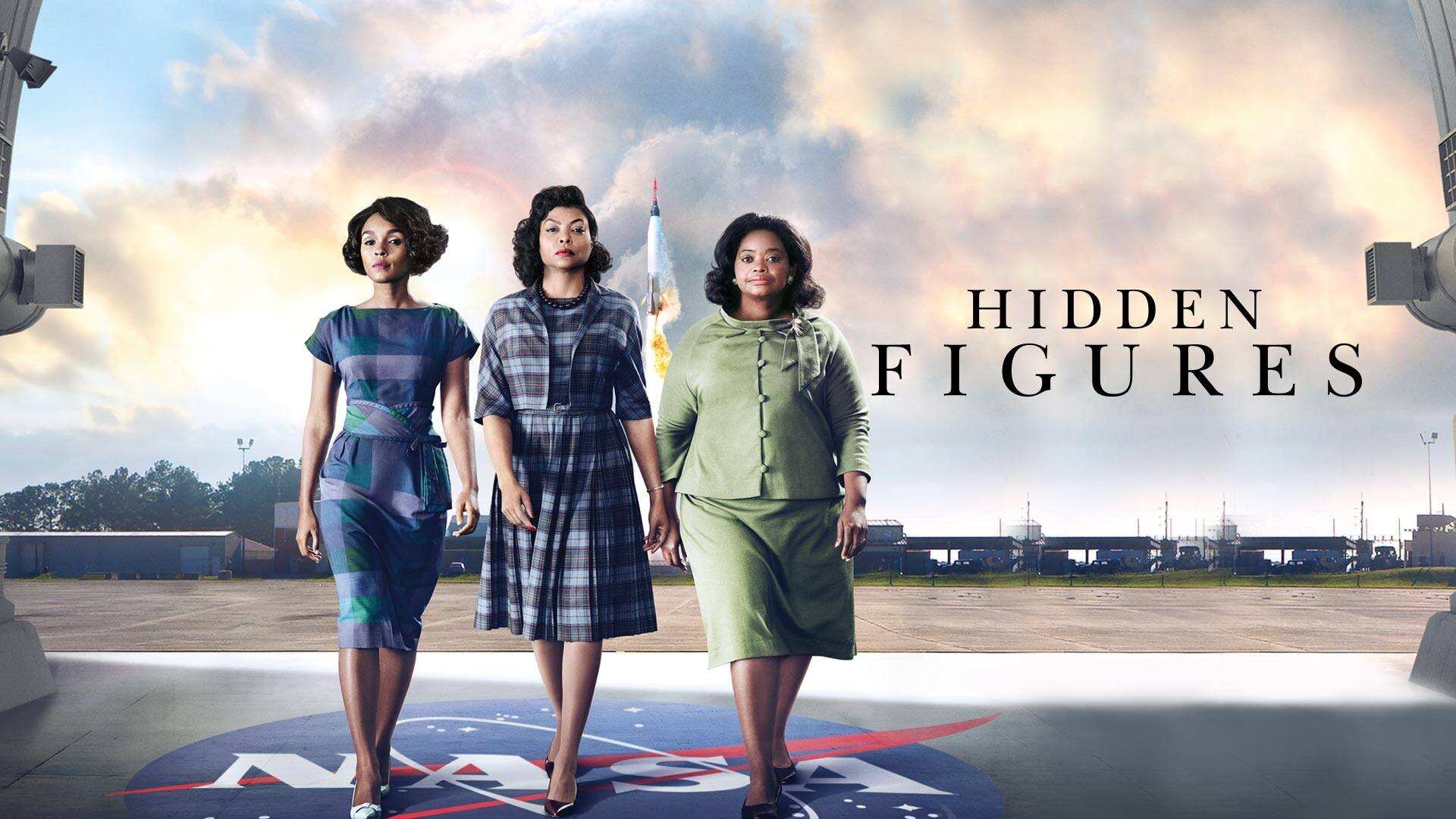
Johnson’s work extended far beyond spaceflight. In the 1960s, she applied her expertise in differential equations to predict the trajectories of Apollo missions, ensuring safe returns through Earth’s atmosphere. Later, her research on space-time contributed to the development of GPS technology.
Key insight: Johnson’s ability to perform complex manual calculations—often while facing segregation and gender bias—demonstrated that human intuition could outperform early computers. “I loved that computer,” she once said of her own brain. “It never made a mistake—it never got tired, and it always gave me the same answer.”
In 2015, President Barack Obama awarded Johnson the Presidential Medal of Freedom. Yet her story remained largely unknown until the 2016 film Hidden Figures brought her work to global attention.
Why it matters: Johnson’s legacy is a testament to how mathematical rigor can overcome systemic barriers. Her calculations didn’t just put humans in space—they proved that diverse perspectives are essential in solving complex problems.
—
3. The Russian Genius Who Invented the Algorithm Behind the Internet
Who: Yulia Rubinsky, the “forgotten mother of computer science”
While American mathematicians were debating the feasibility of a global network in the 1960s, a young Russian woman in Moscow was already solving the problem: How do you route data efficiently across an unreliable system?
Yulia Rubinsky, a student at Moscow State University, developed a graph theory approach to network optimization that became the foundation for the ARPANET—the precursor to the internet. Her 1966 paper, “On the Problem of Optimal Routing in Networks”, introduced algorithms that minimized packet loss and maximized speed, a critical breakthrough for early computer networks.
Unlike her Western counterparts, Rubinsky faced additional challenges: Soviet censorship meant her work was classified for decades, and her contributions were only recognized internationally in the 1990s. Today, her algorithms underpin TCP/IP, the protocol that powers the modern internet.
Key insight: Rubinsky’s work demonstrated that mathematical abstraction could solve real-world problems in computing. Her techniques are now used in 5G networks, cloud computing, and even quantum cryptography.
In 2018, a team of computer scientists at MIT published a retrospective study highlighting Rubinsky’s influence, noting that her methods had been “reinvented multiple times” in the West without proper attribution.
Why it matters: Rubinsky’s story exposes a geopolitical gap in the history of technology. While the U.S. and Europe celebrated their own pioneers, Soviet mathematicians like Rubinsky were making equally vital contributions—often in secret.
—
4. The Meteorologist Who Predicted Hurricanes Before Computers Existed
Who: Viola Davis, the “mother of modern meteorology”
In 1943, as World War II raged, the U.S. military needed a way to predict where hurricanes would strike. The solution came from an unexpected source: a Black woman mathematician working at New York University’s Weather Bureau.
Viola Davis developed the first mathematical model for hurricane tracking, using differential equations to predict storm paths with unprecedented accuracy. Her work allowed the military to evacuate coastal cities and save thousands of lives during the war.
Davis’s methods were so advanced that they weren’t surpassed until the 1960s, when computers finally caught up. Yet her contributions were largely erased from history. It wasn’t until 2020 that her name resurfaced in academic circles, when climate scientists rediscovered her unpublished papers.
Key insight: Davis’s model wasn’t just about prediction—it was about understanding chaos. By treating hurricanes as dynamic systems, she laid the groundwork for modern climate modeling, which now powers everything from flood warnings to renewable energy grids.
Today, her techniques are used in AI-driven weather forecasting, where machines apply the same principles she pioneered decades ago.
Why it matters: Davis’s work highlights how mathematics can bridge gaps in technology. Before supercomputers, she used pen and paper to solve problems that now require quantum computing.
—
5. The Physicist Who Proved Chaos Theory Was Real—and Changed How We See the Universe
Who: Maryam Mirzakhani, the first woman to win the Fields Medal
In 2014, Maryam Mirzakhani made history as the first—and so far only—woman to win mathematics’ highest honor, the Fields Medal. Her work in dynamical systems and hyperbolic geometry didn’t just earn her the prize; it rewrote the rules of physics.
Mirzakhani’s research focused on chaos theory, the study of systems so complex they seem random. She proved that even in deterministic systems—where every variable is known—long-term behavior can be impossible to predict. Her work explained why weather patterns, stock markets, and even galaxy formations follow seemingly unpredictable paths.
Her most famous contribution was a proof of the “magic wand theorem”, which describes how shapes deform under stress—a discovery with applications in material science, robotics, and even medical imaging.
Key insight: Mirzakhani’s ability to visualize abstract mathematical structures allowed her to solve problems that had stumped mathematicians for centuries. “She saw mathematics as a language,” said her colleague Cédric Villani, “and she spoke it fluently in ways no one else could.”
Mirzakhani died in 2017 at age 40 from breast cancer, but her legacy endures. In 2023, NASA named an asteroid after her—27810 Mirzakhani—and her research continues to influence AI models that simulate complex systems.
Why it matters: Mirzakhani’s work proved that mathematics isn’t just about numbers—it’s about understanding the universe itself. Her discoveries have led to breakthroughs in quantum computing, climate science, and even neuroscience.
—
Why Their Stories Still Matter Today
These five women didn’t just solve equations—they changed the course of history. Yet their contributions were often sidelined, ignored, or attributed to male colleagues. The reasons are clear:
- Systemic bias: In the mid-20th century, women in STEM faced barriers from academia to the workplace. Many were forced to work in segregated units or under male supervision.
- Classified work: Projects like Bletchley Park and NASA’s early missions were shrouded in secrecy, erasing women’s roles from public record.
- Cultural erasure: History books often focus on the “great men” of science, leaving out women who made equally vital contributions.
Today, their legacies are being rediscovered—but the impact of their work is still growing. From quantum encryption to self-driving cars, the algorithms and theories they developed are shaping the future.
What’s next? As technology advances, so does the need for diverse mathematical minds. Organizations like Women in Mathematics and Black Women in STEM are working to ensure the next generation of mathematicians isn’t held back by the same biases. Meanwhile, universities are revisiting old records, uncovering forgotten contributions like those of Yulia Rubinsky and Viola Davis.
The lesson is clear: Science doesn’t progress in a straight line—it leaps forward when every voice is heard.
—
Frequently Asked Questions
Who was the first woman to win a major mathematics prize?
Maryam Mirzakhani was the first—and so far only—woman to win the Fields Medal in 2014, the highest honor in mathematics. Her work on dynamical systems and hyperbolic geometry revolutionized the field.
Did any of these mathematicians work on computers before they were widely used?
Yes. Katherine Johnson and Viola Davis performed complex calculations by hand in the 1940s and 1950s, long before digital computers were common. Their manual computations were so precise that they were used to verify early machine results.

How did Joan Clarke’s work influence modern cryptography?
Clarke’s ability to visualize multi-dimensional permutations in Enigma codes laid the groundwork for public-key cryptography, which secures online transactions today. Her techniques are now used in blockchain and AI encryption.
Are there any living mathematicians following in their footsteps?
Absolutely. Women like Caucher Birkar (Fields Medalist, 2018) and Akshay Venkatesh’s collaborator Maryna Viazovska (who solved the sphere packing problem in 2016) are continuing this tradition. Initiatives like ADVANCE (NSF-funded) aim to increase women’s representation in STEM leadership roles.
Why were these women’s contributions often overlooked?
Their work was frequently classified (like Clarke’s at Bletchley Park), attributed to male colleagues, or simply ignored due to gender bias. Many were forced to work in segregated or underfunded units, and their achievements weren’t documented in mainstream histories.
How can I learn more about women in mathematics today?
Start with:
- The Mathematician Who Painted the Universe (biography of Maryam Mirzakhani)
- Hidden Figures (film and book on Katherine Johnson and her team)
- The Codebreaker (on Joan Clarke’s life and work)
- Women of Mathematics (documentary series on modern pioneers)
For academic research, check the American Mathematical Society’s History of Women in Mathematics archive.
—
