Two trapped workers rescued from hydropower tunnel 9 days after Nepal floods
Two trapped workers rescued from hydropower tunnel 9 days after Nepal floods

Rescuers first heard faint human voices through the thick mud and debris of the Trishuli 3A tunnel on Friday morning, nine days after a catastrophic flash flood sealed the underground complex. That fragile breakthrough allowed emergency teams to locate two surviving laborers trapped 170 meters underground, offering a rare moment of relief amid a vast disaster that has left thousands missing across Nepal's northern and central regions.
The disaster originated on August 26 near the Nepal-Tibet border, where an ice-rock avalanche triggered sudden flash floods along the Trishuli River corridor. The wall of water and debris wiped out towns, roads, and hydropower facilities, killing at least 1,282 people in Nepal, according to figures reported by India Today, while the country’s disaster management agency places the death toll at 1,259 with more than 5,000 individuals still missing. Across the border in Tibet, Chinese officials reported 21 deaths and 541 missing persons.
Related YouTube video


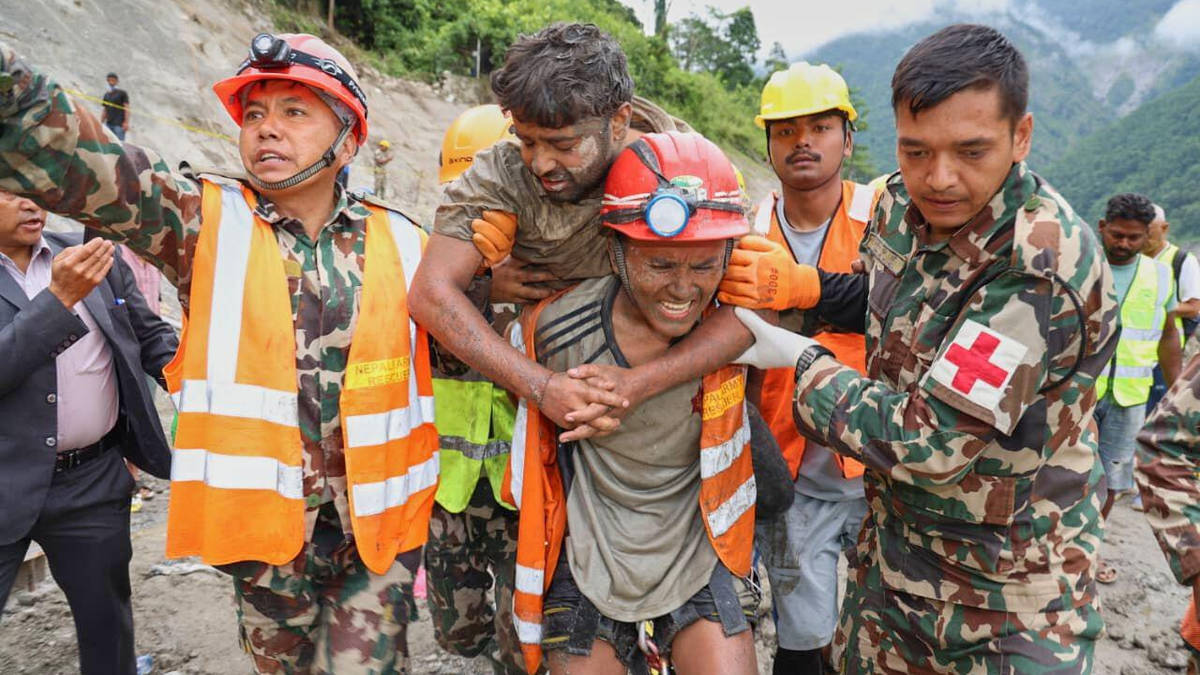
The two men pulled alive from the Trishuli 3A tunnel were identified by the Nepal Army as 45-year-old Kabir Maharjan, a mechanical supervisor, and 30-year-old Sanjay Sah, a mechanical foreman. Both men sustained injuries to their hands and legs, Yahoo News Malaysia reported, citing authorities who noted the trauma was likely caused by crawling through the debris-choked tunnel. Following their extraction, both survivors were airlifted directly to a hospital in Kathmandu for emergency medical treatment.
Account details from the survivors and their families paint a picture of extraordinary endurance and agonizing separation. Hira Shobha, Maharjan’s wife, described the nine-day wait as agonizingly painful for relatives who could neither eat nor sleep. Meanwhile, Sah told a Nepali Army medical team that he remained behind in the facility's control room to direct others to safety before escape routes were cut off, spending his days underground reciting mantras while waiting for help, as detailed by India Today. Sah later communicated that three or four other people might remain alive deeper within the expansive tunnel network.
The discovery has injected cautious optimism into a monumental search effort, though experts emphasize that systemic hurdles continue to plague the response. According to the Independent Power Producers Association of Nepal, roughly 900 workers remain missing across 12 hydropower projects nationwide, with approximately 500 believed trapped inside dark, mud-sealed tunnels. Arnold Dix, president of the International Tunnelling and Underground Space Association, told the Independent that teams had spent a week digging through 50 to 60 meters of debris, remarking that after a week of 24/7 heartache, we might, just, be back in miracle country.
At the same time, disaster risk reduction expert Anil Pokhrel criticized the severe rescue constraints facing the country, pointing out that responders lost critical time due to missing exact coordinates, harsh remote conditions, and a lack of specialized heavy equipment training.
As recovery squads, soldiers, and international specialists continue pumping air through piping into the remaining subterranean chambers, attention remains fixed on the dark, mud-sealed passages where dozens of other laborers are believed to be cut off.
Operation Challenges and Wider Toll
While the extraction of the two men offered a vital lift to search efforts, disaster risk reduction expert Anil Pokhrel pointed to structural shortcomings that hampered the emergency response. According to Pokhrel, reported by outlets including the Independent, rescue teams lost precious time due to difficulties in locating the tunnel's exact coordinates, compounded by harsh remote conditions, severe weather, and a shortage of personnel adequately trained in heavy equipment operations.
Compounding the disaster's scale, the National Disaster Risk Reduction and Management Authority reported that over 5,000 individuals remain unaccounted for following the August 26 catastrophe. Across the border, Chinese authorities noted that 21 people lost their lives and 541 were missing in Tibet. Meanwhile, survival conditions for displaced residents in temporary camps remain challenging, with individuals facing shortages of essential medicines and cash despite the distribution of food and basic provisions, as detailed by Yahoo News Singapore.
Hydropower Project Impact
- Total missing workers nationwide: Approximately 900 across 12 hydropower projects (per local authorities via New York Post)
- Estimated workers trapped in subterranean tunnels: Roughly 500
- Trishuli 3A missing personnel: At least 557 workers, with around 115 believed trapped in the main tunnel according to the Independent Power Producers Association of Nepal
- Project tunnel clearance: Rescuers excavated through 50 to 60 meters of accumulated debris before hearing voices, utilizing earth-moving machinery alongside air-pumping pipes
As recovery squads, soldiers, and international specialists from countries including India, South Korea, and China continue pumping air through piping into the remaining subterranean chambers, the next step centres on locating the roughly 500 workers believed trapped in dark, mud-sealed hydropower tunnels nationwide.
Archypedia is dedicated to independent, evidence-backed reporting. This briefing was synthesized from primary source reporting, corroborated across independent newsrooms, and verified against our Editorial Standards.
Transparency record
Evidence behind this report
This report synthesizes 8 distinct sources. Open the source ledger below to compare the underlying coverage.
- independent.co.uk
- nypost.com
- indiatoday.in
- malaysia.news.yahoo.com
- lbc.co.uk
- sg.news.yahoo.com
- metro.co.uk
- theguardian.com
Prepared under the Archypedia Editorial Policy by the Samir Haddad editorial desk profile. AI-assisted tools may support drafting and verification; public accountability remains with Archypedia. Report an error.