Rescuers pull two trapped tunnel workers alive in Nepal
Rescuers pull two trapped tunnel workers alive in Nepal

Rescuers at the Upper Trishuli 3A project on Friday pulled two hydropower workers alive from a mud-choked subterranean tunnel, triggering cheers from emergency crews and a rare surge of hope nine days after a devastating glacial flood inundated the region (The Jakarta Post). Ministry-released video captured the tense extraction, showing one survivor being helped to his feet before being carried on the backs of emergency workers toward a waiting helicopter (The Jakarta Post). Photographs showed the second man caked in mud with his hands pressed in prayer on a stretcher (The Jakarta Post).
The disaster began on August 26, 2026, when a vast glacial and rock collapse on a mountain along the China-Nepal border sent an enormous surge of ice, water, mud, and debris crashing down the Trishuli valley (The Jakarta Post, Hindustan Times). Described by Foreign Minister Shisir Khanal as a Himalayan tsunami
, the wall of debris smashed at least 12 hydropower projects, destroying approximately 10 percent of Nepal's electricity generation capacity, wiping out roads and bridges, and depositing 2.2 million tonnes of mud across the valley (The Jakarta Post, Moneycontrol).
Related YouTube video
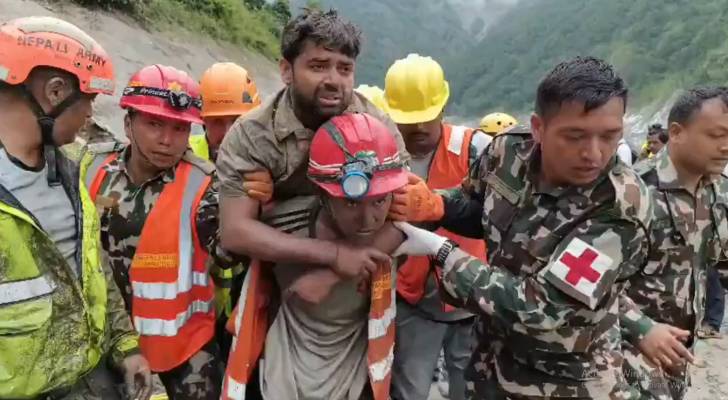
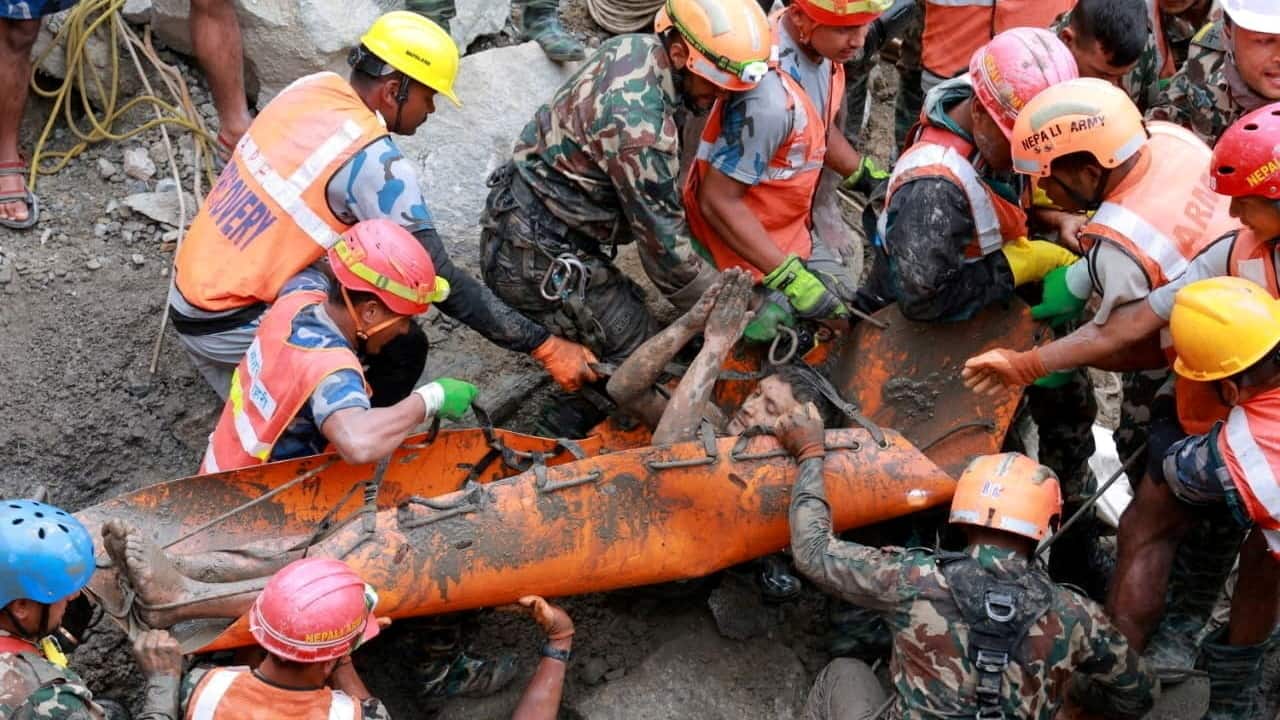

Officials identified the rescued men as 30-year-old mechanical foreman Sanjay Shah and 45-year-old mechanical supervisor Kabir Maharjan (The Jakarta Post). Speaking to army officials from a stretcher with an oxygen mask, Shah recounted that he was in the control room when word of the disaster arrived and urged colleagues to flee (Yahoo News). My responsibility was to save everyone's lives. When there was such a big accident, it was not right for me to run away,
Shah said, explaining that by the time he tried to escape, time had run out (Yahoo News). During his nine days in darkness, Shah chanted prayer mantras and maintained contact with three or four other workers deeper in the mountain (Yahoo News). Both survivors were airlifted to an army hospital in Kathmandu; the prime minister's office reported Shah in stable condition, while Maharjan was placed in intensive care (The Jakarta Post, Yahoo News).
Navigating the ruined subterranean infrastructure has required unconventional coordination. An ad-hoc WhatsApp network of more than 500 members—including engineers, former plant workers, and government officials—has emerged as a vital real-time support line (Hindustan Times, Moneycontrol). When search teams at sites like the Chilime hydropower plant struggled against altered landscapes and buried entrances, officials used the group to instantly acquire powerhouse layout drawings, access tunnel blueprints, and expert insights from former employees (Hindustan Times, Moneycontrol). Nepal Army spokesperson Brig. Gen. Raja Ram Basnet noted that the disaster brought abnormal closures, as mud, rocks, and soil filled underground spaces and fundamentally altered local topography (Hindustan Times, Moneycontrol).
The breakthrough at Trishuli 3A followed nearly six days of digging and pumping oxygen into cavities where workers might be trapped, culminating when rescuers heard a faint hunchha
(yes or OK) response from within the debris (The Jakarta Post, Hindustan Times). Arnold Dix, president of the International Tunnelling and Underground Space Association who supported the operation remotely, remarked that teams were back in miracle country
following a week of constant heartbreak (The Jakarta Post).
Despite the jubilation surrounding Shah and Maharjan, the broader human cost remains staggering. Nepal's disaster authority reported 1,259 bodies recovered and 5,083 people missing, while Chinese state media reported 21 dead and 541 missing in Tibet, bringing the combined death toll to 1,287 and the number of missing to 5,624 (The Jakarta Post, Yakimaherald). More than 800 foreigners from at least 34 countries are among the missing across Nepal and Tibet (The Jakarta Post). Authorities estimate that roughly 900 workers are missing from six hydropower plants along the Trishuli River, with about 500 believed trapped inside tunnels (Yakimaherald, Moneycontrol).
Search operations continue at other compromised sites, including Rasuwagadhi, where rescuers pushed approximately 250 meters into a blocked tunnel and officials believe up to 46 workers may be trapped inside a chamber with potential access to food and water (Hindustan Times, Moneycontrol).
Expanding Operations at Rasuwagadhi and Beyond
While the successful extraction at Upper Trishuli 3A revitalized search efforts, authorities and rescue coordinators emphasize that the next step requires pushing deeper into alternative subterranean sites where hundreds of workers remain unaccounted for. According to Reuters and Moneycontrol reporting, teams at Rasuwagadhi are preparing fresh attempts to penetrate the blocked chamber where the 46 workers are believed to be located. Meanwhile, communication minister Bikram Timilsina stated via social media that officials are actively awaiting further rescues as military personnel, local volunteers, and international experts continue navigating the altered topography of the Trishuli valley.
Archypedia is dedicated to independent, evidence-backed reporting. This briefing was synthesized from primary source reporting, corroborated across independent newsrooms, and verified against our Editorial Standards.
Transparency record
Evidence behind this report
This report synthesizes 6 distinct sources. Open the source ledger below to compare the underlying coverage.
Prepared under the Archypedia Editorial Policy by the Samir Haddad editorial desk profile. AI-assisted tools may support drafting and verification; public accountability remains with Archypedia. Report an error.