Ratko Mladić, the ‘Butcher of Bosnia’, given hero’s funeral in Serbia
Thousands of mourners and high-ranking officials gathered in Belgrade for the military-honors funeral of Ratko Mladić, drawing sharp rebuke from the European Union.
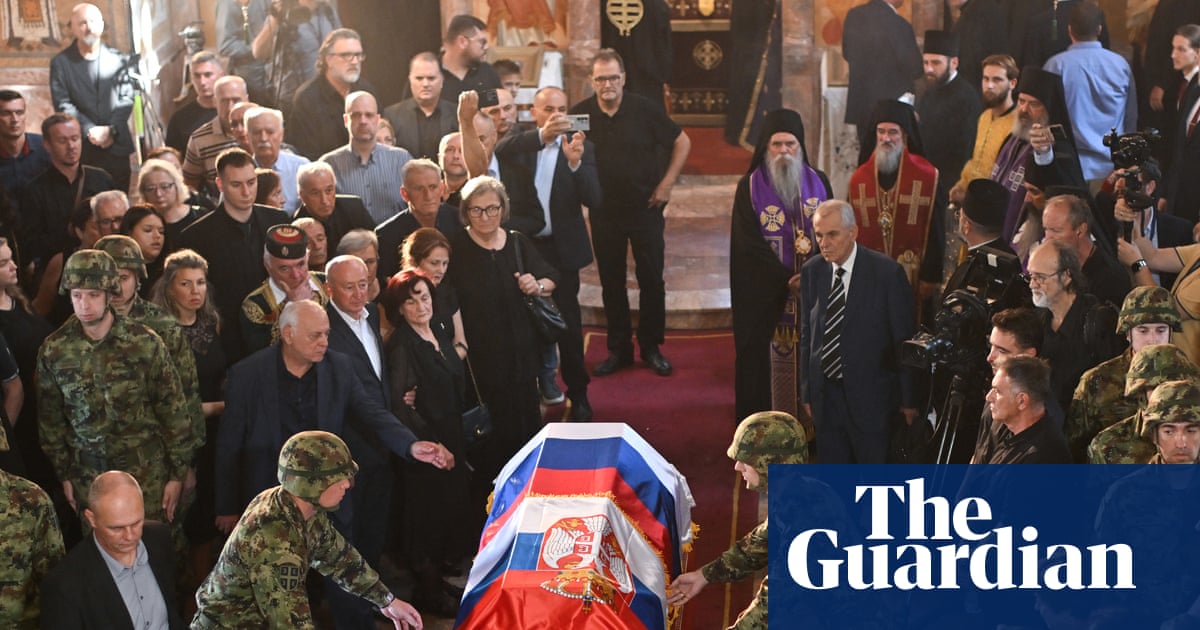
BELGRADE — Formal military honors, a three-volley rifle firing salute, and thousands of mourning attendees converged in the Serbian capital on Monday to bury Ratko Mladić, the United Nations-convicted architect of genocide who died in late August while serving a life sentence at the UN detention facility in The Hague at the age of 84, according to reporting from The Guardian and SBS. The public send-off for the man widely known as the “Butcher of Bosnia” laid bare the deep political and historical fractures separating contemporary Serbia from European integration, igniting swift international condemnation and highlighting the enduring electoral utility of nationalist sentiment under populist rule.
Mladić’s return to Serbian soil carried the trappings of official state patronage, beginning when his flag-draped coffin was flown to Belgrade aboard a government plane and carried off the aircraft by uniformed soldiers, as detailed by The Irish Times. Thousands of mourners, including army veterans and supporters wearing black T-shirts and carrying banners bearing his portrait, queued outside the small St Luka church in Belgrade where his body lay in state, guarded by military personnel alongside his signature cap, a sword, and a display of medals, according to The Nation. Patriarch Porfirije, the head of the Serbian Orthodox Church, praised the general during the service, stating that his name would remain deeply etched in the memory and prayers of the majority of the Serbian Orthodox people who feel a deep sense of gratitude toward him, reported Europesays.
Related YouTube video


A Legacy of Atrocity and Historical Revisionism
The international outcry centers on the grim historical record established by the International Criminal Tribunal for the former Yugoslavia (ICTY), which convicted Mladić in 2017 of genocide, war crimes, and crimes against humanity. During the breakup of Yugoslavia following the June 1991 declarations of independence by Slovenia and Croatia, Mladić commanded Bosnian Serb forces tasked with establishing a “Greater Serbia” through the forcible expulsion of non-Serb populations, according to The Irish Times. That campaign of ethnic cleansing across Bosnia-Herzegovina killed more than 100,000 people and displaced over 2 million.
Among the most devastating episodes of Mladić’s military career was the 1,460-day siege of the Bosnian capital, Sarajevo, where civilian populations endured daily shelling and sniper attacks that left more than 10,000 dead, as noted by The Guardian. The conflict culminated in July 1995 with the Srebrenica massacre, in which Bosnian Serb forces overran the United Nations-designated “safe haven,” separated more than 8,000 Bosniak Muslim men and boys, executed them, and bulldozed their bodies into mass graves. In archival footage from the massacre, Mladić was filmed handing sweets to children before declaring that he was giving the town to the Serb people as a gift, according to Europesays.
| Conflict Event / Metric | Documented Details |
|---|---|
| Bosnian War Casualties | More than 100,000 killed; over 2 million displaced. |
| Siege of Sarajevo | 1,460-day siege resulting in more than 10,000 civilian deaths from sniper fire and shell attacks. |
| Srebrenica Massacre (1995) | At least 8,000 Bosniak Muslim men and boys killed after the UN-designated safe zone was overrun. |
| Mladić Legal Outcome | Indicted in 1995, arrested in 2011 after 16 years as a fugitive, and sentenced to life imprisonment in 2017 by the ICTY. |
For survivors, such as Zdravka Gvozdjar of Sarajevo — whose nine-year-old son was killed during the city's siege, the Belgrade funeral brought back painful memories, with Gvozdjar describing the public glorification to The Nation as “really horrible.” Conversely, scholars like Olivera Simić, professor at Griffith Law School, note that Mladić has spent decades being constructed as a national defender in Serbian public education, political discourse, and popular culture, particularly within the Bosnian Serb entity of Republika Srpska, creating an entrenched narrative that defies judicial verdicts, reported SBS.
Political Balancing and International Fallout
Although the government stopped short of designating the gathering an official state funeral, a step intended to mitigate diplomatic damage, the event closely mirrored one through heavy military and police participation, according to The Guardian. While populist President Aleksandar Vučić skipped the ceremony due to a reported prior engagement with the leader of Uzbekistan, high-ranking officials including Defence Minister Bratislav Gašić and Justice Minister Nenad Vujić attended, alongside Vučić’s son, Danilo, and the Russian ambassador to Serbia, as reported by The Nation and SBS. Vučić himself had previously advocated for Mladić to be released early from The Hague to die on Serbian soil, and dismissed international criticism by calling enlargement commissioner Marta Kos’s statement “extremely short, but stupid, as usual,” according to SBS.
The European Union reacted with severe rebukes, viewing the military pomp as a direct affront to the criteria governing Serbia’s stalled accession process, which has been negotiated since 2014, noted The Guardian. European Commission President Ursula von der Leyen condemned the images from Belgrade as “shocking,” writing on social media that elements of official support demonstrate a failure to confront a dark chapter in European history, according to Huffpost. Marta Kos cancelled a scheduled visit to Serbia, stating that the glorification of a convicted genocide perpetrator is incompatible with the values required for EU membership, a sentiment reinforced by European External Action Service spokesperson Christian Wigand, who emphasized solidarity with all victims and survivors of the Yugoslav wars, reported SBS.
Frequently Asked Questions
What specific crimes was Ratko Mladić convicted of by the international tribunal?
Ratko Mladić was convicted of genocide, war crimes, and crimes against humanity by the International Criminal Tribunal for the former Yugoslavia in 2017, with his life sentence upheld on appeal in 2021. His convictions specifically covered his role in the 1995 Srebrenica massacre, where roughly 8,000 Bosniak Muslim men and boys were killed, and the multi-year siege of Sarajevo, which resulted in over 10,000 civilian deaths.
How did Serbian state officials participate in the funeral despite it not being an official state event?
Although the service was not formally designated a state funeral, it featured extensive military honors, a three-volley rifle salute, and a guard of honor formed by armed forces. Several high-ranking members of the Serbian government, including Defence Minister Bratislav Gašić and Justice Minister Nenad Vujić, attended the ceremony, alongside President Aleksandar Vučić’s son, Danilo, and the Russian ambassador.
The timing of the funeral intersected with domestic political maneuvering in Belgrade. Alongside the public mourning, Serbia's government announced its intention to dissolve parliament and schedule a snap parliamentary election well ahead of the originally planned December 2027 vote, according to The Guardian. Prime Minister Djuro Macut justified the snap poll by stating that asking the populace is the best way to mitigate societal tensions, which had been sharply aggravated following the fatal 2024 collapse of a railway station roof that killed 16 people and sparked corruption allegations against the ruling regime, reported Europesays. While Marko Vujić, an assistant professor at the University of Belgrade’s Faculty of Political Sciences, noted that the regime likely did not plan the election announcement specifically for the funeral, the administration leveraged the nationalist momentum surrounding the event as parliament moved toward dissolution, according to The Guardian.
Archypedia is dedicated to independent, evidence-backed reporting. This briefing was synthesized from primary source reporting, corroborated across independent newsrooms, and verified against our Editorial Standards.
Transparency record
Evidence behind this report
This report synthesizes 6 distinct sources. Open the source ledger below to compare the underlying coverage.
Prepared under the Archypedia Editorial Policy by the Samir Haddad editorial desk profile. AI-assisted tools may support drafting and verification; public accountability remains with Archypedia. Report an error.