North Korea fires several short-range ballistic missiles toward sea
North Korea fires several short-range ballistic missiles toward sea
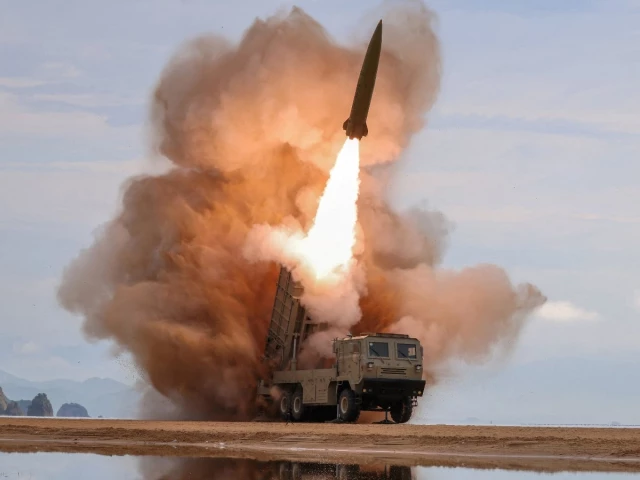
Technical Profile and Strategic Escalation
Specialized defense reporting indicates that the projectiles launched Saturday involved the Hwasong-11 series of ballistic missiles alongside rounds fired successively from 600-millimeter multiple rocket launchers. These systems mirror the tactical profile deployed during previous exercises, such as the KN-25 super-large multiple rocket launchers fired by North Korea last month while Seoul and Washington staged their annual Ulchi Freedom Shield maneuvers.| Event / Exercise | Timing | Key Hardware / Details |
|---|---|---|
| Ulchi Freedom Shield (UFS) | August | More than 10 short-range ballistic missiles and 600mm rocket launchers fired |
| Freedom Edge Trilateral Drills | September 7–11 | Fourth iteration involving major naval and air assets from Seoul, Washington, and Tokyo |
| Saturday Missile Launch | September 12, 5:20 a.m. | Multiple short-range ballistic missiles and 600mm rocket systems launched from Wonsan; 250 km flight |
strong and reflective countermeasures from the standpoint of power.Pyongyang has consistently characterized joint security drills between South Korea and the United States as rehearsals for an invasion.
Alliance Friction and Diplomatic Maneuvering
The resumption of missile testing highlights underlying policy contradictions within the Western-allied security architecture. U.S. President Donald Trump recently ordered a reduction in the scale of joint military exercises, describing them as both costly andtotally inappropriate and hostiletoward Pyongyang. That conciliatory posture aimed to pave the way for a potential meeting later this year with North Korean leader Kim Jong Un. Despite Washington's unilateral scaling back of certain bilateral maneuvers, trilateral operational integration has persisted through mechanisms like Freedom Edge. Established initially in June 2024, the multidomain exercise completed its fourth iteration on Friday, integrating major naval and air assets to counter nuclear and missile developments by the North.
Frequently Asked Questions
What specific weapons did North Korea test on Saturday?
According to regional sources, North Korea fired Hwasong-11 series ballistic missiles and rounds from 600-millimeter multiple rocket launchers in successive order from the Wonsan area.
Related YouTube video


How far did the missiles travel?
South Korea's Joint Chiefs of Staff reported that the missiles flew approximately 250 kilometers before landing in the sea off the east coast of North Korea.
Surveillance and Strategic Implications
According to the South Korean Joint Chiefs of Staff, military authorities in Seoul and Washington maintained continuous telemetry tracking from the inception of the launch sequence, immediately relaying the gathered intelligence to Tokyo. The coordinated monitoring effort highlights the operational integration underpinning the trilateral defense framework, even as geopolitical pressures test alliance cohesion.
Data released by The Express Tribune and The Korea Times underscores that the timing of the Saturday volley directly challenged the conclusion of the Freedom Edge exercises, which had deployed major naval and air assets in international waters near Jeju Island. Defense analysts note that Pyongyang's reliance on successive salvos from the Hwasong-11 family and 600-millimeter multiple rocket launchers mirrors the tactical posture adopted during last month's Ulchi Freedom Shield maneuvers.
In response to the early morning provocation, South Korea's presidential National Security Office convened an emergency security session. Senior officials from the Ministry of National Defense and the Joint Chiefs of Staff evaluated the security impact of the trajectory and reiterated demands for an immediate cessation of activities violating United Nations Security Council resolutions.
Meanwhile, the U.S. Pacific Command issued a public statement confirming close consultations with regional allies. The command stated that current assessments indicated no immediate threat to American personnel, territory, or partner nations, reaffirming Washington's commitment to regional defense.
The immediate operational focus centers on the enhanced surveillance posture maintained by South Korea's armed forces, which remain on full alert for secondary launches. As regional actors analyze the technical specifications of the Wonsan test, the next step involves high-level diplomatic deliberations slated for Washington later this month, where North Korea-related security architecture is expected to feature prominently on the agenda during the bilateral summit between President Trump and Chinese President Xi Jinping.
Archypedia is dedicated to independent, evidence-backed reporting. This briefing was synthesized from primary source reporting, corroborated across independent newsrooms, and verified against our Editorial Standards.
Transparency record
Evidence behind this report
This report synthesizes 5 distinct sources. Open the source ledger below to compare the underlying coverage.
Prepared under the Archypedia Editorial Policy by the Samir Haddad editorial desk profile. AI-assisted tools may support drafting and verification; public accountability remains with Archypedia. Report an error.