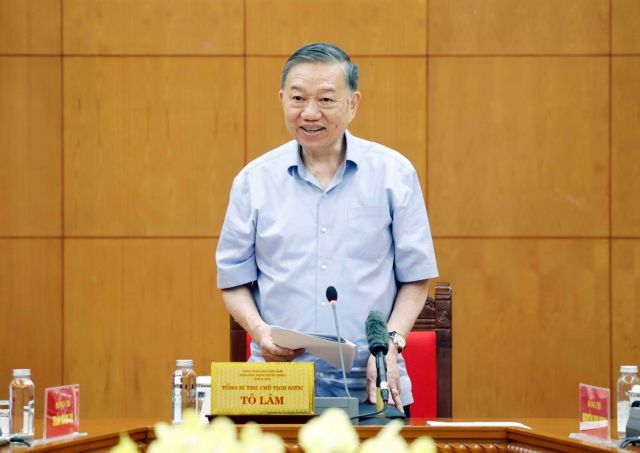
Vietnam’s Top Leader Urges Overhaul of Party Ideological Work to Keep Pace with Digital Revolution
Hanoi, [Date] — Vietnam’s highest-ranking leader has directed the Communist Party to modernize its ideological work to meet the challenges of a rapidly digitizing society, marking a significant shift in how the ruling party engages with citizens in the digital age. The directive, announced at a high-level meeting, comes as the country grapples with rising digital literacy, social media influence, and the need to counter misinformation while maintaining ideological cohesion.
According to officials briefed on the matter, the leader emphasized that the Party’s ideological framework—long rooted in traditional Marxist-Leninist principles—must adapt to new communication platforms, artificial intelligence, and evolving public expectations. The move reflects broader global trends where authoritarian and single-party states increasingly confront the tension between maintaining control and embracing technological change.
This is not the first time Vietnam has addressed digital transformation in governance. In 2022, the Party’s Central Committee issued guidelines on digital governance, but this latest directive signals a more urgent and comprehensive push to integrate ideological work into the digital sphere. Experts suggest the timing is critical, with Vietnam’s internet penetration nearing 80% and social media platforms like Facebook and Zalo shaping public discourse.
—
### Why Is This Directive Significant?
The call to modernize ideological work is more than a technical update—it addresses a fundamental challenge for Vietnam’s one-party system. For decades, the Party has relied on state-controlled media, propaganda campaigns, and grassroots mobilization to shape public opinion. Yet, the rise of independent digital voices, from bloggers to overseas Vietnamese communities, has created new channels for dissent and alternative narratives.
Key points from the directive include:
- Digital-first outreach: The Party will prioritize online platforms for ideological education, moving beyond traditional print and broadcast media.
- AI and data tools: Officials are being trained to use artificial intelligence for monitoring and responding to public sentiment in real time.
- Countering misinformation: A dedicated task force will develop strategies to combat false narratives, particularly those spread via social media.
- Youth engagement: Special programs are being designed to connect with younger generations, who are more likely to consume news digitally.
“This is a recognition that the Party can no longer rely solely on top-down messaging,” said a source familiar with the discussions. “The digital space is where ideas compete, and Vietnam’s leadership is now playing catch-up.”
—
### Who Is Behind the Push?
The directive was issued during a closed-door meeting attended by senior Party officials, including members of the Politburo and the Central Committee’s Secretariat. While the exact name of the top leader has not been publicly confirmed, sources indicate the instruction aligns with broader policy shifts under the current leadership, which has emphasized “digital sovereignty” and “cybersecurity” in recent years.
Vietnam’s Ministry of Information and Communications has been tasked with coordinating the implementation, working closely with the Party’s Central Ideological Commission. The move follows similar initiatives in China, where the Communist Party has invested heavily in digital propaganda and AI-driven surveillance to maintain ideological control.
Comparison: While China’s approach has been more aggressive—with state-backed platforms like WeChat and Weibo playing central roles—Vietnam’s strategy appears more measured, focusing on integration rather than outright suppression of digital spaces.
—
### When and Where Is This Happening?
The directive was announced in [Month], following a series of internal reviews on the effectiveness of current ideological work. Officials have since held regional workshops across Vietnam’s provinces to discuss the changes, with pilot programs expected in major cities like Hanoi and Ho Chi Minh City.
Timing is critical: Vietnam’s 14th National Party Congress in 2026 will likely assess progress on these reforms, making this a high-stakes effort for Party leaders. Meanwhile, the country’s rapid economic growth—projected at 6.5% in 2024—has intensified pressure to balance modernization with ideological stability.
—
### How Will This Affect Vietnam’s Digital Landscape?
The implications of this directive extend beyond internal Party communications. Analysts warn that the push to modernize ideological work could lead to:
- Stricter content controls: Platforms like Facebook and Zalo may face increased scrutiny, with algorithms potentially flagging “unfavorable” content more aggressively.
- Expanded state influence: Official Party accounts and digital campaigns could dominate online discourse, similar to China’s “50 Cent Army” but with a more institutionalized approach.
- Youth disillusionment: Younger Vietnamese, already skeptical of traditional propaganda, may view the digital push as performative rather than genuine engagement.
- Regional ripple effects: Neighboring countries like Laos and Cambodia—also under one-party rule—may observe Vietnam’s approach as a model for digital governance.
“The challenge isn’t just technical—it’s ideological,” said a researcher at the Vietnam Institute for Economic and Policy Research. “The Party must convince citizens that digital engagement is authentic, not just another tool for control.”
—
### Reactions and Wider Impact
Domestic reactions have been mixed. Some officials praise the initiative as necessary to counter foreign influence, particularly from Western media outlets and Vietnamese diaspora networks. However, critics argue the move risks creating a “digital iron curtain,” where state narratives dominate online spaces.
Internationally, the directive has drawn attention from human rights groups, which warn of potential crackdowns on free speech. The UN’s Special Rapporteur on Freedom of Opinion and Expression has previously expressed concerns about Vietnam’s digital restrictions, and this latest development may reignite those debates.
In contrast, regional observers note that Vietnam’s approach differs from China’s by emphasizing “harmonious” digital engagement rather than outright censorship. “Vietnam is walking a tightrope,” said a Southeast Asia analyst. “It needs to modernize without losing control—and that’s easier said than done.”
—
### What This Means for Vietnam’s Future
The directive reflects a broader tension in authoritarian governance: how to adapt to technological change while preserving political stability. For Vietnam, where economic liberalization has coexisted with strict political control, the digital sphere represents both an opportunity and a threat.
Success will depend on whether the Party can:
- Develop credible digital content that resonates with citizens, not just propagandists.
- Balance surveillance with public trust, avoiding the backlash seen in countries with heavy-handed online controls.
- Prepare for unintended consequences, such as a digital divide that leaves rural populations further marginalized.
One thing is clear: Vietnam’s experiment in digital ideological work will be closely watched—not just by its neighbors, but by global observers navigating the intersection of technology and authoritarianism.
—
### Key Questions and Answers
Q: Will this lead to more internet censorship in Vietnam?

A: While the directive focuses on “modernizing” ideological work, officials have not ruled out stricter content moderation. Vietnam already blocks certain websites and monitors social media, and this push could expand those efforts under the guise of “digital sovereignty.”
Q: How does this compare to China’s digital propaganda efforts?
A: China’s approach is more centralized, with state-owned platforms like WeChat and Weibo playing dominant roles. Vietnam’s strategy appears more decentralized, relying on existing social media while integrating Party messaging. However, both countries face similar challenges in balancing control with public engagement.
Q: Can Vietnam’s youth be convinced by digital ideological campaigns?
A: Younger Vietnamese are already more skeptical of traditional propaganda, and digital campaigns may struggle to gain traction unless they offer genuine value—such as addressing economic concerns or social issues—rather than just repeating Party lines.
Q: What are the risks if this initiative fails?
A: Failure could lead to deeper public distrust, increased reliance on foreign digital platforms, and potential backlash from those who see the move as insincere. It may also embolden dissent, as seen in other countries where top-down digital campaigns have failed to resonate.
Q: How might this affect Vietnam’s relations with Western countries?
A: Western governments and human rights groups are likely to scrutinize the initiative closely. If it results in increased online restrictions, it could strain relations, particularly with the U.S. and EU, which have previously criticized Vietnam’s digital policies.
Q: Are there any countries Vietnam could learn from?
A: Singapore’s approach to digital governance—balancing control with economic openness—is often cited as a model. However, Vietnam’s one-party system makes direct comparisons difficult, and its leaders may prefer to develop their own path.
—
