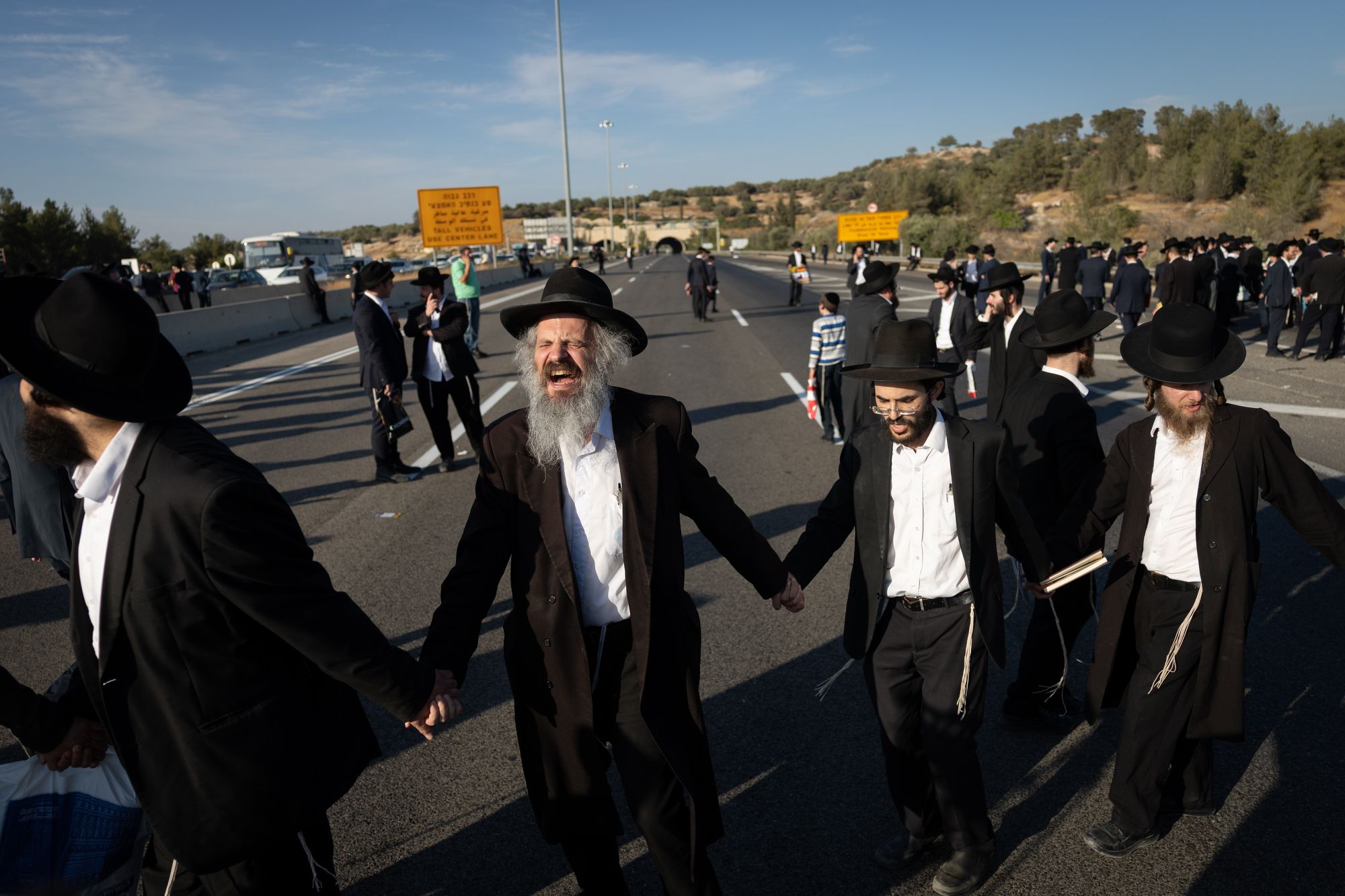
Ultra-Orthodox convoy protests threaten Israel’s roads: How draft law clashes could paralyze traffic nationwide
Ultra-Orthodox Jewish groups have announced plans to launch a series of coordinated convoy protests across Israel, deliberately targeting major highways and intersections to disrupt travel and pressure the government over military draft exemptions. Organizers warn of “slow travel and long hours” for commuters, while authorities brace for potential nationwide traffic chaos as demonstrations escalate ahead of a critical legal deadline.
With police facing unprecedented logistical challenges, the protests—scheduled to begin within days—could mark the most disruptive civil disobedience campaign in Israel since the 2022 judicial reform clashes. The standoff centers on a contentious new law that would require ultra-Orthodox men to serve in the military, a move deeply opposed by religious leaders who argue it violates their community’s values and could destabilize their institutions.
This article explains how the protests are organized, why they pose a unique threat to Israel’s transportation network, and what happens next as the government and police scramble to respond.
What are the ultra-Orthodox convoy protests, and why are they happening?
The planned protests involve hundreds of vehicles—including buses, private cars, and motorcycles—forming slow-moving convoys on major routes such as Highway 1 (Tel Aviv-Jerusalem), Highway 4 (Tel Aviv-Beersheba), and Route 6 (the coastal highway). Unlike traditional demonstrations, these convoys are designed to deliberately obstruct traffic, forcing drivers to wait for extended periods or take detours.
According to organizers affiliated with the Edah HaChareidis (United Torah Judaism party) and other ultra-Orthodox factions, the protests are a direct response to the government’s push to implement a military draft law for ultra-Orthodox men, which passed its first reading in the Knesset last month. The law, supported by Prime Minister Benjamin Netanyahu’s coalition, would end decades of exemptions for ultra-Orthodox students in yeshivas (religious seminaries), requiring them to serve in the Israel Defense Forces (IDF) for up to three years.
Key figures:
- 18,000+ ultra-Orthodox men currently exempt from military service, according to IDF estimates.
- 30+ planned convoy routes across Israel, with organizers claiming participation from thousands of protesters.
- June 2024 deadline for the government to finalize draft implementation details, triggering the protests.
Ultra-Orthodox leaders argue the draft law threatens their way of life, as many yeshiva students spend years studying full-time. “This is not just about military service—it’s about the survival of our community,” said Rabbi Yisrael Yaakov Fisher, a prominent figure in the opposition. “If the government forces conscription, our institutions will collapse.”
Meanwhile, the IDF and government officials maintain the draft is necessary to address demographic imbalances in military service, where ultra-Orthodox men make up a growing portion of the population but contribute far fewer soldiers. Currently, only about 44% of ultra-Orthodox men aged 18–21 serve in the IDF, compared to nearly 80% of secular Jews.
How will the convoys disrupt travel, and what routes are at risk?
The protests are strategically planned to maximize disruption, targeting routes critical for daily commutes, emergency services, and economic activity. Police have confirmed that convoys will operate in three distinct phases, each lasting several hours:
Phase 1 (June 10–12): Test runs on secondary roads to gauge police response.
Phase 2 (June 17–19): Full-scale convoys on major highways, synchronized to create gridlock.
Phase 3 (June 24–26): “Rolling protests” where convoys move between locations to evade police blockades.
High-risk areas include:
- Highway 1 (Tel Aviv-Jerusalem): A primary artery for government officials, diplomats, and daily commuters. Protesters plan to block lanes near Gush Etzion and Mevaseret Zion.
- Highway 4 (Tel Aviv-Beersheba): Critical for southern Israel’s economy, with planned stops at Modi’in and Lod.
- Route 6 (Coastal Highway): Used by 300,000+ daily drivers, with convoys targeting Petah Tikva and Rishon LeZion.
- Jerusalem’s Old City entrances: A symbolic location where protesters may gather to protest near the Western Wall and Damascus Gate.
According to Israel Police traffic division sources, preliminary simulations suggest convoys could reduce traffic flow by up to 70% on affected routes, with delays of 2–4 hours for commuters. Emergency services, including ambulances and fire trucks, may also face significant delays.
Why this matters: Unlike past protests, which were often localized, these convoys are designed to create a domino effect, where a single blocked route forces drivers onto others, amplifying congestion. “This isn’t just about stopping traffic—it’s about making the entire country feel the pain,” said Avraham Sofer, a logistics expert at the Israel Institute of Transportation.
Who is organizing the protests, and what are their demands?
The convoys are being coordinated by a coalition of ultra-Orthodox groups, including:
- Edah HaChareidis (United Torah Judaism)
- Degel HaTorah (National Religious Party)
- Local yeshiva administrations in Bnei Brak, Jerusalem, and Beit Shemesh
- Independent activists using social media to mobilize participants
Their core demands include:
- Full repeal of the draft law or a return to the previous exemption system.
- Alternative national service (e.g., civil defense, education) for ultra-Orthodox men.
- Financial compensation for yeshiva students who would otherwise serve in the military.
- Police non-interference, with organizers threatening legal action if convoys are dispersed.
Organizers have framed the protests as a nonviolent but uncompromising stance, emphasizing that participants will not engage with police or block emergency vehicles. However, local residents in protest areas have expressed frustration, with some towns—like Modi’in and Rishon LeZion—preparing to block protesters from entering using private vehicles and barricades.
In a statement, Mayor Yossi Litzman of Bnei Brak—a city with a large ultra-Orthodox population—warned that the convoys could “divide the country further”. “We understand the anger, but this is not the way to solve it,” he said. “We need dialogue, not gridlock.”
How is the government responding, and what are the legal risks?
The government has taken a two-pronged approach: attempting to negotiate with ultra-Orthodox leaders while preparing for potential mass arrests. Key developments include:
- Police mobilization: An additional 1,500 officers have been deployed to high-risk areas, with plans to use water cannons and roadblocks if convoys refuse to disperse. Border Police units are on standby for crowd control.
- Legal threats: Ultra-Orthodox leaders have filed petitions with the Supreme Court arguing that the draft law violates religious freedom. The court is expected to rule by June 20.
- Diplomatic pressure: The U.S. Embassy has urged “restraint” from all sides, citing concerns over regional stability ahead of upcoming elections.
- Alternative proposals: The government has offered to extend the draft age from 26 to 30 and provide scholarships for yeshiva students, but ultra-Orthodox factions have rejected these as insufficient.
Legal experts warn that if police intervene aggressively, it could escalate tensions. “This is a high-stakes game of chicken,” said Prof. Mordechai Kremnitzer, a constitutional law expert at Hebrew University. “If the police crack down hard, we could see riots. If they don’t, the protests will spread.”
Key legal questions:
- Can protesters be arrested for obstructing traffic under Israel’s Road Safety Law?
- Will the Supreme Court block the draft law before it takes effect?
- Could the protests trigger a government collapse if coalition partners withdraw support?
What happens next: A timeline of critical events
The next two weeks will determine whether the protests escalate into a full-blown crisis. Here’s what to watch:
| Date | Event | Potential Impact |
|---|---|---|
| June 10–12 | Test convoy runs on secondary roads | Police assess response tactics; protesters gauge public support. |
| June 14 | Knesset votes on draft law amendments | If amendments fail, protests may intensify. |
| June 17–19 | Full-scale convoy protests on major highways | Expected nationwide traffic chaos; police may use force. |
| June 20 | Supreme Court ruling on draft law petitions | If court blocks law, protests may end; if upheld, convoys continue. |
| June 24–26 | “Rolling protests” with mobile convoys | Hardest to police; could lead to unrest in multiple cities. |
| July 1 | Government deadline to finalize draft implementation | If no resolution, protests could become permanent. |
Beyond the immediate traffic disruptions, analysts warn of longer-term consequences, including:
- Economic losses: Estimated $50–100 million in daily traffic-related costs, according to Bank of Israel projections.
- Political instability: The draft law is a cohesion test for Netanyahu’s coalition, with hardline parties threatening to withdraw support.
- Social divisions: Tensions between ultra-Orthodox communities and secular Israelis could worsen, risking violent clashes.
- International perception: Foreign governments may criticize Israel for repressing protests or failing to resolve internal conflicts.
How are other countries handling similar protests?
Israel’s convoy protests draw comparisons to past civil disobedience campaigns in other nations, where slow-moving demonstrations were used to pressure governments. Here’s how similar situations played out:
| Country | Protest Type | Outcome | Key Difference |
|---|---|---|---|
| France (2018–2019) | Yellow Vest protests (blocking highways) | Government concessions on fuel taxes; protests lasted 18 months. | No legal draft requirement at stake; economic focus. |
| India (2022) | Farmer tractor rallies (blocking Delhi highways) | Government reversed farm laws after 400+ days of protests. | Direct economic impact on capital city. |
| Turkey (2013) | Gezi Park protests (road blockades) | Police crackdown; government blamed “foreign agents.” | No legal mandate forcing participation. |
Unlike these cases, Israel’s protests are tied to a legal mandate with constitutional implications, making the standoff uniquely complex. “This isn’t just about traffic—it’s about who gets to define Israeli identity,” said Dr. Oded Rabinowitz, a political scientist at Tel Aviv University.
What residents and businesses should know: Practical advice
With protests expected to disrupt travel, here’s what commuters, businesses, and residents should prepare:
- Check real-time traffic updates: Use apps like Waze or Google Maps, which will likely flag convoy routes in advance.
- Avoid protest areas: Police have identified high-risk zones (see map below) where convoys are most likely to form.
- Have backup routes: Major highways like Highway 1 and Route 6 may have alternative paths, but expect delays.
- Businesses in affected areas: Prepare for supply chain disruptions; some companies are already relocating temporary operations.
- Emergency services: Ambulances and fire trucks may face delays—plan for extended response times.
- Protesters’ advice: Organizers recommend carrying water, snacks, and prayer books for long delays.
Note: While protests are framed as nonviolent, unpredictable incidents can occur. Authorities advise avoiding confrontation and reporting any suspicious activity to police.
Common questions about the ultra-Orthodox convoy protests
Will the protests actually stop traffic?
Yes. Police simulations suggest convoys could reduce traffic flow by 50–70% on major routes, with delays of 2–4 hours during peak times. The strategy mimics past protests in France and India, where slow-moving vehicles created gridlock.
Can police arrest protesters?
Under Israel’s Road Safety Law, obstructing traffic is illegal, and police have the authority to disperse convoys. However, ultra-Orthodox leaders have threatened legal challenges if arrests occur, arguing the protests are a form of civil disobedience.
What happens if the Supreme Court blocks the draft law?
If the court rules against the government, the protests are likely to end immediately, as organizers have tied their campaign to the law’s implementation. However, the government could reintroduce a modified version, restarting the conflict.
Are there safe alternatives to driving during the protests?
Public transportation (buses, trains) may also be affected, but Egged and Israel Railways have not yet announced service changes. Ride-sharing apps like Gett may see surge pricing, while taxis could face shortages due to roadblocks.
Could this lead to a government collapse?
Possibly. The draft law is a key issue for Netanyahu’s coalition, with parties like Shas and United Torah Judaism threatening to withdraw support if the law passes. A collapse would trigger new elections, further destabilizing the country.
What’s the historical precedent for convoy protests in Israel?
Israel has seen limited use of convoy protests in the past, primarily during the 2011 social justice protests and the 2022 judicial reform clashes. However, those were smaller in scale and did not target major highways systematically.
For more context, see our related explainer on Israel’s draft law and its political implications.
