
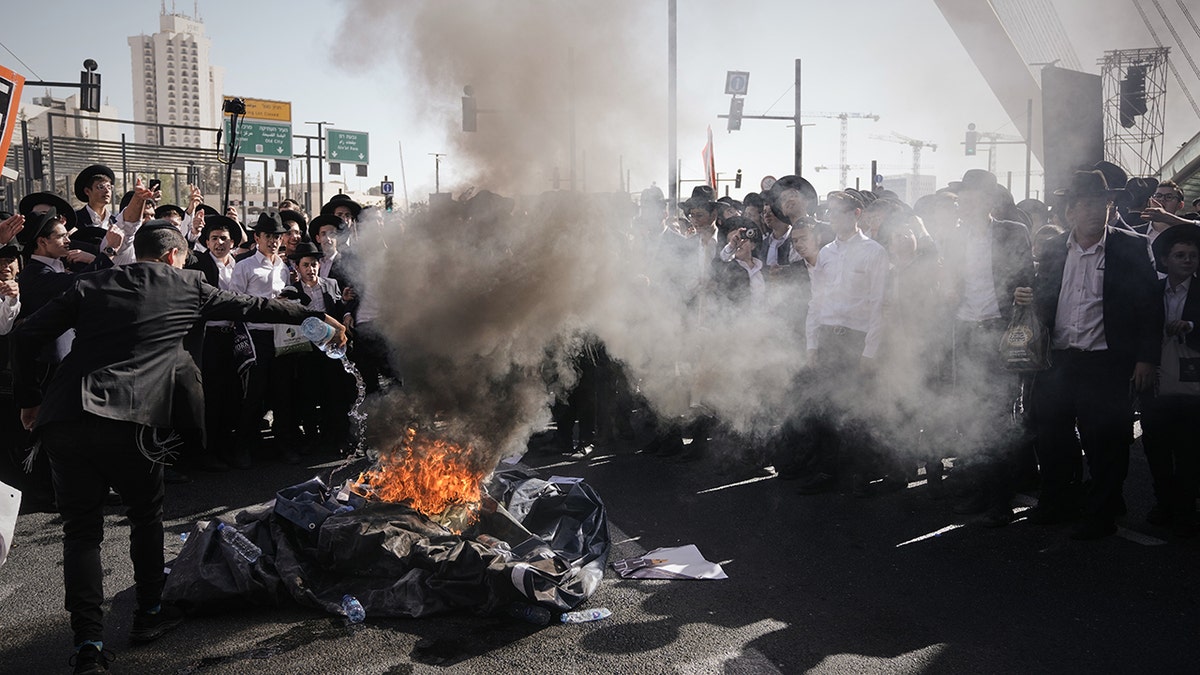
Dozens of Ultra-Orthodox Block Kikar Shabbat in Jerusalem as Protests Escalate into Violence
Jerusalem has become the flashpoint for a severe escalation in civil unrest as dozens of ultra-Orthodox protesters blocked Kikar Shabbat, a move that coincided with a series of violent attacks targeting the judiciary. What began as a demonstration against the state’s efforts to enforce military conscription has spiraled into a security crisis, culminating in a violent riot at the private residence of a Supreme Court justice.
The unrest, driven by the Haredi community’s fierce opposition to IDF draft arrests, has seen protesters transition from public blockades to targeted aggression. The most alarming development involved a mob storming the home of Supreme Court Justice Sohlberg, leaving the property smashed and resulting in the arrest of over 50 individuals. The severity of the violence has prompted unprecedented condemnation from the highest levels of the Israeli government, including Prime Minister Benjamin Netanyahu and President Isaac Herzog.
The Escalation: From Kikar Shabbat to Judicial Homes
The unrest manifested in two distinct but related waves of activity across Jerusalem. The first was a strategic disruption of urban movement, where dozens of ultra-Orthodox individuals blocked Kikar Shabbat, a central hub in the city. These blockades are a common tactic used by Haredi protesters to draw attention to their grievances and exert pressure on the municipal and national governments.
However, the nature of the protests shifted from civil disobedience to criminal violence when a crowd targeted the home of Supreme Court Justice Sohlberg. Reports indicate that Haredi protesters stormed the judge’s residence, engaging in a riot that saw the property “smashed up.” This transition from blocking streets to attacking the private sanctuary of a judicial official marks a significant and dangerous escalation in the tactics employed by the anti-draft movement.
Law enforcement responded to the chaos at Justice Sohlberg’s home with a significant surge in personnel. The crackdown resulted in the detention of more than 50 Haredi Jews, as police struggled to contain a crowd that had moved beyond peaceful protest into active vandalism and intimidation.
“Is this Kristallnacht?”
This provocative question appeared in reports following the attack, drawing a chilling parallel between the smashing of the judge’s home and the historical violence of the 1938 pogroms. The comparison underscores the perceived gravity of the event: the targeting of a specific individual’s home based on their professional role and legal rulings.
The Catalyst: The IDF Draft and Haredi Arrests
At the heart of this volatility is the long-standing and deeply contentious issue of the Israel Defense Forces (IDF) draft. For decades, a significant portion of the ultra-Orthodox (Haredi) community has been exempt from military service to pursue full-time Torah study. This arrangement has historically been a cornerstone of the social contract between the state and the religious sectors, but it has faced increasing scrutiny and legal challenges.
The current wave of violence was triggered specifically by IDF draft arrests. As the state has moved to enforce conscription laws and the Supreme Court has pushed for a more equitable distribution of the military burden, individuals within the Haredi community have been arrested for evading service. To the protesters, these arrests are not merely legal enforcement but an assault on their way of life and religious freedom.
Key Drivers of the Conflict
- Religious Primacy: The belief that Torah study provides a spiritual shield for the nation that is as essential as physical military defense.
- Judicial Friction: The Supreme Court is often viewed by Haredi leadership as an activist body that interferes with religious autonomy and government agreements.
- State Pressure: Increasing manpower needs within the IDF have led to a more aggressive stance on enforcing draft laws.
| Event Phase | Action Taken | Primary Target | Outcome |
|---|---|---|---|
| Civil Disobedience | Blocking Kikar Shabbat | Urban Infrastructure | Traffic disruption, public visibility |
| Violent Escalation | Storming of Residence | Justice Sohlberg | Property damage, intimidation |
| Law Enforcement Response | Mass Arrests | Protesters | 50+ individuals detained |
Government Reaction and Political Fallout
The violence has placed the Israeli government in a precarious position. Prime Minister Benjamin Netanyahu, whose coalition often relies on the support of Haredi political parties, was forced to take a hard line against the rioters. Netanyahu slammed the violent ultra-Orthodox riot at Justice Sohlberg’s home, making it clear that while political disagreements are permissible, violent attacks on judicial officers are unacceptable.
The condemnation was not limited to the Prime Minister. President Isaac Herzog and Yariv Levin also blasted the riot. The unified front presented by the Prime Minister, the President and the Justice Ministry suggests that the storming of a judge’s home crossed a “red line” that transcends the usual political divide over the draft.
Analysis of the Official Response
The reaction from Netanyahu and his allies is particularly notable given the internal pressures of the current administration. The government must balance the demands of its Haredi partners—who view the draft arrests as a persecution—with the necessity of maintaining the rule of law and protecting the judiciary from mob violence.
By “slamming” the violence, the government is attempting to decouple the legitimacy of the protest against the draft from the illegitimacy of the violent methods used. However, for many in the Haredi community, the arrests remain the primary provocation, and the government’s condemnation of the riot may be seen as a betrayal of their interests.
The Significance of Targeting the Judiciary
The decision to target the home of a Supreme Court justice is a strategic shift in the nature of Israeli protests. Historically, Haredi demonstrations have focused on public squares, government buildings, or religious sites. Moving the conflict to a private residence indicates a desire to personalize the struggle and intimidate the individuals responsible for the legal mandates regarding the draft.
This action strikes at the core of democratic stability. The judiciary is designed to operate independently of public passion and political pressure. When the home of a judge becomes a target for a mob, it sends a message that the law is no longer a shield, and that those who interpret the law are subject to the whims of the street.
The mention of “Kristallnacht” in the aftermath of the event serves as a stark reminder of the dangers of targeted, home-based violence. While the political context is entirely different, the imagery of smashing windows and storming homes evokes a history of persecution that the Israeli state is desperate to avoid replicating within its own borders.
Broader Social and Legal Implications
The events in Jerusalem are a symptom of a widening rift in Israeli society. The tension between the “secular-nationalist” view of equal burden-sharing in the military and the “ultra-Orthodox” view of religious exemption is reaching a breaking point.
Potential Long-Term Impacts
- Increased Security for Judges: The state may be forced to provide permanent, high-level security for judicial officials, further isolating them from the public.
- Hardening of Haredi Positions: The arrests of over 50 protesters may further radicalize a segment of the youth within the Haredi community, who may see the state as an oppressive force.
- Judicial Backlash: The violence may lead the Supreme Court to take an even firmer stance on the draft, viewing any concession as a surrender to mob rule.
these events highlight the fragility of the current political coalition. If the Prime Minister continues to condemn the actions of the Haredi street, he risks alienating the extremely parties that sustain his government. Conversely, if he is seen as too lenient, he risks losing the support of the secular public and the security establishment.
For those seeking a related explainer on the Israeli judicial system, it is important to understand that the Supreme Court often serves as the final arbiter in disputes between religious tradition and state law, making it a natural, albeit dangerous, target for those who feel the law is being weaponized against them.
Understanding the Cycle of Violence
To understand why “dozens of ultra-Orthodox block Kikar Shabbat in Jerusalem” and eventually storm a judge’s home, one must look at the cycle of escalation. The process typically follows this pattern:
- The Trigger: A legal ruling or a police action (such as the IDF draft arrests).
- The Mobilization: Religious leaders or community activists call for protests to show strength and solidarity.
- The Public Disruption: Blockades of major intersections like Kikar Shabbat to create economic and social friction.
- The Radicalization: A small but vocal minority moves from public protest to targeted attacks, often fueled by a sense of existential threat to their religious way of life.
- The State Response: Arrests and condemnations, which are then used by the protesters as further evidence of “persecution.”
This cycle suggests that as long as the core issue—the military draft—remains unresolved, the potential for further violence remains high. The blockade of Kikar Shabbat was not an isolated event but a prelude to the more severe confrontation at Justice Sohlberg’s residence.
Frequently Asked Questions
Why did ultra-Orthodox protesters block Kikar Shabbat in Jerusalem?
The blockades were part of a larger protest movement against the Israeli government and the judiciary’s efforts to enforce IDF draft laws. By blocking a central Jerusalem hub, protesters aimed to disrupt the city and bring national attention to their opposition to the arrests of Haredi draft evaders.
Who is Justice Sohlberg and why was their home targeted?
Justice Sohlberg is a judge of the Israeli Supreme Court. The home was targeted because the Supreme Court is the body responsible for the legal rulings that have led to the IDF draft arrests of ultra-Orthodox citizens. The attackers sought to intimidate the judiciary and protest the court’s stance on military service.
How many people were arrested during the riots?
Following the storming of the judge’s home and the subsequent violence, law enforcement arrested over 50 Haredi Jews.
What was the government’s reaction to the violence?
Prime Minister Benjamin Netanyahu, President Isaac Herzog, and Yariv Levin all strongly condemned the riots. They described the attacks on the judge’s home as unacceptable and slammed the violent tactics used by the protesters.
What is the core dispute regarding the IDF draft?
The dispute centers on whether ultra-Orthodox men should be required to serve in the military like other Israeli citizens. The Haredi community argues that full-time Torah study is a religious obligation and a spiritual necessity for the state, while critics argue that the exemption is unfair and places an undue burden on the rest of the population.
As Jerusalem remains on high alert, the focus now shifts to whether the government can find a political solution to the draft crisis or if the street violence seen at Kikar Shabbat and the home of Justice Sohlberg will become a recurring feature of the Israeli social landscape. The intersection of religious conviction, judicial authority, and national security continues to create a volatile environment where a single arrest can trigger a city-wide riot.
