Beyond Compliance: The Business Impact of U.S. Terrorist Designations in Brazil – FTI Consulting
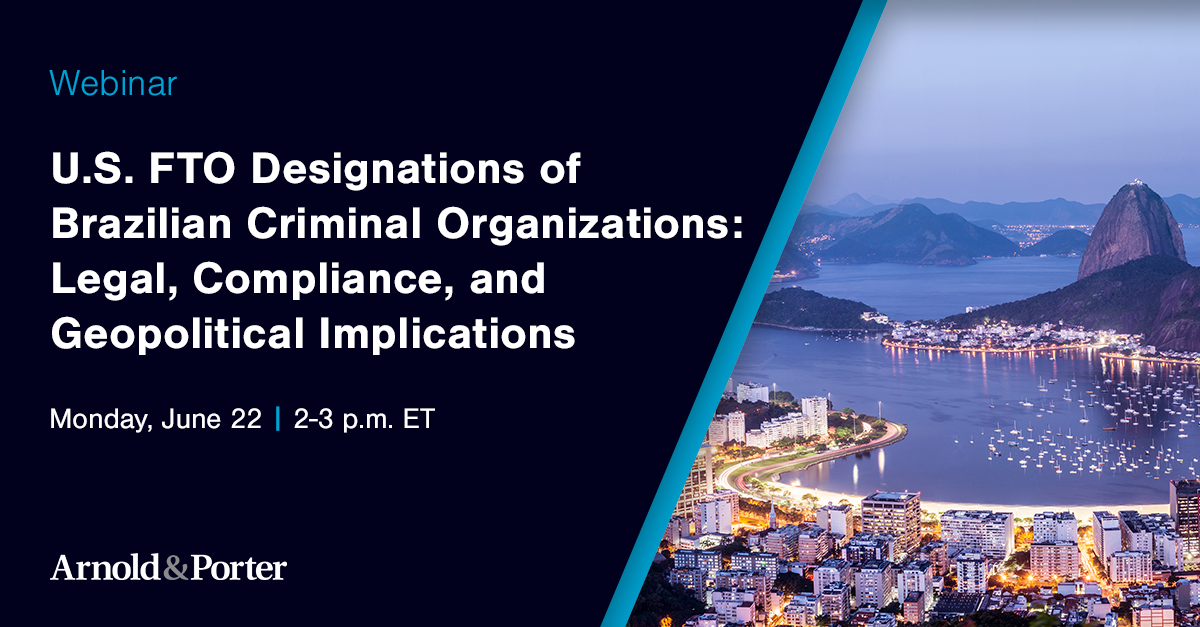
The U.S. government’s designation of Brazilian criminal organizations as Foreign Terrorist Organizations (FTOs) exposes global companies to severe legal penalties and extraterritorial risks under “material support” statutes. According to analysis from FTI Consulting, Arnold & Porter, and Latham & Watkins, this shift moves the risk profile for businesses in Brazil from standard anti-money laundering (AML) compliance to the much more stringent regime of counter-terrorism financing (CTF).
What triggered the U.S. FTO designations for Brazilian criminal organizations?
The U.S. Department of State possesses the authority to designate foreign groups as FTOs when they are foreign organizations engaged in terrorist activity that threatens the security of U.S. nationals or the national security of the United States. In the case of Brazilian criminal organizations, this designation reflects a transition in how the U.S. views these groups—moving from seeing them as mere drug trafficking syndicates to recognizing them as entities capable of systemic instability and terrorist-like activity.
Latham & Watkins notes that these designations are not merely symbolic. They trigger a suite of restrictive measures designed to isolate the organization from the global financial system. While Brazilian authorities have long fought these groups as “organized crime,” the U.S. FTO label applies a different legal framework that carries heavier penalties for those who interact with them, even indirectly.
The primary drivers for this shift include:
- Increased Sophistication: The evolution of Brazilian groups into transnational entities with reach across South America and Europe.
- Violence Scales: The use of terror-like tactics to control territories and intimidate state institutions.
- Financial Integration: The ability of these groups to infiltrate legitimate businesses, making it harder to separate “clean” commerce from “dirty” funding.
How do U.S. terrorist designations create extraterritorial risks for companies?
A U.S. FTO designation does not stop at the U.S. border. According to Comsure, these designations trigger extraterritorial risks that can ensnare companies with no physical presence in the United States. The “U.S. nexus” is the critical factor here. If a transaction touches a U.S. server, uses U.S. dollars (which typically clear through a U.S. correspondent bank), or involves a U.S. person (including citizens or green card holders), the U.S. government claims jurisdiction.
The risk is centered on the concept of “material support.” Under U.S. law, providing material support to a designated FTO is a federal crime. As Arnold & Porter explains, “material support” is defined broadly. It isn’t just about handing over cash; it can include providing lodging, training, expert advice, or even certain types of administrative services.
For a business operating in Brazil, this means that a vendor, a landlord, or a logistics partner who is secretly affiliated with a designated organization could inadvertently turn a legitimate business transaction into a criminal violation of U.S. law. The extraterritorial reach means that a Brazilian company using U.S. dollar accounts to pay a supplier could be flagged for providing material support if that supplier is linked to an FTO.
| Risk Factor | Standard Criminal Risk | FTO Designation Risk |
|---|---|---|
| Legal Framework | AML / Local Criminal Law | U.S. Material Support Statutes |
| Jurisdiction | Primarily Local/National | Global (via U.S. Nexus) |
| Penalty Trigger | Knowledge of illicit funds | Providing any “material support” |
| Asset Impact | Local seizure/freezing | Global blocking of U.S. assets |
Why is “material support” a higher risk than standard AML compliance?
Many executives believe that having a robust Anti-Money Laundering (AML) program is sufficient. However, FTI Consulting emphasizes that “Beyond Compliance: The Business Impact of U.S. Terrorist Designations in Brazil – FTI Consulting” requires a fundamental shift in strategy. AML is generally focused on the source of the funds (where did the money come from?) and the destination (where is it going?).
Counter-terrorism financing (CTF) and material support laws are different. They focus on the recipient. If the recipient is an FTO, the intent or the “cleanliness” of the money is often irrelevant. You can use perfectly legal, tax-paid profits to pay a service provider, but if that provider is a front for an FTO, you have provided material support.
According to Arnold & Porter, the legal threshold for conviction in material support cases can be lower than in traditional money laundering cases. The government does not always need to prove that the company intended to further the terrorist goals of the organization; they only need to prove that the company provided the support knowing the organization was a designated FTO.
Key distinctions include:
- The “Knowledge” Standard: In AML, you look for “red flags” of money laundering. In CTF, the focus is on the identity of the entity on the U.S. Treasury’s SDN (Specially Designated Nationals) list.
- The Scope of “Support”: AML targets financial transactions. Material support targets anything of value, including personnel, facilities, or specialized knowledge.
- The Severity of Sanctions: Violations of FTO laws can lead to massive fines, the loss of banking licenses, and prison sentences for executives.
Which sectors in Brazil face the highest exposure to these designations?
Not all industries are equally exposed. Those that rely on complex supply chains, physical infrastructure in high-risk areas, or heavy logistics are most vulnerable. According to reports from Comsure and FTI Consulting, the following sectors are under the highest scrutiny:
Logistics and Transportation
Companies managing ports, trucking, and warehousing in Brazil are at extreme risk. Criminal organizations often infiltrate these sectors to move illicit goods. If a logistics company unknowingly leases a warehouse to a front company controlled by an FTO, they may be providing “material support” in the form of facilities.
Real Estate and Infrastructure
Construction and real estate firms often deal with local intermediaries to secure land or permits. In many Brazilian regions, these intermediaries may have ties to designated groups. Providing a “facility” or “service” to an FTO-linked entity is a direct violation of U.S. sanctions.
Financial Services and Fintech
Banks and payment processors are the first line of defense and the first to be penalized. The rise of fintech in Brazil has created new channels for rapid money movement. If these platforms fail to screen against the latest U.S. FTO lists, they risk losing their ability to clear transactions in U.S. dollars, effectively cutting them off from the global economy.
Agriculture and Mining
These sectors often operate in remote areas where the state’s presence is weak and criminal organizations exert “territorial control.” Paying “protection money” or “security fees” to local groups—which may now be designated as FTOs—is a textbook example of providing material support.
How should businesses update their risk frameworks to address these designations?
Moving “beyond compliance” means shifting from a check-the-box mentality to a risk-based intelligence approach. FTI Consulting suggests that companies must integrate geopolitical intelligence into their due diligence processes. Standard KYC (Know Your Customer) is no longer enough; companies need KYB (Know Your Business) and KYS (Know Your Supplier) at a much deeper level.
Latham & Watkins recommends several immediate steps for firms operating in Brazil:
- Comprehensive Screening: Update screening software to include not just the SDN list, but all U.S. Department of State FTO designations. This must include “beneficial ownership” checks to find the people behind the shell companies.
- Contractual Protections: Insert strict “terrorism and sanctions” clauses into all vendor contracts. These clauses should allow for immediate termination without penalty if a partner is linked to a designated entity.
- On-the-Ground Intelligence: Rely less on self-reported data from vendors and more on independent, third-party intelligence. In Brazil, this means understanding who actually controls the territory where a vendor operates.
- Audit the “U.S. Nexus”: Map out every point where the company touches the U.S. financial system. Identify which accounts are in USD and which employees are U.S. persons, as these are the primary triggers for U.S. jurisdiction.
“The gap between local Brazilian law and U.S. extraterritorial sanctions is where the greatest business risk resides. A transaction that is legal in São Paulo can be a felony in Washington D.C.”
For more on managing these risks, you may find a related explainer on global sanctions compliance useful for broader context.
Common misconceptions about U.S. FTO designations in Brazil
There are several dangerous myths that companies often believe regarding these designations. Correcting these is essential for survival in a high-scrutiny environment.
Myth 1: “We aren’t a U.S. company, so this doesn’t apply to us.”
As noted by Comsure, the U.S. uses the dollar as a tool of foreign policy. If you use USD, you are using a U.S. financial product. This provides the U.S. government with the jurisdiction to penalize you, regardless of where your headquarters are located.
Myth 2: “As long as we don’t know it’s a terrorist group, we are safe.”
U.S. regulators often apply a “should have known” standard. If the information was available via a reasonable due diligence process (like checking an SDN list), “willful blindness” is not a legal defense. The burden of proof is effectively shifted to the company to show they did their due diligence.
Myth 3: “These groups are just gangs, not terrorists.”
While this may be true from a sociological perspective, the legal designation is what matters. Once the U.S. Department of State labels a group as an FTO, the legal machinery of counter-terrorism kicks in. The U.S. government does not distinguish between a politically motivated terrorist and a profit-motivated criminal once the FTO label is applied.
Frequently Asked Questions
What is an FTO designation?
An FTO (Foreign Terrorist Organization) designation is a formal label applied by the U.S. Secretary of State to a foreign group. This label triggers strict sanctions, freezes assets within U.S. jurisdiction, and makes it a crime to provide “material support” to the group.
What constitutes “material support” under U.S. law?
Material support is broadly defined and includes providing funds, weapons, lodging, training, expert advice, assistance, or personnel. According to Arnold & Porter, it can even include providing a physical facility or a piece of equipment that the organization uses.
How does a U.S. nexus work for a Brazilian company?
A U.S. nexus occurs when a transaction involves U.S. currency (USD), passes through a U.S. bank, uses U.S.-based software/servers, or involves a U.S. citizen or permanent resident. This nexus allows the U.S. government to exercise jurisdiction over the activity.
Why is this different from standard AML (Anti-Money Laundering) laws?
AML focuses on the source and movement of illicit funds. CTF (Counter-Terrorism Financing) and material support laws focus on the recipient. Even if the money used is legally earned, providing it to a designated FTO is a crime.
What should a company do if they discover a supplier is linked to an FTO?
According to legal guidance from Latham & Watkins, companies should immediately cease all transactions, freeze any pending payments, and consult with specialized legal counsel to determine if a voluntary self-disclosure to the U.S. Treasury’s Office of Foreign Assets Control (OFAC) is necessary to mitigate penalties.
The shift toward designating Brazilian criminal organizations as FTOs represents a hardening of the U.S. approach to organized crime in Latin America. For businesses, the cost of ignorance is now potentially existential. The transition from simple compliance to a strategic risk-management framework is no longer optional; it is a requirement for any firm that wishes to remain connected to the global financial system.
