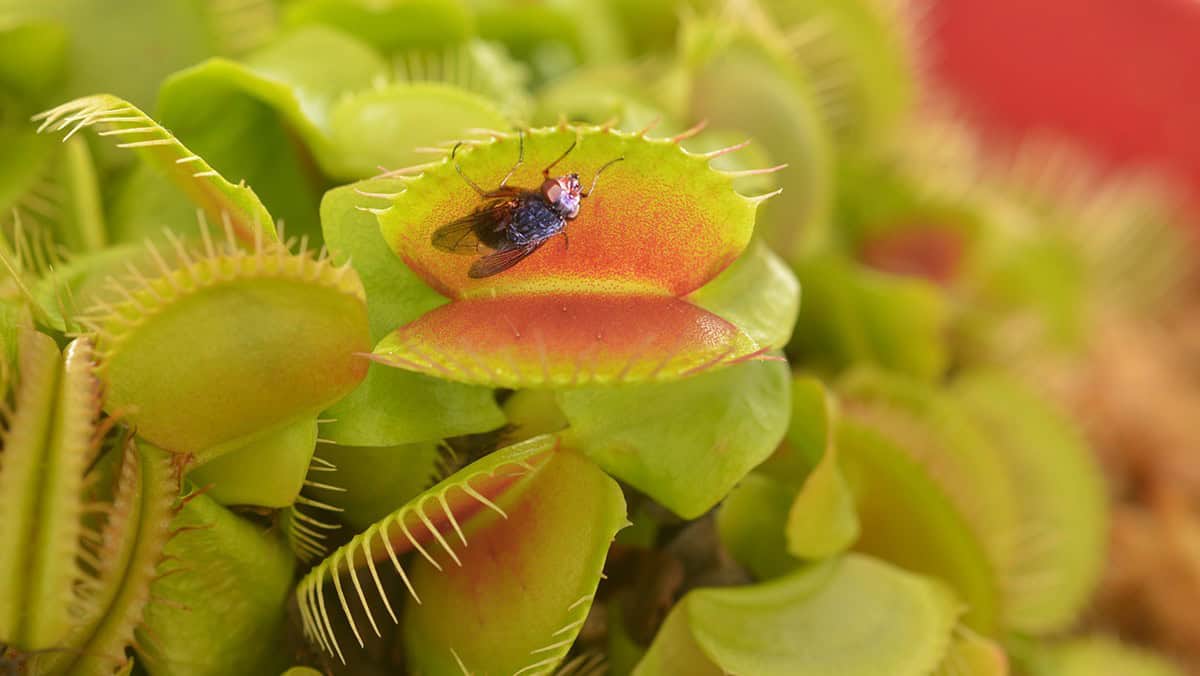
Venus Flytraps Snap Shut by Rapid Cell-Wall Softening: New Research Unlocks Secret of Plant Speed
Venus flytraps snap shut by rapid cell-wall softening that releases stored elastic energy, according to research highlighted by Physics World. This mechanism allows the plant to transition from an open to a closed state in less than a second, bypassing the slower biological processes typically associated with plant movement. The discovery explains how the plant achieves animal-like speed without muscles.
How the Venus Flytrap Achieves Rapid Closure
For decades, the speed of the Venus flytrap (Dionaea muscipula) puzzled biologists. Most plant movements occur over hours or days, driven by the slow growth of cells or the gradual movement of water. The Venus flytrap, however, closes its lobes in a fraction of a second. According to reports from Smithsonian Magazine, this process happens so quickly that it defies traditional botanical explanations of turgor pressure alone.
The latest findings indicate that the secret lies in the cell walls. Rather than relying solely on the movement of water into or out of cells—a process that takes significant time—the plant utilizes a “snap-buckling” instability. Research cited by Physics World explains that the plant stores elastic energy in its leaves while they are open. When a trigger hair is touched, a signal triggers a rapid softening of the cell walls in specific areas.
This softening acts as a mechanical trigger. Once the cell walls lose their rigidity, the stored energy is released instantaneously, forcing the leaves to flip from a convex (curved outward) shape to a concave (curved inward) shape. This is not a growth process, but a mechanical collapse that happens nearly simultaneously across the leaf surface.
- Stored Energy: The open trap acts like a loaded spring.
- Trigger Mechanism: Sensory hairs detect prey, sending an electrical signal.
- Cell-Wall Softening: Specific cell walls lose stiffness rapidly.
- Snap-Buckling: The leaf geometry flips, closing the trap in milliseconds.
The Physics of Snap-Buckling and Elasticity
The mechanism described as “snap-buckling” is a concept well-known in structural engineering but rarely attributed to living plants. As noted by Physics World, the Venus flytrap operates as a bistable system. This means the trap has two stable states: fully open and fully closed. There is no stable “half-way” point; once the threshold for softening is met, the plant must snap to the other state.
This physical transition is what allows for such extreme speed. According to the research, the softening of the cell walls reduces the resistance of the leaf tissue, allowing the internal stresses to overcome the structural integrity of the open lobe. The result is a rapid inversion of the leaf’s curvature.
The transition is not a gradual bend but a sudden structural failure—by design—that converts stored potential energy into kinetic motion.
This differs from other rapid plant movements. For example, the Mimosa pudica (the “sensitive plant”) closes its leaves by rapidly dumping water from specific cells called pulvini. While fast, this water-based movement is generally slower and relies on different biological pathways than the cell-wall softening seen in the Venus flytrap.
Comparing Rapid Plant Movement Mechanisms
To understand why the discovery of cell-wall softening is significant, it is helpful to compare the Venus flytrap’s mechanism with other known rapid plant responses. The following table outlines these differences based on botanical data reported by The Guardian and Smithsonian Magazine.
| Plant Species | Mechanism of Movement | Primary Driver | Relative Speed |
|---|---|---|---|
| Venus Flytrap | Cell-Wall Softening / Snap-Buckling | Stored Elastic Energy | Ultra-Fast (< 1 second) |
| Mimosa pudica | Turgor Pressure Loss | Water Flux (Osmosis) | Fast (Seconds) |
| Sunflowers | Differential Growth | Hormonal/Auxin Distribution | Slow (Hours/Days) |
Biological Triggers: From Touch to Snap
The mechanical snap is the final step in a complex biological chain. The process begins when an insect touches the sensitive trigger hairs located on the inner surface of the lobes. According to Smithsonian Magazine, a single touch is often not enough to trigger the trap; this prevents the plant from wasting energy on raindrops or falling debris. Usually, two touches within a short window, or one touch followed by another, are required to initiate the closure.
Once the threshold is met, the plant generates an action potential—an electrical signal similar to those found in animal neurons. This signal travels across the leaf, triggering the chemical changes that lead to the rapid softening of the cell walls. This intersection of electrical signaling and mechanical engineering allows the plant to react to its environment with a precision that mimics a nervous system.
The speed of this signal is critical. If the signal traveled too slowly, the prey could escape before the snap-buckling occurred. By utilizing a pre-loaded elastic state, the plant ensures that the actual movement is nearly instantaneous once the “lock” (the rigid cell wall) is released.
Implications for Robotics and Smart Materials
The discovery that Venus flytraps snap shut by rapid cell-wall softening has implications far beyond botany. According to newsline.com, engineers and material scientists are looking at this mechanism to inspire a new generation of “soft robotics” and smart materials.

Bio-Inspired Soft Robotics
Traditional robots rely on motors, gears, and rigid joints. However, soft robotics aims to create machines that can interact safely with humans or navigate fragile environments. By mimicking the snap-buckling of the Venus flytrap, engineers can create actuators that store energy and release it suddenly without needing a constant power source or heavy motors. This could lead to grippers that snap shut around an object with high speed and precision using minimal energy.
Smart Materials and Adaptive Architecture
Material scientists are investigating polymers that can change their stiffness in response to external stimuli, such as temperature, light, or electrical currents. A material that can “soften” on command to trigger a structural snap could be used in:
- Deployable Space Structures: Satellites or solar panels that snap into place once they reach orbit.
- Medical Devices: Stents or surgical tools that remain flexible during insertion but snap into a rigid, functional shape once they reach the target site.
- Adaptive Clothing: Fabrics that change shape or porosity based on the wearer’s environment.
As noted by newsline.com, the ability to transition between two stable states via a change in material properties is a “holy grail” for efficiency in mechanical design.
Correcting Common Misconceptions
The popular understanding of the Venus flytrap often oversimplifies how it works. Many believe the plant “muscles” the trap shut or that it is simply “sucking” the leaves together. The reality is more akin to a mechanical trap than a muscle contraction.
Misconception 1: It is like a human muscle.
Human muscles contract by sliding proteins (actin and myosin) past each other. The Venus flytrap has no such proteins. Instead, it uses the physical properties of cellulose and pectin in its cell walls to create a structural collapse.
Misconception 2: It is purely water-driven.
While water (turgor pressure) provides the initial tension that “loads” the spring, the actual snap is caused by the softening of the walls. If it were purely water-driven, the movement would be significantly slower, as water must physically move across cell membranes.
Misconception 3: The trap closes instantly upon any touch.
The plant employs a sophisticated counting mechanism. As reported by Smithsonian Magazine, the plant “remembers” the first touch for a short period. This biological timer ensures that the energy-expensive snap is only triggered by live prey, not by wind or rain.
Scientific Context and Research Evolution
The path to this discovery involved a shift in how scientists viewed plant anatomy. For years, the focus was on the chemistry of the cells. However, the research highlighted by Physics World suggests that the geometry and mechanics of the leaf are just as important as the biology.
By applying principles of physics—specifically the study of elasticity and instability—researchers were able to model the leaf as a mechanical beam. When the stiffness of that beam is suddenly reduced (the cell-wall softening), the beam must buckle. This interdisciplinary approach, combining botany with structural physics, has provided the most complete explanation to date of the plant’s speed.
This development mirrors other breakthroughs in bio-mimicry, where the “how” of a biological function is translated into a mathematical model that can then be replicated in synthetic materials. The Venus flytrap is no longer seen just as a carnivorous curiosity, but as a masterclass in efficient mechanical design.
Frequently Asked Questions
How exactly do Venus flytraps snap shut by rapid cell-wall softening?
The plant stores elastic energy in its leaves while they are open. When trigger hairs are activated, an electrical signal causes the cell walls in specific areas to soften rapidly. This loss of rigidity triggers a “snap-buckling” effect, where the leaf flips from a convex to a concave shape almost instantly, closing the trap.
Is the Venus flytrap the only plant that uses this mechanism?
While many plants move rapidly, the specific combination of stored elastic energy and rapid cell-wall softening for snap-buckling is a hallmark of the Venus flytrap. Other plants, like the Mimosa pudica, use turgor pressure (water movement), which is a different biological process.

Why does this discovery matter for technology?
According to newsline.com, this mechanism provides a blueprint for soft robotics and smart materials. Engineers can create devices that store energy and release it suddenly through a change in material stiffness, reducing the need for heavy motors and constant power supplies.
How fast does the trap actually close?
As reported by Smithsonian Magazine, the trap can snap shut in less than a second. This speed is necessary to prevent fast-moving insects from escaping once the trigger hairs have been touched.
What prevents the plant from closing every time a raindrop hits it?
The plant uses a “counting” mechanism. It typically requires two stimuli within a specific timeframe to trigger the action potential. This ensures the plant only spends the energy required for closure when it is likely that a prey insect is present.
