JWST Captures Abnormally Mature Galaxy Cluster from the ‘Cosmic Noon’ Era
The James Webb Space Telescope (JWST) has identified a galaxy cluster from the “cosmic noon” period that is unexpectedly well-developed for its age. According to data reported via Phys.org, this cluster exhibits structural maturity and “quenched” galaxies typically found in the local universe, challenging current cosmological models regarding the speed of early galactic evolution.
What makes this JWST galaxy cluster discovery abnormal?
Standard cosmological timelines suggest that during “cosmic noon”—the period roughly 2 to 3 billion years after the Big Bang—galaxy clusters should exist as “protoclusters.” These are loose, chaotic collections of young galaxies characterized by intense bursts of star formation and vast clouds of primordial gas. However, the images provided by the JWST reveal a cluster that has already transitioned into a mature state.
The abnormality lies in the presence of massive, “red and dead” galaxies within the cluster. In astronomical terms, a quenched galaxy is one that has ceased forming new stars. Usually, this process takes billions of years of environmental interaction and gas depletion. Finding a concentrated group of these mature galaxies so early in the universe’s history suggests that some structures evolved far more rapidly than current simulations predict.
Key indicators of this abnormal development include:
- High Stellar Mass: Individual galaxies within the cluster possess masses that should have taken longer to accumulate.
- Advanced Quenching: A significant percentage of the cluster’s galaxies have already stopped star formation.
- Compact Morphology: The cluster shows a level of gravitational cohesion and central density more common in the modern universe.
Understanding the ‘Cosmic Noon’ frontier
Cosmic noon refers to the epoch between redshift z=2 and z=3, a window where the universe experienced its peak rate of star formation. During this time, galaxies were churning out stars at a rate significantly higher than they do today. It is the primary frontier for astronomers seeking to understand how the raw materials of the Big Bang organized into the complex structures seen in the current sky.
According to the research, observing this era is critical because it represents the transition from the “wild west” of early galaxy mergers to the more stable, organized clusters of the late universe. By pushing the frontier of cosmic noon, JWST allows researchers to see exactly when the first massive clusters stopped growing and began to “die” or quench.
The discovery of a well-developed cluster at this stage suggests that the “noon” of the universe may have had localized “afternoons”—regions where evolution accelerated, creating pockets of advanced maturity while the rest of the universe remained in a state of frantic growth.
How JWST’s technology enabled this discovery
Previous observatories, including the Hubble Space Telescope, struggled to identify these mature clusters at high redshifts because the light from the early universe is stretched into infrared wavelengths as it travels across expanding space. This phenomenon, known as cosmological redshift, renders these galaxies invisible to telescopes that primarily detect ultraviolet or visible light.
The JWST utilizes the Near-Infrared Camera (NIRCam) and the Mid-Infrared Instrument (MIRI) to pierce through cosmic dust and capture these redshifted photons. According to the technical specifications of the mission, this infrared capability allows astronomers to see the “old” stars—the redder, cooler stars—that signify a galaxy has reached maturity. Hubble could see the bright, blue, star-forming regions of early galaxies, but it often missed the older, quenched populations that define a mature cluster.
The precision of JWST’s mirrors and the sensitivity of its detectors allow for the measurement of “spectral energy distributions.” This data helps researchers determine the age of the stellar populations within the cluster, confirming that these galaxies are indeed older than the surrounding environment should allow.
Comparing protoclusters and the abnormally developed cluster
To understand why this discovery is disruptive, it is necessary to contrast the observed cluster with the expected “protocluster” model. In a typical protocluster, gravity is only beginning to pull galaxies together, and the environment is rich in cold gas that fuels star birth.
| Feature | Typical Protocluster (Cosmic Noon) | Observed Abnormal Cluster |
|---|---|---|
| Star Formation Rate | Extremely high; “starburst” phase | Low to zero; heavily quenched |
| Galaxy Color | Predominantly blue (young stars) | Predominantly red (old stars) |
| Gas Content | Abundant cold molecular gas | Depleted or heated gas |
| Structure | Diffuse, loosely connected | Compact, gravitationally bound |
| Evolutionary Stage | Early assembly | Advanced maturity |
The implications for the Lambda-CDM model
The discovery puts pressure on the Lambda-CDM (Lambda Cold Dark Matter) model, which is the current standard model of Big Bang cosmology. This model predicts a “bottom-up” approach to structure formation: small clumps of matter merge to form galaxies, which then merge to form clusters over vast stretches of time.
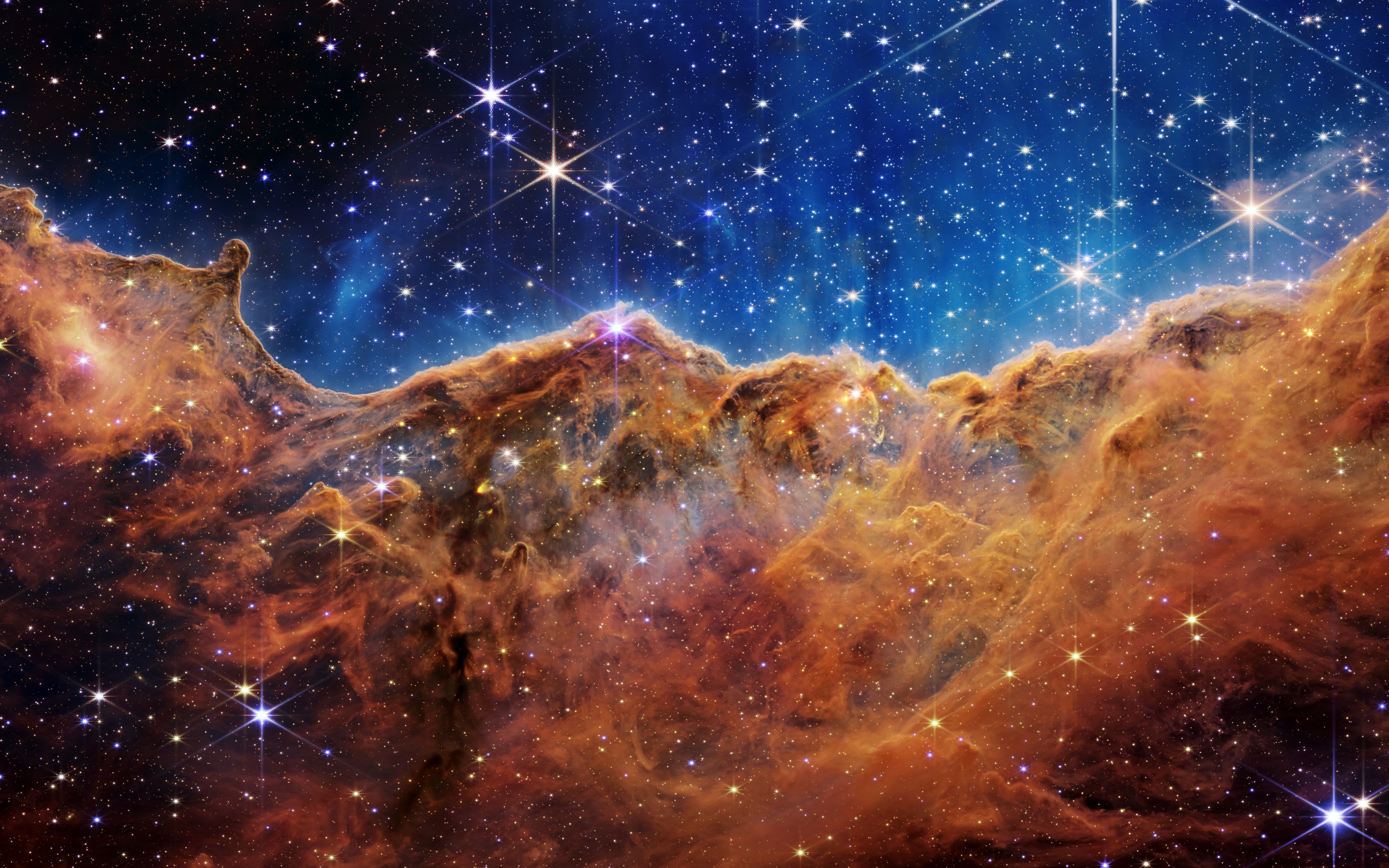
If massive, quenched clusters existed significantly earlier than predicted, it suggests one of three things, according to theoretical frameworks in astrophysics:
- Accelerated Accretion: Dark matter halos may have collapsed more quickly than current models simulate, pulling gas and galaxies together at higher speeds.
- Efficient Quenching: The mechanisms that stop star formation—such as active galactic nuclei (AGN) feedback where supermassive black holes blow gas out of a galaxy—might be more powerful or occur earlier than previously thought.
- Initial Conditions: The density fluctuations in the very early universe may have been higher in certain regions, providing a “head start” for some clusters.
“Finding such a developed structure so early in the universe’s history forces a reconsideration of the timeline for how the largest structures in the cosmos are built.”
The role of AGN feedback in early quenching
A central question arising from these JWST images is how these galaxies stopped forming stars so quickly. In the modern universe, “environmental quenching” occurs when a galaxy falls into a dense cluster; the pressure of the hot intergalactic medium strips away the galaxy’s cold gas, effectively starving it of the fuel needed for new stars.
However, in the cosmic noon era, this process should be in its infancy. Researchers are now looking toward Active Galactic Nuclei (AGN) as the likely culprit. An AGN is a supermassive black hole at the center of a galaxy that is actively consuming matter. As the black hole feeds, it releases staggering amounts of energy in the form of radiation and jets.
According to astrophysical theory, this energy can heat the surrounding gas to millions of degrees or eject it from the galaxy entirely. If the galaxies in this abnormally developed cluster hosted exceptionally active black holes, they could have “shut down” their own star formation far faster than the slow process of environmental stripping, leading to the premature maturity observed by the JWST.
Broader impact on the study of galactic evolution
This discovery changes the roadmap for future deep-field surveys. Astronomers can no longer assume that the early universe is a uniform landscape of young, blue galaxies. The existence of this cluster proves that the universe was “patchy,” with some regions evolving at a breakneck pace while others lagged behind.
This suggests that the “cosmic noon” is not a single event, but a staggered process. Future observations will likely target similar “over-dense” regions to determine if this cluster is a one-off anomaly or if there is a hidden population of mature early clusters that previous telescopes simply weren’t equipped to see.
For researchers, this means the focus must shift toward finding the “missing link” between the first stars and these mature clusters. If the end result (a mature cluster) exists so early, the beginning of the process must have occurred even closer to the Big Bang than previously estimated.
Related research into early supermassive black holes may provide the necessary context to explain how these clusters reached maturity so quickly.
Frequently Asked Questions
What is the “Cosmic Noon” in astronomy?
Cosmic noon is the period roughly 2 to 3 billion years after the Big Bang when the universe reached its peak rate of star formation. It is a critical era for understanding how galaxies transitioned from primordial gas clouds into the structured systems we see today.
Why is it surprising to find a “well-developed” cluster so early?
According to standard cosmological models, galaxy clusters take billions of years to mature. They should start as “protoclusters” with high star-formation rates. Finding a cluster with “quenched” (non-star-forming) galaxies and a compact structure during cosmic noon suggests the evolution happened much faster than expected.
How did the James Webb Space Telescope find this when Hubble couldn’t?
The JWST operates in the infrared spectrum. Because the universe is expanding, light from the early universe is redshifted into infrared wavelengths. While Hubble could see the hot, young stars, JWST can detect the cooler, older stars and see through cosmic dust, allowing it to identify mature galaxies that were previously invisible.
Does this discovery mean the Big Bang theory is wrong?
No, it does not invalidate the Big Bang theory. Instead, it challenges the specific timeline and mechanisms of structure formation within the Lambda-CDM model. It suggests that our understanding of how quickly matter clumps together and how galaxies stop forming stars needs refinement.
What are “quenched” galaxies?
Quenched galaxies are those that have ceased the process of star formation. They have either run out of cold gas or had their gas heated or ejected—often by a supermassive black hole—leaving behind a population of aging, red stars.
As the JWST continues to survey the high-redshift universe, these findings will likely lead to a revised timeline of the cosmic dawn and noon, providing a more granular look at the diverse speeds at which the universe grew.
