The Exploration Co. Completes Nyx Drop Test On Path To 2028 Mission – Aviation Week
The pursuit of sustainable, repeatable human spaceflight has reached a critical milestone with the recent announcement that The Exploration Co. Completes Nyx Drop Test On Path To 2028 Mission – Aviation Week. For those tracking the evolution of the “New Space” economy, this event is more than a mere technical check-box. it is a high-stakes validation of the descent and recovery systems that will eventually safeguard astronauts returning from the vacuum of space.
The Nyx vehicle, the centerpiece of The Exploration Co.’s ambitious roadmap, is designed to bridge the gap between current orbital capabilities and a future of frequent, cost-effective interplanetary transit. The successful completion of the drop test confirms that the vehicle’s parachute systems and structural integrity can withstand the violent transitions of atmospheric reentry, clearing a major hurdle as the company accelerates its countdown to a target launch window in 2028.
Understanding the Nyx Drop Test: What Actually Happened?
In the aerospace world, a “drop test” is a fundamental yet nerve-wracking phase of development. To understand why the fact that The Exploration Co. Completes Nyx Drop Test On Path To 2028 Mission – Aviation Week is so significant, one must first understand the physics of returning to Earth. When a capsule re-enters the atmosphere, it travels at hypersonic speeds, generating immense heat, and pressure. However, the most dangerous phase for the crew often occurs after the heat shield has done its job: the transition from supersonic speeds to a survivable landing velocity.
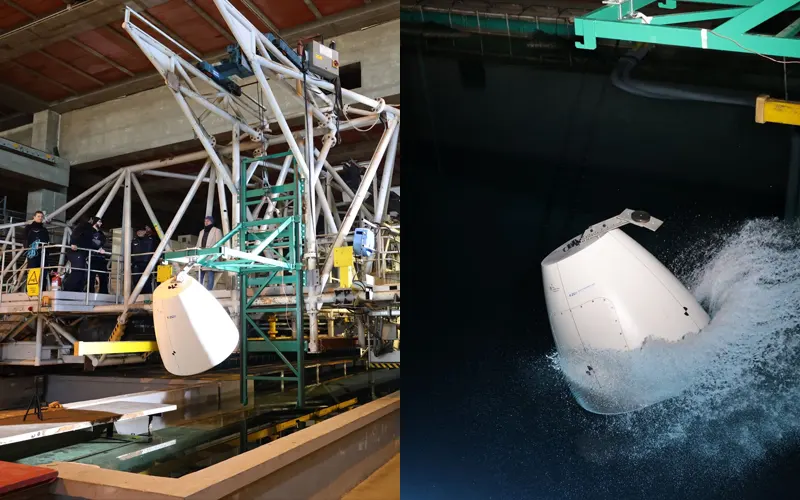
The Nyx drop test involved releasing a full-scale or high-fidelity prototype of the Nyx capsule from a high-altitude platform. The goal was to verify several critical sequences in real-time:
- Drogue Parachute Deployment: The initial, smaller chutes that stabilize the capsule and begin the deceleration process.
- Main Canopy Inflation: The deployment of the massive main parachutes that provide the primary braking force.
- Structural Load Management: Ensuring the capsule’s frame can handle the “jolt” of parachute inflation without compromising the crew cabin.
- Attitude Control: Confirming the capsule maintains the correct orientation during descent to ensure a safe splashdown or touchdown.
By simulating these conditions on Earth, The Exploration Co. Has reduced the “unknowns” associated with the 2028 mission. Any failure during a drop test is a lesson learned in a controlled environment; a failure during an actual mission is catastrophic.
“The transition from orbital velocity to a stationary point on Earth is perhaps the most complex choreography in physics. A successful drop test proves that the choreography is sound.”
The Architecture of Nyx: A New Breed of Space Capsule
The Nyx vehicle is not merely another iteration of the Apollo-style capsules of the 1960s. It represents a shift toward modularity and rapid reusability. While the industry has seen the success of the SpaceX Crew Dragon and the Boeing Starliner, The Exploration Co. Is carving out a niche focused on long-term sustainability and expanded crew capacities.
Key Technical Specifications and Design Philosophy
The design of Nyx prioritizes three core pillars: safety, versatility, and cost-reduction. Unlike traditional capsules that are often discarded or require extensive refurbishments, Nyx is being engineered for a higher cadence of flights.
One of the most innovative aspects of the Nyx design is its approach to the Thermal Protection System (TPS). By utilizing advanced composite materials, the company aims to create a heat shield that requires less maintenance between missions, directly supporting the goal of making the 2028 mission a springboard for a permanent presence in orbit.
| Feature | Traditional Capsules | The Nyx Vehicle |
|---|---|---|
| Reusability | Limited/Expensive Refurbishment | Designed for High-Cadence Reuse |
| Entry Profile | Ballistic or Semi-Ballistic | Optimized Lift-to-Drag Ratio |
| Recovery System | Standard Parachute Array | Next-Gen Stabilized Descent System |
| Mission Goal | LEO / Lunar Transit | Sustainable Orbital & Deep Space Infrastructure |
The Strategic Roadmap: The Path to 2028
The announcement that The Exploration Co. Completes Nyx Drop Test On Path To 2028 Mission – Aviation Week is a pivotal data point in a much larger timeline. Space exploration is rarely a linear path; it is a series of incremental victories. The 2028 target is an ambitious deadline that requires the synchronization of propulsion, life support, avionics, and recovery systems.
The Milestone Timeline
To reach a manned flight by 2028, The Exploration Co. Is following a rigorous verification matrix. The drop test is the “gate” that allows them to move from theoretical modeling and component testing into integrated vehicle testing.
- Phase 1: Conceptual Design & Simulation (Completed) – Utilizing computational fluid dynamics (CFD) to predict reentry behavior.
- Phase 2: Sub-system Validation (Completed) – Individual testing of heat shields, parachutes, and oxygen scrubbers.
- Phase 3: Integrated Drop Testing (Current Milestone) – Testing the vehicle as a whole system during descent.
- Phase 4: Uncrewed Orbital Flight Test (Upcoming) – Launching Nyx into orbit and returning it to Earth without a crew to prove the full loop.
- Phase 5: Crewed Certification (Target 2028) – Final safety certifications and the first human flight.
For more information on how these milestones compare to other agencies, see our related explainer on commercial space certification processes.
Why This Matters: The Broader Impact on the Space Economy
The success of the Nyx drop test has implications that extend far beyond the walls of The Exploration Co. We are currently witnessing a transition from the “Government Era” of space exploration to the “Commercial Era.” In the previous era, NASA or the Soviet space program bore all the risk and cost. Today, private entities are driving innovation by taking calculated risks and iterating faster.
Breaking the Monopoly on Orbital Access
For years, the ability to return humans safely from space was the exclusive domain of a few superpowers and, more recently, a single dominant private player. By developing the Nyx vehicle, The Exploration Co. Is introducing competition into the orbital transport market. Competition typically leads to two things: lower prices and higher safety standards.
The Role of “Fail-Fast” Engineering
The drop test is a prime example of the “fail-fast” philosophy. Rather than spending a decade in a laboratory attempting to perfect a mathematical model, The Exploration Co. Built a prototype and dropped it. This empirical approach allows engineers to see where the real-world physics deviate from the computer models, allowing for rapid adjustments before the vehicle ever leaves the atmosphere.
Technical Challenges and Potential Roadblocks
While the headline The Exploration Co. Completes Nyx Drop Test On Path To 2028 Mission – Aviation Week is overwhelmingly positive, it would be naive to suggest the path to 2028 is without peril. Space is an unforgiving environment, and “successful tests” on Earth do not always translate to “successful missions” in orbit.
The “Death Valley” of Aerospace Testing
There is a notorious gap in aerospace development known as the transition from sub-orbital testing to orbital reality. A drop test simulates the end of the journey, but it does not simulate the beginning—the extreme vibrations of launch, the radiation of the Van Allen belts, or the vacuum-induced outgassing of materials.
Some of the primary risks The Exploration Co. Must now manage include:
- Thermal Soak: Ensuring the heat shield can handle the actual plasma temperatures of orbital reentry, which are far higher than any atmospheric drop test can simulate.
- Avionics Reliability: The software governing the parachute deployment must be flawless; a delay of a few milliseconds can lead to a vehicle tumble.
- Funding and Scaling: Moving from a prototype to a flight-ready vehicle requires a massive infusion of capital and a scalable supply chain for aerospace-grade materials.
Common Misconceptions About Space Recovery Tests
When the general public reads that a company has completed a “drop test,” there are often several misunderstandings about what that actually means. It is important to clarify these points to provide a realistic view of the progress.

Misconception 1: “The vehicle has already flown.”
A drop test is not a flight. It is a descent test. The vehicle is dropped from a plane or balloon; it does not go into space, orbit the Earth, or experience the heat of reentry. It is a test of the landing, not the mission.
Misconception 2: “The 2028 mission is now guaranteed.”
In aerospace, nothing is guaranteed until the engines ignite and the capsule returns. While the drop test removes one major variable, there are still thousands of critical systems—from life support to guidance computers—that must be validated.
Misconception 3: “What we have is just like the Apollo missions.”
While the shape is similar, the technology is worlds apart. Modern capsules use fly-by-wire systems, advanced carbon-composites, and autonomous docking systems that were science fiction during the 1960s.
The Competitive Landscape: Nyx vs. The World
To truly appreciate the significance of The Exploration Co. Completes Nyx Drop Test On Path To 2028 Mission – Aviation Week, we must look at the current roster of reentry vehicles. The “Space Race 2.0” is not about reaching the moon first, but about who can make the journey the most sustainable.
Compared to the SpaceX Dragon, which has mastered the “water landing” and rapid refurbishment, Nyx is aiming for a versatility that may allow for different landing modalities. The goal is to create a vehicle that is not just a taxi to the International Space Station (ISS), but a robust platform for deep-space exploration and potential commercial space stations.
The entry of The Exploration Co. Into this arena forces other players to innovate. When one company proves a new parachute deployment method or a more efficient heat shield, it raises the bar for the entire industry, ultimately making space safer for everyone.
Frequently Asked Questions
What exactly is a “drop test” in the context of the Nyx vehicle?
A drop test is a controlled experiment where a spacecraft prototype is released from a high altitude to test its descent systems. For the Nyx vehicle, this specifically meant verifying that the parachutes deploy correctly and that the capsule remains stable as it slows down for landing.
Why is the 2028 date significant for The Exploration Co.?
The 2028 target represents the company’s goal for its first crewed mission. Achieving this would mark the transition of The Exploration Co. From a development-stage firm to an operational spaceflight provider, providing a new alternative for transporting humans to orbit.
Does a successful drop test mean the vehicle is ready for space?
No. A drop test only validates the recovery phase of the mission. The vehicle still needs to undergo vacuum chamber testing, vibration testing (to simulate launch), and uncrewed orbital flight tests before it is deemed safe for humans.
How does the Nyx vehicle differ from the capsules used by NASA or SpaceX?
While it shares the basic “capsule” shape, Nyx focuses on high-cadence reusability and a modular design intended to lower the cost of frequent trips to space, potentially offering different capacities and landing options than current industry standards.
What happens if the 2028 mission deadline is missed?
In the aerospace industry, delays are common due to the extreme safety requirements. While missing a deadline can affect investor confidence, the priority is always “safety over schedule.” A delay to ensure a perfect recovery system is always preferable to a premature launch.
The Horizon of Human Exploration
The news that The Exploration Co. Completes Nyx Drop Test On Path To 2028 Mission – Aviation Week serves as a reminder that we are in a transitional era of human history. We are moving away from a time when space was a destination for a select few government astronauts and toward a time when it is an extension of our economic and scientific sphere.
The Nyx vehicle is a physical manifestation of this ambition. Every parachute that opens correctly and every structural joint that holds under pressure brings us closer to a world where orbital travel is a routine part of human endeavor. As The Exploration Co. Moves from the drop tower to the launch pad, the industry will be watching closely to see if this new architecture can truly redefine the economics of the cosmos.
The road to 2028 is long and fraught with technical challenges, but the successful completion of the Nyx drop test proves that the foundation is solid. The focus now shifts to the integration of all systems, the rigors of orbital testing, and the eventual moment when the first crew climbs aboard the Nyx to venture into the black.
