Thailand Revives $30 Billion Coast-to-Coast Corridor to Rival Malacca Strait
Thailand is reviving plans for a $30 billion coast-to-coast corridor designed to provide a strategic alternative to the Malacca Strait, according to reports from DatamarNews and Media Selangor. The project involves constructing a “land bridge” consisting of deep-sea ports and rail links to connect the Gulf of Thailand with the Andaman Sea, bypassing one of the world’s most congested maritime chokepoints.
What is the Thailand coast-to-coast land bridge project?
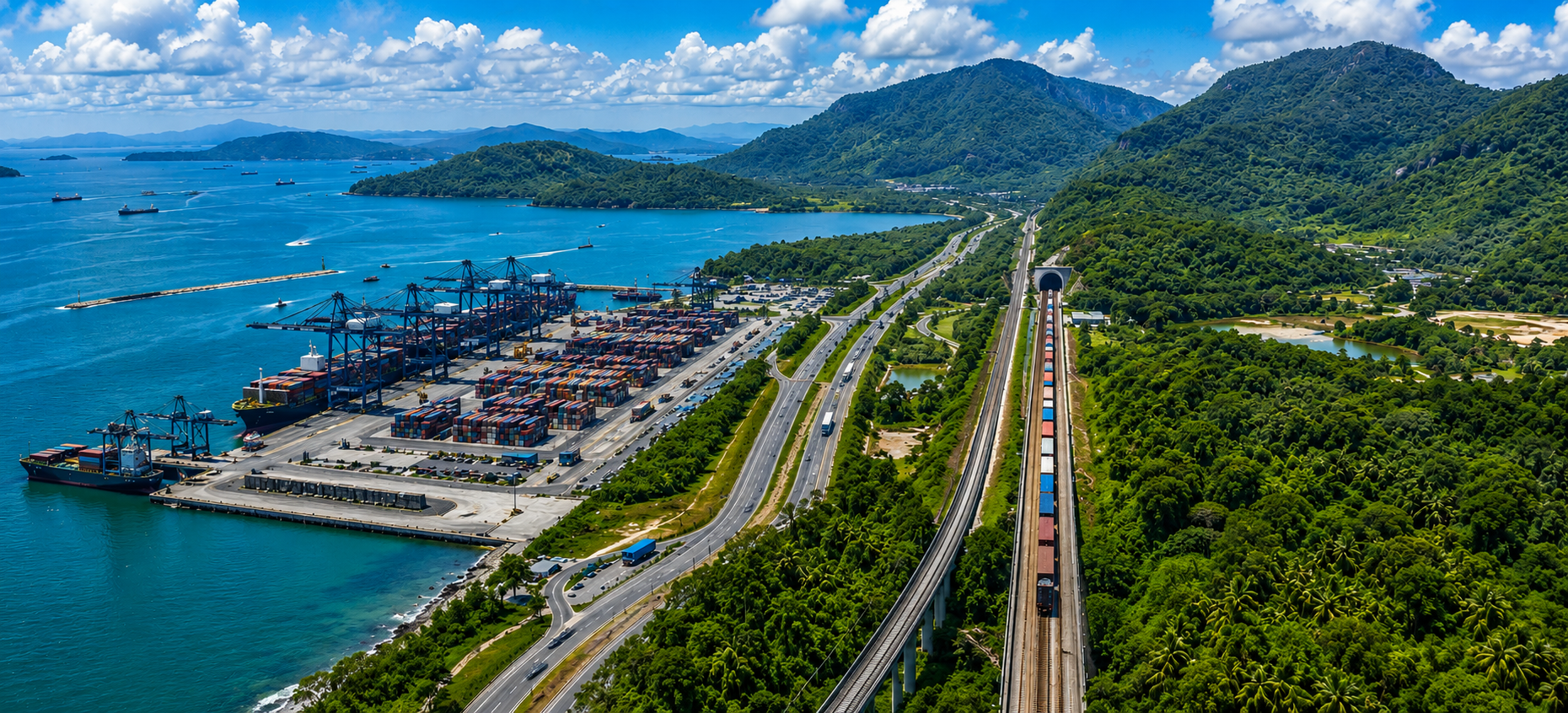
The proposed corridor is a massive infrastructure undertaking that seeks to link Thailand’s eastern and western coastlines. Rather than digging a traditional canal, the Thai government is focusing on a land bridge model. This approach involves building two major deep-sea ports—one on the Gulf of Thailand and one on the Andaman Sea—connected by a high-capacity railway and highway system.
According to DatamarNews, the project is estimated to cost approximately $30 billion. The primary objective is to allow cargo ships to unload at one port, transport goods across the isthmus via rail or road, and reload them onto different ships at the opposing port. This avoids the need for vessels to sail the entire length of the Malay Peninsula to reach the Malacca Strait.
Key components of the project include:
- Deep-sea port facilities: Specialized terminals capable of handling ultra-large container ships.
- Automated rail links: High-speed freight rail to move containers quickly between coasts.
- Integrated logistics hubs: Warehousing and processing zones to encourage industrial growth along the corridor.
- Road infrastructure: Expanded motorway networks to support heavy trucking and regional trade.
Why does Thailand want to rival the Malacca Strait?
The Malacca Strait is the primary shipping channel between the Indian Ocean and the Pacific Ocean. While it is the most efficient route for most global trade, it suffers from chronic congestion and security vulnerabilities. By creating a coast-to-coast corridor, Thailand aims to solve several systemic issues associated with the current maritime route.
Reducing Transit Times and Distance
Shipping vessels traveling from the Middle East or Africa to East Asia currently navigate the entire length of the Malacca Strait. A land bridge would significantly shorten the physical distance traveled, potentially saving ships several days of sailing time and reducing fuel consumption.
Mitigating the “Malacca Dilemma”
The term “Malacca Dilemma” refers to the strategic vulnerability of nations—particularly China—that rely heavily on the strait for energy imports. Because the strait is narrow, it could be easily blocked during a geopolitical conflict or by a maritime accident. According to reports from Media Selangor, providing an alternative route reduces this strategic risk for global powers.
Combatting Maritime Congestion and Piracy
The Malacca Strait is one of the most crowded waterways in the world. This congestion leads to slower transit speeds and an increased risk of collisions. Additionally, the region has historically been a hotspot for piracy and armed robbery at sea. A land-based alternative removes vessels from these high-risk waters for a portion of their journey.
How does the land bridge differ from the proposed Kra Canal?
For decades, Thailand discussed the “Kra Canal,” a project that would have physically cut the country in two to create a navigable waterway. However, the current $30 billion coast-to-coast corridor is a fundamentally different concept. The shift from a canal to a land bridge is driven by political, environmental, and financial pragmatism.
| Feature | Kra Canal (Former Plan) | Land Bridge (Current Plan) |
|---|---|---|
| Method | Excavated waterway for ships | Ports connected by rail/road |
| Environmental Impact | High (permanent ecosystem split) | Moderate (localized construction) |
| National Security | High risk (physically divides Thailand) | Low risk (maintains land integrity) |
| Cost/Complexity | Extremely high / Engineering nightmare | High / Standard infrastructure |
| Operation | Continuous ship passage | Transshipment (unload/reload) |
The land bridge avoids the sovereign security concerns of physically separating the southern provinces from the rest of Thailand. It also avoids the staggering cost and environmental devastation associated with dredging a deep-water canal through a tropical rainforest and diverse marine habitats.
Who are the primary stakeholders and investors?
A project of this magnitude requires immense capital and international cooperation. While the Thai government is the primary driver, the $30 billion price tag necessitates foreign direct investment (FDI) and public-private partnerships.

The Thai Government
The government views the corridor as a catalyst for economic revitalization. By transforming the region into a global logistics hub, Thailand hopes to attract manufacturing plants and services that want to be positioned near a major trade artery.
China and the Belt and Road Initiative (BRI)
China is a natural partner for this project. As the world’s largest trader, China stands to benefit the most from a route that bypasses the Malacca Strait. The land bridge aligns closely with the goals of the Belt and Road Initiative, which seeks to diversify trade routes and increase Chinese influence in Southeast Asian infrastructure.
India and the East-West Economic Corridor
India has a vested interest in the stability and efficiency of trade routes connecting the Indian Ocean to the Pacific. A land bridge could potentially integrate with India’s “Act East” policy, enhancing trade ties between New Delhi and Bangkok.
Singapore
Singapore is the primary entity that could be negatively impacted. The city-state’s economy is built on its role as the premier transshipment hub of the Malacca Strait. Any viable alternative that diverts significant traffic away from the strait threatens Singapore’s dominance in maritime logistics.
What are the economic implications of the $30 billion investment?
The financial scale of the project suggests that Thailand is not merely building a road, but creating an entire economic ecosystem. The $30 billion investment is expected to trigger secondary growth in several sectors.
Industrialization of Southern Thailand
The corridor is expected to create “special economic zones” around the new ports. These zones would likely host factories, assembly plants, and cold-storage facilities, moving the local economy away from a reliance on agriculture and tourism toward high-value logistics and manufacturing.
Job Creation and Urbanization
Construction of the ports and rail links will create thousands of immediate jobs. In the long term, the operation of the ports and the associated industrial zones will necessitate a skilled workforce, likely leading to the growth of new urban centers along the corridor.
Revenue from Transshipment Fees
Thailand intends to generate significant revenue by charging fees for the use of the land bridge. If the time and fuel savings are substantial enough, shipping companies will be willing to pay a premium to bypass the Malacca Strait.
However, some economists warn that the “transshipment” model is inherently less efficient than a direct water route. The cost of unloading a ship, moving containers by rail, and reloading them onto another ship may offset the fuel savings gained by the shorter distance. For the project to be viable, the rail system must be incredibly fast and automated.
What are the main challenges and risks?
Despite the strategic appeal, the Thailand coast-to-coast corridor faces significant hurdles that could delay or derail the project.
Environmental Concerns
The proposed route passes through ecologically sensitive areas. Environmental groups have raised alarms about the destruction of mangroves, the disruption of wildlife corridors, and the impact of massive deep-sea ports on marine biodiversity. Ensuring the project meets modern ESG (Environmental, Social, and Governance) standards will be critical for attracting Western investors.
Land Acquisition and Social Displacement
Building a railway and highway across the isthmus requires the acquisition of vast tracts of land. This often leads to conflicts with local landowners and indigenous communities. The Thai government must navigate complex compensation schemes to avoid social unrest in the southern regions.
Funding and Debt Sustainability
Securing $30 billion is a daunting task. If Thailand relies too heavily on loans from a single foreign power, it risks falling into a “debt trap,” where strategic assets are handed over to creditors in exchange for debt relief. Balancing investment from various global partners will be essential for maintaining national sovereignty.
Technical Viability of Transshipment
The success of the land bridge depends entirely on the efficiency of the “transfer” process. If the time spent unloading and reloading exceeds the time saved by bypassing the Malacca Strait, the corridor will fail to attract shipping lines. This requires a level of logistical precision and automation that is rarely seen on such a scale.
How does this fit into the wider geopolitical landscape?
The revival of the coast-to-coast corridor is not just an economic move; it is a geopolitical statement. The region is currently a theater of competition between the United States and China.
The US-China Tug-of-War
The U.S. views the Malacca Strait as a strategic lever. In a conflict scenario, the U.S. Navy could theoretically block the strait, cutting off energy supplies to China. By supporting or ignoring the land bridge, the U.S. can influence China’s strategic autonomy. Conversely, China’s involvement in the project would solidify its grip on Southeast Asian trade infrastructure.
ASEAN Integration
Within the Association of Southeast Asian Nations (ASEAN), the project could create tension. While Thailand benefits, Malaysia and Singapore may view it as an attempt to divert wealth and trade. The project’s success will depend on whether Thailand can frame it as a regional benefit rather than a nationalistic victory.
For more context on regional trade dynamics, a related explainer on ASEAN maritime security provides further insight into the complexities of the South China Sea and the Malacca Strait.
Frequently Asked Questions
Is the Thailand land bridge a canal?
No. Unlike the previously proposed Kra Canal, the land bridge does not involve digging a waterway. It consists of two deep-sea ports connected by a land-based transport system (rail and road) where cargo is transferred from one ship to another.

How much is the estimated cost of the project?
According to DatamarNews and Media Selangor, the estimated cost for the coast-to-coast corridor is approximately $30 billion.
Will this project replace the Malacca Strait?
It is unlikely to replace the Malacca Strait entirely, as the strait remains the most direct water route for many. However, it is designed to be a viable alternative that reduces congestion and provides a strategic bypass for ships and nations wanting to avoid the strait’s bottlenecks.
Which countries are most likely to invest in the corridor?
China is considered a primary potential investor due to its Belt and Road Initiative. Other interested parties may include India and various global private equity firms specializing in infrastructure and logistics.
What is the main advantage of a land bridge over a canal?
The land bridge is cheaper to build, less environmentally damaging, and does not physically divide the country into two separate landmasses, which addresses major national security concerns for Thailand.
The revival of this $30 billion project marks a significant shift in Thailand’s strategic ambitions. By attempting to rival the Malacca Strait, Bangkok is positioning itself as the central logistics hub of Southeast Asia. The project’s ultimate success will depend on whether the Thai government can secure diverse funding, overcome environmental opposition, and prove that the efficiency of land-based transshipment can truly compete with the world’s most famous shipping lane.
