Google DeepMind unveils GenCeption to transform video AI into vision models
Google DeepMind's GenCeption model utilizes video generation technology to perform traditional computer vision tasks, aiming to replace specialized systems.

Google DeepMind has introduced a new approach to computer vision called GenCeption, a model that repurposes pre-trained video generation technology to perform traditional vision tasks. This development suggests that video generators, which have largely functioned as creative entertainment tools, may contain the foundational world models required for advanced spatial and physical reasoning. The architecture moves away from fragmented toolchains, where specialized models are built for single purposes like segmentation or depth estimation, and toward a unified system capable of multiple tasks.
By training on a relatively small synthetic dataset of 7,500 videos — comprising 800 digital human models and 200 motion sequences rendered in Blender — researchers demonstrated that a single model could match or exceed the performance of dedicated systems. These results were verified against specialized models, such as DepthAnything 3, as well as Meta’s SAM 3, across tasks including 3D pose estimation, surface normal mapping, and language-guided segmentation. GenCeption utilizes the Wan2.1 video model as its base, opting for a simpler architecture that produces predictions in a single forward pass to enhance practical speed.
Related media

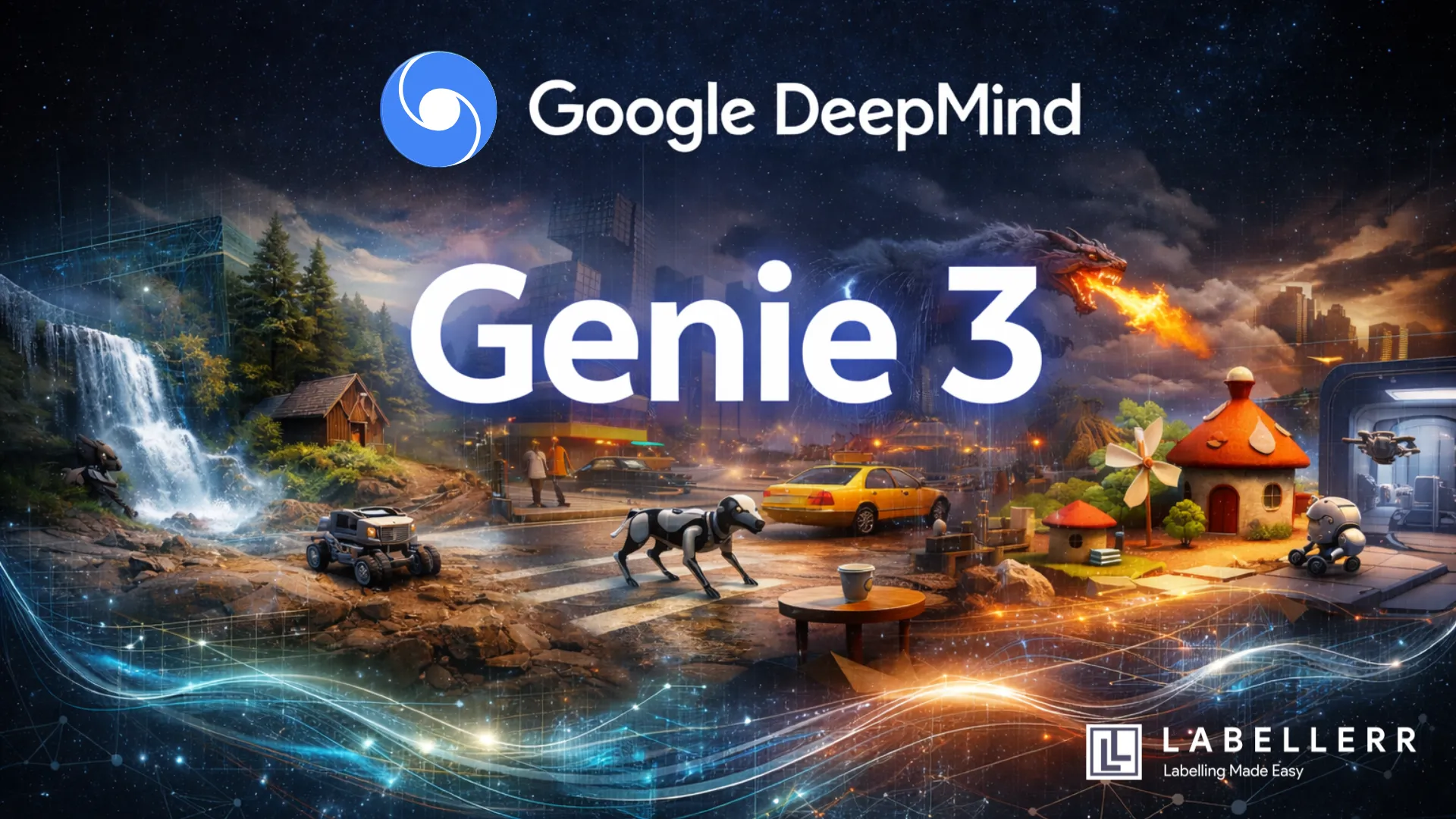

From Media Generation to World Simulation
Models such as Veo 3 have excelled at synthesizing realistic sequences, but newer iterations like Genie 3 focus on building interactive, navigable environments. In January 2026, Google provided access to Genie 3 for Google AI Ultra subscribers in the United States. Following this rollout, the model has been integrated with Google Street View. This connection allows users to explore simulated versions of real-world locations by drawing on 280 billion images captured across seven continents. According to Jonathan Herbert, director of Google Maps, the breakthrough lies in spatial continuity: the model remembers what was behind a user, allowing for a coherent 3D space where lighting and weather can be modified in real time.
This integration is not solely for consumer entertainment. Robotics developers are utilizing these simulated environments to train agents in scenarios that would be dangerous or impractical to capture in the real world, such as navigating extreme weather or rare encounters. Because collecting egocentric data, information captured from a robot’s own perspective, is a critical bottleneck in embodied AI, these interactive, high-fidelity simulations provide a scalable alternative to expensive, traditional data collection methods.
Debating the "World Model" Label
Despite these technical strides, the definition and capabilities of these models remain a subject of intense industry debate. Former Meta chief AI scientist Yann LeCun has argued that generative video models are a dead end for true physical understanding, preferring architectures like V-JEPA that predict abstract concepts rather than pixels. Furthermore, an international research team recently proposed the OpenWorldLib definition, which explicitly excludes text-to-video models due to their lack of feedback from the real world. Research from Tsinghua University and independent evaluations of models like Sora 2 and Veo 3.1 have highlighted significant limits in basic physics and logic, noting that these systems often fail when tested outside their training distribution.
The researchers behind GenCeption acknowledge that their work is not perfect, and they have documented inconsistent results in areas like 3D keypoint estimation. However, proponents argue that the consistent improvement between model versions suggests that these systems are on a trajectory toward becoming general-purpose foundation models for vision.
What to Watch Next
- Global Expansion: Following the US launch of Genie 3 for Google AI Ultra subscribers, a wider international rollout is planned over the coming weeks.
- Physical Reasoning: The industry is closely watching whether these models can evolve beyond "plausible" visual output to demonstrate reliable reasoning regarding causality and physical laws in novel, unseen environments.
Whether these systems ultimately replace specialized vision stacks or simply provide a new creative layer remains to be determined. As of July 2026, the convergence of massive real-world datasets and generative architecture is shifting expectations for what AI can achieve, effectively building the substrate for the next generation of physical, interactive intelligence.
Archypedia is dedicated to independent, evidence-backed reporting. This briefing was synthesized from primary source reporting, corroborated across independent newsrooms, and verified against our Editorial Standards.
Transparency record
Evidence behind this report
This report synthesizes 10 distinct sources. Open the source ledger below to compare the underlying coverage.
- the-decoder.com
- thenextweb.com
- techcrunch.com
- labellerr.com
- time.com
- winsomemarketing.com
- arstechnica.com
- arxiv.org
- en.wikipedia.org
- blog.prompt20.com
Prepared under the Archypedia Editorial Policy by the Niko Vale editorial desk profile. AI-assisted tools may support drafting and verification; public accountability remains with Archypedia. Report an error.


