X-Humanoid robot beats Usain Bolt's 100m world record in Beijing
The record-breaking run ended with the machine slamming into cushions, highlighting a divide between raw speed and functional stability.

A humanoid robot crossed the finish line of a 100-meter dash in 9.39 seconds on Saturday, beating the 9.58-second world record set by Usain Bolt in 2009. The victory for Beijing-based X-Humanoid ended in immediate physical failure; footage from the event shows the machines slamming into cushions to stop their momentum before being carried off the track on stretchers.
The sprint took place during the second World Humanoid Robot Games in Beijing, an event featuring more than 2,000 robots from 16 countries competing across 51 categories at the Olympic speed skating oval. While organizers presented the results as evidence of China's rapid progress in advanced robotics, the spectacle revealed a divide between raw speed and functional stability. Other robots at the games tripped, fell, smashed into pieces, or caught fire during competitions, according to CBS News and Yahoo.
Related YouTube video
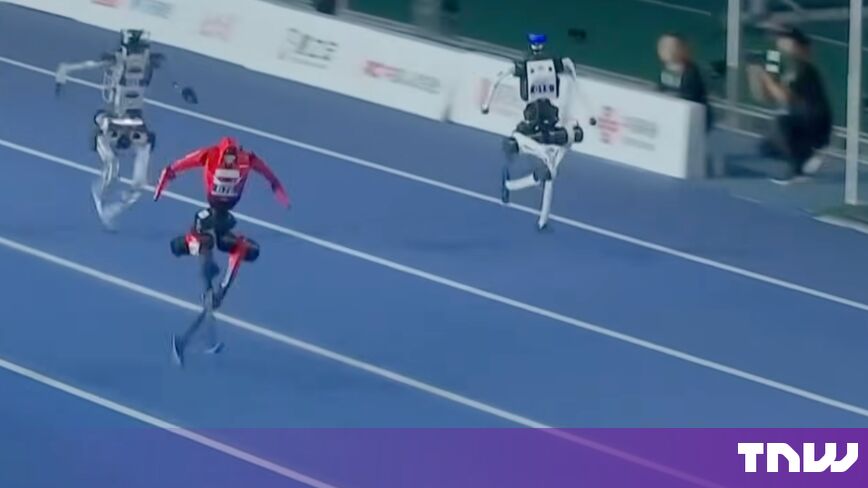


The record-breaking run was achieved by a robot identified as Tiangong Ultra
, developed by the Beijing Humanoid Robot Innovation Centre, according to Whalesbook. A second robot, Lightning
, created by smartphone manufacturer Honor, clocked a time of 9.47 seconds. Honor also reportedly timed a machine at 9.32 seconds during trials, as reported by Thenextweb. X-Humanoid also claimed a record in the standing high jump, with a robot reaching 2.88 meters, surpassing Cuba's Javier Sotomayor's 1993 mark of 2.45 meters.
Roboticists argue these achievements rely on engineering modifications rather than true autonomy. Honor lengthened its robot's legs by 10 centimeters to reach a total of 1.05 meters specifically to optimize sprinting speed. Moreover, historical data from the event suggests a reliance on human intervention; during a half marathon at the first games in 2025, only 38% of entries ran autonomously, with the remainder being remotely piloted, according to Thenextweb.
This distinction — between a machine that can run a known track and one that can navigate an unfamiliar environment — is a primary point of contention. Rodney Brooks, MIT emeritus professor and iRobot founder, previously described a Beijing robot race as a publicity stunt
that shows no safety at all
and offers nothing useful that you could use in any application
, via Thenextweb.
Yanran Ding of the University of Michigan noted a cognitive bias
that leads observers to believe sprinting is more difficult than a task like folding laundry, though she asserts the opposite is true. This philosophical gap has resulted in divergent regional strategies:
- China: Prioritizing high-profile speed showcases and synchronized coordination, such as the hundreds of robots that marched in formation during Saturday's opening ceremony.
- Europe: Focusing on functional autonomy. London-based Humanoid raised $152 million with Bosch as a manufacturing partner, and NEURA Robotics is building gyms to train machines in
messy physical environments
.
The pursuit of these records coincides with escalating geopolitical friction. Last month, the U.S. Federal Communications Commission banned the import of new foreign-made humanoid robots, citing national security concerns targeted at China. The Pentagon has also flagged Unitree, a leading Chinese robotics firm, for alleged ties to the Chinese military, an accusation Beijing has denied.
Financial markets have reacted to these developments with instability. Whalesbook reports that robotics-related stocks, including those of Unitree, have experienced significant volatility on regional exchanges as investors weigh the excitement of world records against the technical instability of the hardware.
The performance leap is numerically stark. Tiangong Ultra's 100-meter time improved from 21.50 seconds just one year ago, according to Whalesbook. This follows a trajectory established at the 2025 games, where Unitree’s H1 won the 400-meter event in 88 seconds, well behind the human record of 43 seconds, according to Thenextweb.
While Chinese manufacturers claim to have thousands of orders from private businesses and the government, the technology remains fragmented. The requirement for stretchers at the finish line suggests a lingering failure in basic balance and safety.
The primary technical hurdle remains the transition from controlled, flat-track demonstrations to reliable deployment. Developers must now determine if these machines can move beyond the Olympic speed skating oval to achieve mass real-world deployment in industrial or commercial sectors.
How significant is this development?
Contribute your assessment to the aggregated reader intelligence ledger.
Archypedia is dedicated to independent, evidence-backed reporting. This briefing was synthesized from primary source reporting, corroborated across independent newsrooms, and verified against our Editorial Standards.
Transparency record
Evidence behind this report
This report synthesizes 5 distinct sources. Open the source ledger below to compare the underlying coverage.
Prepared under the Archypedia Editorial Policy by the Rafael Ortega editorial desk profile. AI-assisted tools may support drafting and verification; public accountability remains with Archypedia. Report an error.