Trump au premier rang d'un grand prix automobile dans Washington
Trump au premier rang d'un grand prix automobile dans Washington

Touring the federal capital in an armored limousine before stepping up to the start line directly beneath the Capitol dome, Donald Trump placed himself squarely at the center of the nation's 250th-anniversary celebrations on Sunday, August 23, 2026. Waving the green flag to launch the inaugural Freedom 250 Grand Prix, the American president capped off a politically orchestrated spectacle that brought single-seater racing at speeds approaching 300 km/h through the heart of Washington, according to reporting from Sud Radio and Le Parisien.
The high-stakes event, initiated by a presidential executive decree signed on January 30, 2026, closed out months of commemoration for the signing of the Declaration of Independence. While organizers and supporters embraced the roaring tribute to an inherently American sport, the $35 million undertaking exposed a sharp friction between political pageantry and the logistical reality of shutting down the federal capital, as detailed across coverage from Bluewin and La Liberté.
Related YouTube video


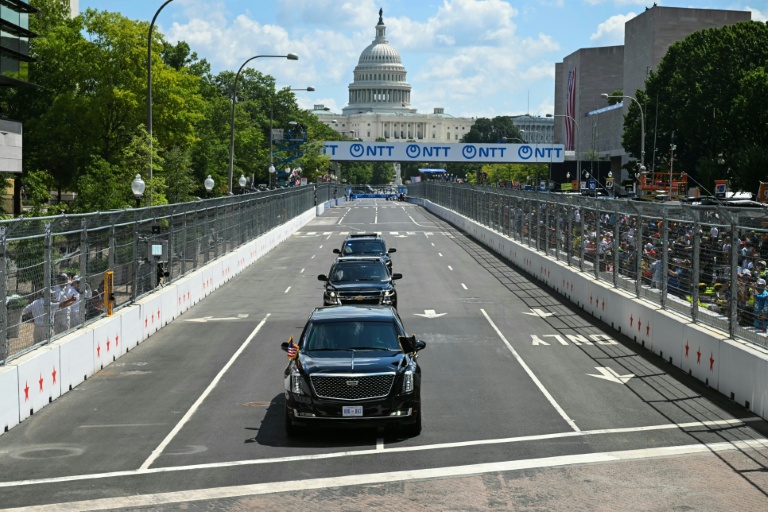
Racing across a challenging 400 km distance, American driver Kyle Kirkwood claimed victory after navigating 147 laps on a circuit measuring just under 3 km. Winding past landmarks including the Washington Monument obelisk, the National Archives, and the Smithsonian museums, Kirkwood completed the race in 2 hours and 40 minutes, edging out Denmark's Christian Lundgaard by 3.09 seconds, according to race reports covered by La Télé and La Liberté.
Australian Will Power took third place, while Sweden's Marcus Ericsson finished fourth, as reported by bluewin.ch and La Télé. The grueling urban track exacted a heavy toll on the starting grid. Defending champion Alex Palou — who entered the weekend holding six victories this season and hunting for a fourth consecutive title — saw his championship aspirations collapse following a penalty, a botched tire change, and a crash that relegated him to a 20th-place finish out of 25 starters, as detailed by Sud Radio. Later in the event, New Zealander Scott McLaughlin crashed into a tire barrier with 19 laps remaining while attempting to challenge Kirkwood, who ultimately seized clear air with 13 laps left to secure his seventh career IndyCar victory and sixth on a street circuit, as noted by Sud Radio.
"Je ne trouve même pas les mots. C'est incroyable. J'en ai presque les larmes aux yeux. C'est un grand moment pour nous, un grand moment pour l'Amérique"
Kyle Kirkwood, IndyCar race winner, via Sud Radio
Transforming the historic district into a racetrack required intense infrastructural adjustments. Local authorities repaved street potholes, while the National Gallery of Art conducted studies to evaluate potential structural risks posed by high-frequency vehicle vibrations to its collections, as noted by bluewin.ch and La Liberté. Backed by IndyCar owner Roger Penske, who noted that the race happened because the president, an avid racing fan, actively demanded it, the capital absorbed a total organizational price tag of $35 million.
Crowds filled the National Mall and peered past trackside barriers under clear blue skies, generating a mix of awe and political division. Raechel Ferguson, a 23-year-old visitor from Arizona, praised the novelty of attending her first IndyCar event during a milestone national anniversary, as reported by Sud Radio and Le Parisien. Local resident Mario Espinal noted an electric atmosphere while acknowledging the deep political overlay defining the weekend. Motorsport legend Mario Andretti, whose 1969 Indy 500-winning car is housed in a local Smithsonian museum, hailed the capital circuit as an incredible achievement, according to Sud Radio.
Freedom 250 Grand Prix Fact Sheet
- Distance and Duration: Drivers completed 147 laps across a 400 km distance in 2 hours and 40 minutes.
- Podium: Kyle Kirkwood won the race, followed by Christian Lundgaard in second, Will Power in third, and Marcus Ericsson in fourth.
- Infrastructure Cost: The event carried a total organizational price tag of $35 million.
Stakeholders face an immediate operational decision as organizers and officials prepare to convene during the following week to evaluate the massive inaugural undertaking and decide whether to pursue an annual fixture in Washington, with Roger Penske indicating to Sud Radio and bluewin.ch that future editions are not off the table.
How significant is this development?
Contribute your assessment to the aggregated reader intelligence ledger.
Archypedia is dedicated to independent, evidence-backed reporting. This briefing was synthesized from primary source reporting, corroborated across independent newsrooms, and verified against our Editorial Standards.
Transparency record
Evidence behind this report
This report synthesizes 6 distinct sources. Open the source ledger below to compare the underlying coverage.
Prepared under the Archypedia Editorial Policy by the Rafael Ortega editorial desk profile. AI-assisted tools may support drafting and verification; public accountability remains with Archypedia. Report an error.


:strip_icc():format(jpeg)/kly-media-production/medias/9347724/original/000157700_1789365960-20260914_105827.jpg)