Nvidia GTC Taipei Recap: RTX Spark, Vera, Data Centres and More – Tech Wire Asia Analysis
The global technology landscape is currently witnessing a seismic shift in how personal computing is defined, and the recent events in Taipei have served as the epicenter of this transformation. As Nvidia expands its footprint beyond the high-end gaming GPU market, the company is aggressively positioning itself as the foundational architect of the “AI PC” era. By integrating advanced silicon with a new philosophy of personal intelligence, Nvidia is not merely updating hardware; It’s attempting to rewrite the operating logic of the Windows ecosystem.
For those following the Nvidia GTC Taipei recap: RTX Spark, Vera, data centres and more – Tech Wire Asia discourse, the overarching theme is clear: the transition from cloud-dependent AI to “Edge AI.” The goal is to move the heavy lifting of Large Language Models (LLMs) and generative AI from distant data centers directly onto the user’s desk or into their laptop. This shift promises lower latency, enhanced privacy, and a fundamentally more responsive user experience, effectively turning the PC into a personal AI agent rather than a simple tool for productivity.
The Dawn of the AI PC: Redefining the Windows Experience
One of the most significant takeaways from the Taipei announcements is the deep strategic alignment between Nvidia and Microsoft. The two giants are collaborating to reinvent the Windows PC, moving away from the traditional CPU-centric architecture toward a tripartite system comprising the CPU, the GPU, and the NPU (Neural Processing Unit). This “Personal AI” vision suggests a future where the operating system doesn’t just run applications but anticipates user needs through local AI processing.
The core objective here is to enable “Local AI,” where complex tasks—such as real-time language translation, advanced image generation, and sophisticated coding assistance—happen on the device. This reduces the reliance on expensive cloud API calls and mitigates the privacy concerns associated with sending sensitive data to external servers.
The Pillars of Personal AI
- Local Inference: The ability to run LLMs locally, ensuring the AI remains functional even without an internet connection.
- Contextual Awareness: AI that understands the user’s local files, emails, and habits without compromising security.
- Energy Efficiency: Utilizing specialized AI cores to perform tasks that would otherwise drain a laptop’s battery if handled by a general-purpose CPU.
“The PC is no longer just a gateway to the cloud; it is becoming the engine of intelligence itself.”
Unpacking the Hardware: RTX Spark and Vera
Central to Nvidia’s push into the consumer AI space are the introductions of RTX Spark and Vera. While often discussed in technical circles, these initiatives represent the “how” behind the “what” of the AI PC.
RTX Spark: Igniting Local Creativity
RTX Spark is designed to democratize the creation and deployment of AI-enhanced applications. It focuses on providing developers with the tools to optimize their software for Nvidia’s Tensor cores, allowing for “sparking” instant AI generations on the fly. Whether it is an architect visualizing a building in real-time or a gamer experiencing dynamically generated worlds, RTX Spark serves as the bridge between raw GPU power and usable AI software.
Vera: The Intelligence Layer
Vera represents a shift toward more integrated AI management. Rather than acting as a standalone app, Vera is envisioned as a layer of intelligence that optimizes how the system allocates resources between the CPU and GPU. It ensures that AI workloads are routed to the most efficient processor, preventing system lag and maximizing the throughput of generative tasks. Vera is the “conductor” of the AI PC orchestra.
| Feature | RTX Spark | Vera |
|---|---|---|
| Primary Focus | Developer tools & Creative acceleration | System optimization & AI orchestration |
| User Impact | Faster AI generation & New app capabilities | Smoother performance & Battery efficiency |
| Technical Goal | Tensor Core utilization | Workload distribution (CPU/GPU/NPU) |
Beyond the Desktop: The Data Centre Powerhouse
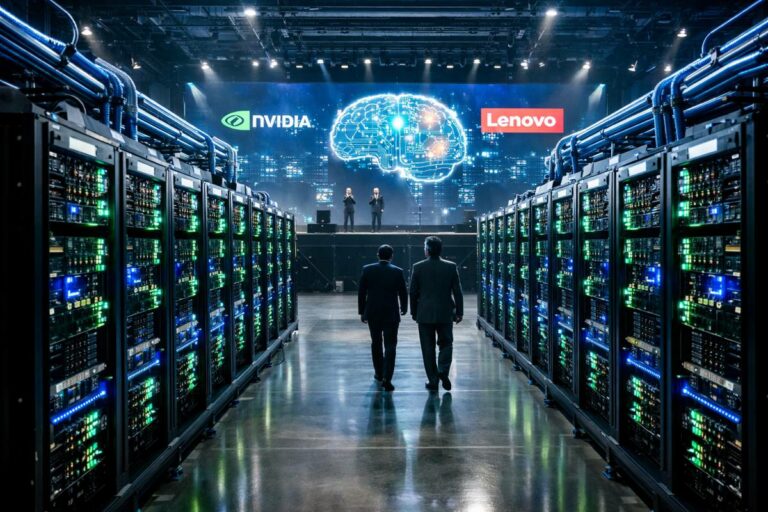
While the consumer-facing AI PC grabs the headlines, Nvidia’s dominance in the data center remains the bedrock of its financial and technological empire. The Taipei discussions reinforced that the “AI PC” is only one half of the equation; the other half is the massive infrastructure required to train the models that eventually run on those PCs.
Nvidia is continuing to scale its data center offerings, focusing on the interconnectivity between GPUs. The challenge is no longer just about how fast a single chip can compute, but how efficiently thousands of chips can communicate. This is where Nvidia’s networking prowess (via Mellanox) becomes a critical moat, preventing competitors from simply throwing more hardware at the problem.
The Feedback Loop: Data Centre to Edge
There is a symbiotic relationship between Nvidia’s data center chips and its consumer hardware. The massive models trained in the data center are “distilled” or compressed into smaller, more efficient versions that can be deployed via RTX Spark and Vera on local machines. This creates a closed-loop ecosystem where Nvidia controls both the training (Data Center) and the inference (PC).
For a deeper understanding of how this affects the broader industry, you might find a related explainer on Edge AI infrastructure useful.
The Competitive Clash: Nvidia vs. Intel
Nvidia’s aggressive expansion into the PC chip market has naturally created friction with traditional incumbents, most notably Intel. For decades, Intel has owned the “brain” of the PC. Now, Nvidia is arguing that the GPU is the new brain.

Interestingly, the rhetoric from Intel has been surprisingly diplomatic. Intel leadership has suggested that competition in the PC chip space is a “good thing,” arguing that Nvidia’s push will accelerate the entire industry’s transition to AI. However, beneath the surface, the battle is for the “socket.” If the OS begins to rely more on the GPU/NPU for primary functions, the CPU becomes a supporting actor rather than the lead.
Key Points of Contention
- Architecture: Intel’s x86 dominance vs. Nvidia’s GPU-centric acceleration.
- Integration: The race to integrate the NPU directly into the processor (Intel Core Ultra) vs. Nvidia’s discrete GPU power.
- Ecosystem: Microsoft’s role as the kingmaker, deciding which hardware standards become the default for Windows AI.
Market Implications and Economic Ripples
The shift toward AI PCs isn’t just a technical milestone; it’s a financial catalyst. Analysts are closely watching how this pivot affects the semiconductor supply chain. While Nvidia’s growth is undeniable, the “AI push” creates uneven risks across the sector.
For example, some semiconductor equipment manufacturers may face volatility. When a company pivots its architecture—moving from traditional CPU-heavy designs to GPU-centric ones—the types of testing and packaging required change. Some firms may find their current equipment obsolete, while others see a surge in demand for advanced packaging (like CoWoS). Despite these risks, many financial institutions maintain a bullish outlook on the sector, viewing the AI PC as the biggest catalyst for a hardware refresh cycle since the introduction of the mobile internet.
Investors are particularly focused on the “replacement cycle.” Most current PCs lack the hardware necessary to run the next generation of “Personal AI” tools. This creates a massive opportunity for a global upgrade cycle, as businesses and consumers are forced to buy new hardware to remain competitive in an AI-driven economy.
Common Misconceptions About AI PCs
As the hype builds, several misunderstandings have surfaced regarding what an “AI PC” actually is. It is important to clarify these to understand the real value proposition.
Misconception 1: “It’s just a faster computer.”
An AI PC is not just about clock speed. A traditional PC is designed for sequential processing (doing one thing at a time very quickly). An AI PC is designed for parallel processing (doing thousands of small things simultaneously), which is how neural networks function.
Misconception 2: “You don’t need the internet for AI anymore.”
While local AI (via RTX Spark) allows for many tasks to happen offline, the internet is still required for updating models, syncing data, and accessing the massive “frontier” models that are too large for any consumer PC to hold.
Misconception 3: “The NPU replaces the GPU.”
In reality, the NPU is for low-power, always-on AI tasks (like background blur in a video call), while the GPU is for high-performance AI tasks (like generating a 4K image). They work in tandem, not as replacements.
Analyzing the Long-Term Trajectory
The events in Taipei signal that we are entering the “deployment phase” of the AI revolution. The last two years were about the “wow factor” of ChatGPT and Midjourney—tools that lived in the cloud. The next two years will be about integration. We are moving toward a world where AI is an invisible layer of the operating system, as fundamental as the file folder or the taskbar.
Nvidia’s strategy is to ensure that no matter where AI happens—whether in a massive server farm in Virginia or on a laptop in a cafe in Taipei—it happens on Nvidia silicon. By controlling the software libraries (CUDA), the hardware (RTX/Blackwell), and the orchestration layers (Vera), they are building a vertical monopoly on intelligence.
The success of this vision depends heavily on the software ecosystem. Hardware is only as good as the apps that use it. This is why the partnership with Microsoft is the most critical piece of the puzzle. If Windows becomes the primary vehicle for Personal AI, and that AI is optimized for Nvidia, the competitive moat becomes nearly insurmountable for others.
Frequently Asked Questions
What exactly is the “AI PC” mentioned in the Nvidia GTC Taipei recap?
An AI PC is a computer equipped with specialized hardware—specifically GPUs and NPUs—designed to run artificial intelligence tasks locally on the device rather than relying on cloud servers. This allows for faster processing, better privacy, and offline AI capabilities.
How do RTX Spark and Vera differ?
RTX Spark is primarily a set of tools and a framework aimed at developers to accelerate AI creativity and app performance. Vera is an orchestration layer that manages how the computer’s resources (CPU, GPU, NPU) are shared to ensure AI tasks run efficiently without slowing down the rest of the system.
Will Nvidia’s move into PC chips make Intel obsolete?
Not necessarily. While Nvidia is challenging Intel’s dominance in “intelligence” processing, CPUs are still essential for general system management and basic logic. The industry is moving toward a “heterogeneous computing” model where the CPU and GPU share the workload.
Why are data centers still important if we are moving to “Local AI”?
Data centers are where the “heavy lifting” occurs. Massive AI models are trained on thousands of GPUs in data centers because the power and memory requirements are too high for a PC. Once a model is trained, a smaller, “distilled” version is sent to the AI PC for daily use.
What is the impact of these announcements on consumers?
For the average user, this means the next generation of laptops will likely be more expensive but significantly more capable. You can expect features like real-time system-wide translation, AI-driven battery management, and the ability to run powerful AI assistants without a subscription or an internet connection.
As the industry moves forward, the focus will shift from the raw power of chips to the seamlessness of the user experience. The integration of RTX Spark and Vera into the Windows ecosystem marks the beginning of a period where the hardware disappears into the background, leaving only the intelligence behind. The race is no longer about who has the fastest processor, but who provides the most intuitive personal assistant, and Nvidia is currently holding the strongest hand in that game.
