Nio Delivers 37,705 Vehicles in May, Highest This Year – CnEVPost: A Strategic Surge in the Chinese EV Market
The electric vehicle landscape in China has just witnessed a significant shift in momentum. Recent data confirms that Nio delivers 37,705 vehicles in May, highest this year – CnEVPost, signaling a robust recovery and an aggressive push into a new phase of growth. This surge represents a staggering 62.3% increase year-on-year, transforming the company’s trajectory as it navigates one of the most competitive automotive environments in history.
For industry observers and investors, this isn’t merely a monthly spike in sales. It is the culmination of a multi-pronged strategy involving brand diversification, a refreshed product pipeline, and a relentless commitment to infrastructure that sets Nio apart from its peers. As the company enters what leadership describes as a “peak new product launch period,” the May delivery numbers serve as a critical proof of concept for Nio’s long-term viability and its ability to scale in a price-sensitive market.
Decoding the May Delivery Surge: The Numbers Behind the Momentum
To understand the magnitude of Nio’s performance in May, one must look beyond the raw figure of 37,705 units. The year-on-year growth of 62.3% indicates that Nio is not just maintaining its market share but is actively expanding its footprint. This growth comes at a time when many EV manufacturers are struggling with inventory gluts and eroding margins due to the ongoing price wars in China.
The May peak is particularly noteworthy because it establishes a new benchmark for the current calendar year. This trajectory suggests that Nio has successfully cleared previous bottlenecks in production and delivery, while simultaneously stimulating demand through a mix of updated hardware and strategic pricing.
| Metric | May Performance | Year-on-Year Change | Significance |
|---|---|---|---|
| Total Deliveries | 37,705 units | +62.3% | Highest monthly volume of the year |
| Onvo Deliveries | Significant Increase | +92% | Rapid adoption of mass-market brand |
| Stock Market Reaction | Nio-SW (HK) | ~6% Rise | Positive investor sentiment |
The surge is not limited to the flagship Nio brand. A critical component of this success is the rapid ascent of Onvo, Nio’s new mass-market sub-brand. By diversifying its offerings, Nio is effectively hedging its bets—maintaining its “luxury” status with the primary brand while capturing the volume-driven middle market through Onvo.
The Onvo Effect: Capturing the Mass Market with L80 and L90
One of the most striking revelations in the May data is the performance of the Onvo brand, which saw deliveries jump by 92%. The introduction of the L80 and L90 models has proven to be a masterstroke in market positioning. While the main Nio brand targets the high-end executive and luxury consumer, Onvo is designed to compete directly with the likes of the Tesla Model Y and other mid-range electric SUVs.
The L80 and L90 are not merely “cheaper” versions of Nio vehicles; they are engineered for efficiency and accessibility without sacrificing the core technological advantages that define the ecosystem. The 92% jump in deliveries suggests that there is a massive, untapped appetite for a vehicle that offers Nio’s sophisticated software and charging ecosystem at a more attainable price point.
Why the Onvo Strategy is a Game-Changer
- Volume Scaling: By targeting the mass market, Nio can achieve the economies of scale necessary to lower per-unit production costs across all its brands.
- Ecosystem Expansion: Every Onvo vehicle on the road increases the utility and visibility of Nio’s proprietary battery-swapping network.
- Customer Acquisition: Onvo serves as an entry point into the Nio ecosystem. A customer who starts with an L80 today is a prime candidate for a flagship Nio SUV in five years.
This dual-brand approach allows Nio to operate a “pincer movement” in the market: squeezing competitors from the top with luxury prestige and from the middle with high-value technology.
The Product Pipeline: Entering the ‘Peak Launch Period’
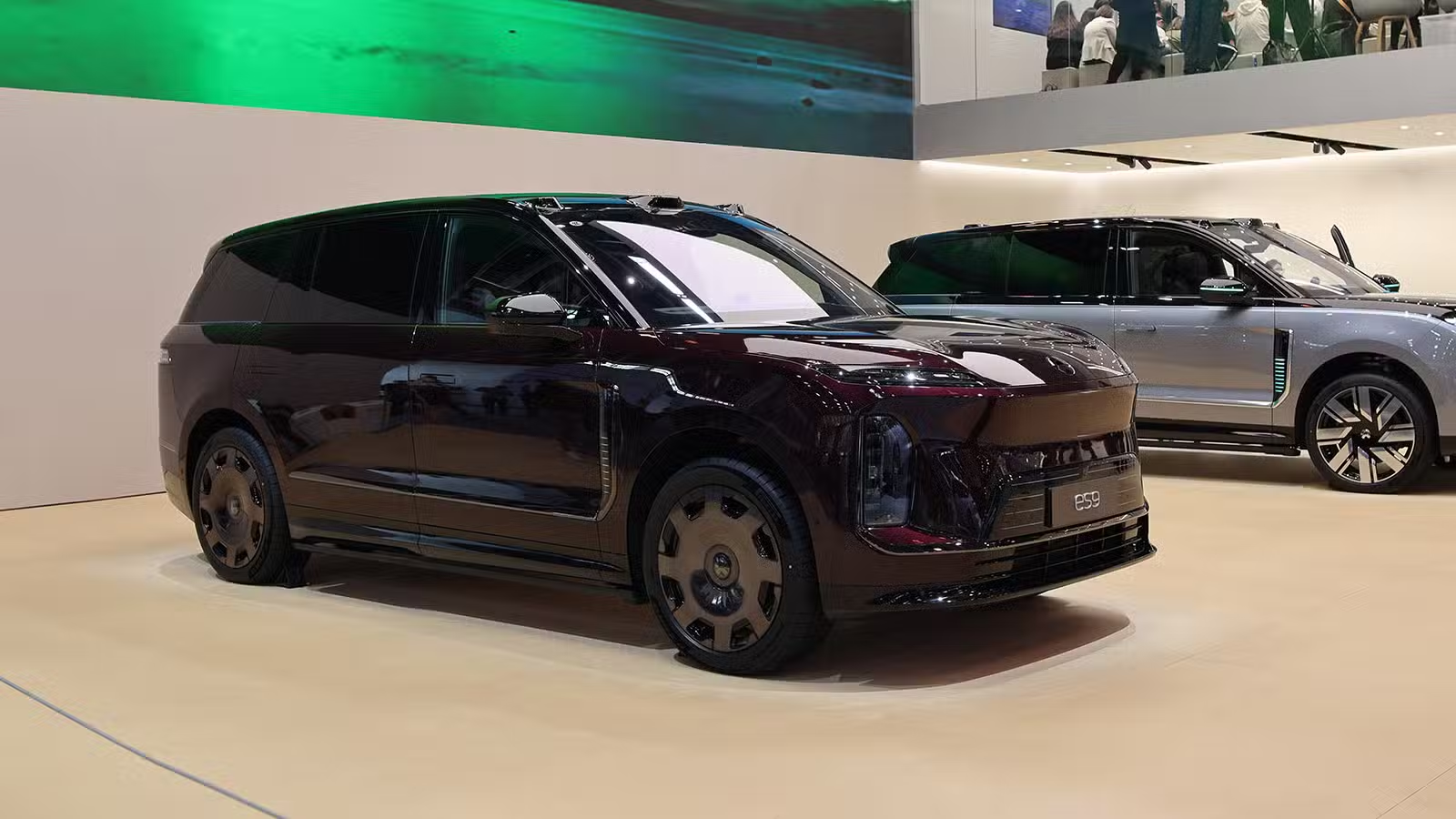
The delivery surge in May is a precursor to a much larger offensive. Nio has officially entered a “peak new product launch period,” a phase characterized by the rapid introduction of new models and iterations. Central to this strategy is the launch of the ES9 SUV, a vehicle positioned to redefine the luxury electric segment.
The ES9 is more than just another SUV; it is a statement of intent. By pushing the boundaries of range, interior luxury, and autonomous driving capabilities, Nio is attempting to distance itself from “commodity” EVs. The ES9 targets the ultra-premium segment, where margins are highest and brand loyalty is strongest.
“The transition from a single-brand luxury player to a multi-brand powerhouse is the most dangerous yet rewarding phase for an EV company. Nio’s ability to scale Onvo while simultaneously launching the ES9 indicates a high level of operational maturity.”
This aggressive launch schedule is designed to keep the brand in the headlines and ensure that there is always a “fresh” model available to entice buyers. In the fast-moving Chinese market, where consumer preferences shift quarterly, this cadence of innovation is a survival requirement.
Financial Implications and Market Reaction
The markets have responded with notable enthusiasm to the news that Nio delivers 37,705 vehicles in May, highest this year – CnEVPost. In Hong Kong, Nio-SW (09866) saw its shares climb nearly 6% during afternoon trade. This reaction underscores a growing confidence among institutional investors that Nio’s “burn rate” is beginning to be offset by genuine commercial scale.
Analyst Perspectives: The CLSA Revaluation
The sentiment is echoed by major financial institutions. CLSA recently raised its price target (TP) for NIO Inc. To USD 7 and initiated coverage of its H shares with an “Outperform” rating. This upgrade is significant because it suggests that analysts are no longer viewing Nio solely as a speculative growth stock, but as a company with a clear path toward operational stability.
The revaluation is likely based on several key factors:
- Diversified Revenue Streams: The success of Onvo reduces the company’s reliance on a modest number of ultra-wealthy buyers.
- Infrastructure Moat: Nio’s investment in battery swapping is finally paying dividends as it becomes a competitive advantage that cannot be easily replicated by Tesla or BYD.
- 2026 Outlook: Projections for 2026 are increasingly upbeat, with expectations that the company will reach a critical mass of deliveries to achieve sustainable profitability.
For those following the valuation of luxury EVs, Nio’s current trajectory suggests a shift from “survival mode” to “expansion mode.”
The Broader Context: The ‘EV War’ in China
To fully appreciate Nio’s May success, the environment in which it operates. The Chinese EV market is currently a battlefield. Domestic giants like BYD are leveraging vertical integration to crash prices, while Tesla continues to use aggressive pricing strategies to maintain dominance.
In this climate, Nio’s strategy is distinct. Rather than engaging in a “race to the bottom” on price, Nio is competing on experience. This is where the concept of “User Enterprise” comes into play. Nio doesn’t just sell a car; it sells a lifestyle, complete with Nio Houses (luxury clubhouses for owners) and a seamless battery-swapping experience.
The Battery Swapping Advantage
While the rest of the world focuses on faster chargers, Nio has bet heavily on battery swapping. This technology allows a user to replace a depleted battery with a fully charged one in under five minutes. As urban density increases in Chinese cities and charging infrastructure struggles to keep pace with vehicle growth, the swap station becomes a powerful sales tool.
The May delivery numbers prove that this infrastructure is working. Customers are not just buying a car; they are buying freedom from “range anxiety” and the inconvenience of long charging stops.
Addressing Common Misconceptions About Nio’s Growth
Despite the positive numbers, critics often point to Nio’s high capital expenditure and historical losses. However, a nuanced analysis reveals a different story.

Misconception 1: Nio is spending too much on infrastructure.
The Reality: The battery-swapping network is a long-term asset. Once the network reaches a critical density, the cost of maintaining it drops while the value to the consumer increases. It creates a “lock-in” effect similar to the Apple ecosystem.
Misconception 2: Onvo will dilute the Nio brand.
The Reality: By creating a separate brand identity for Onvo, Nio protects the exclusivity of its primary brand. This is a proven strategy used by Toyota (Lexus) and Mercedes-Benz (Smart), allowing them to capture multiple price points without eroding luxury prestige.
Misconception 3: The May surge is a fluke.
The Reality: The 62.3% year-on-year growth is too substantial to be a random spike. It correlates directly with the rollout of new models and the expansion of the Onvo line, suggesting a structural improvement in demand.
Strategic Outlook: The Road to 2026
Looking ahead, the focus for Nio shifts from monthly delivery targets to long-term valuation. The upbeat 2026 outlook mentioned by analysts is rooted in the belief that Nio is currently building the foundation for a sustainable, multi-brand empire.
The key milestones to watch over the next 24 months include:
- Global Expansion: How Nio translates its “experience-first” model to European and other international markets.
- Onvo’s Market Penetration: Whether the L80 and L90 can maintain their growth rate and capture a significant percentage of the mid-market.
- ES9 Adoption: The ability of the new flagship SUV to command premium pricing and high margins.
- Profitability Timeline: The point at which delivery volumes allow the company to transition from burning cash to generating consistent net income.
Nio is essentially playing a long game. While other companies are optimizing for this quarter’s earnings, Nio is optimizing for the next decade of urban mobility. The May delivery figures are a strong signal that the market is beginning to reward this patience.
Frequently Asked Questions
Why is the May delivery number significant for Nio?
The delivery of 37,705 vehicles is the highest monthly total for Nio this year and represents a 62.3% increase year-on-year. This indicates a strong recovery in demand and the successful launch of new product lines, particularly the Onvo sub-brand.
What is the “Onvo” brand and how does it differ from Nio?
Onvo is Nio’s mass-market sub-brand designed to attract a wider range of consumers. While the Nio brand focuses on high-end luxury, Onvo offers more affordable, high-value electric vehicles like the L80 and L90, allowing the company to scale its volume without compromising its luxury image.
How does battery swapping contribute to Nio’s sales growth?
Battery swapping eliminates range anxiety by allowing users to switch a depleted battery for a full one in minutes. This unique infrastructure serves as a major competitive advantage and a key selling point that differentiates Nio from other EV makers who rely solely on plug-in charging.
What does the “Outperform” rating from CLSA mean for investors?
An “Outperform” rating suggests that the analyst believes the stock will perform better than the average return of the overall market or its peer group. Combined with a raised price target of USD 7, it signals growing confidence in Nio’s strategic direction and financial future.
What is the ES9 SUV and why is it important?
The ES9 is Nio’s latest flagship SUV, designed for the ultra-luxury segment. It is critical because it maintains Nio’s prestige in the high-end market and provides the high profit margins necessary to fund the expansion of the mass-market Onvo brand.
The momentum established in May is more than a statistical win; it is a strategic validation. By balancing the prestige of the ES9 with the volume of the Onvo L80 and L90, Nio is constructing a resilient business model. As the company navigates its peak launch period, the industry will be watching closely to see if this surge is the beginning of a dominant new era for the brand in the global electric vehicle transition.
