Republicans Are Pouring Millions Into Anti-Trans Advertisements In Election
Republican campaigns have prioritized significant spending on television ads regarding transgender rights. Meanwhile, the Ohio Senate race centers on economic concerns surrounding artificial intelligence data centers.
As the nation moves toward the final months of the 2026 election cycle, political campaigns are deploying aggressive advertising strategies to shape voter opinion. With a projected total expenditure of $10.2 billion across all media, campaigns are fighting for attention in an environment where established party lines are increasingly strained by localized economic anxieties and ideological debates.
National GOP Strategy: Anti-Transgender Messaging
National Republican efforts, including those by Donald Trump and the Senate Leadership Fund, have prioritized significant financial resources toward criticizing transgender rights. Since August, the GOP has allocated more than $65 million for television advertisements targeting transgender issues in competitive states, according to an analysis of AdImpact data. These campaigns, active in states including Montana, Ohio, Pennsylvania, Texas, and Wisconsin, frequently highlight transgender participation in sports and gender-affirming care.
Related media

A central component of this strategy is the Trump campaign's widespread advertisement, Kamala is for They/Them
. The spot targets Vice President Kamala Harris for her past comments regarding gender-affirming care for incarcerated individuals and those in immigration detention. During the September 10 presidential debate, Donald Trump criticized Harris for her 2019 responses to an American Civil Liberties Union questionnaire, in which she noted support for policies ensuring that federal prisoners could access surgical and other gender-affirming care. Harris has since faced complex scrutiny; during her 2020 presidential bid, she was criticized for attempting to block access to gender-affirming surgery for an incarcerated individual while serving as California’s attorney general in 2015. She later stated she took full responsibility
for those legal briefs.
The Republican platform for 2024 officially pledges to keep men out of women's sports
—a stance directed at transgender women. As the legality of bans on gender-affirming care for trans youth rests with the Supreme Court, which is scheduled to hear arguments regarding Tennessee's ban later this term, the restriction of trans rights has become a primary rallying cry for Republicans at every level of government. Some advertisements have faced backlash for the nonconsensual use of images of LGBTQ+ figures. Individuals such as drag queen and activist Pattie Gonia and former wrestler Mack Beggs have publicly denounced the use of their likenesses in political materials. Gonia, known out of drag as Wyn Wiley, stated, The Trump campaign did not have my permission to use my name or likeness. Yes, we are reviewing our legal options.
Ohio Senate Race: The Data Center Flash Point
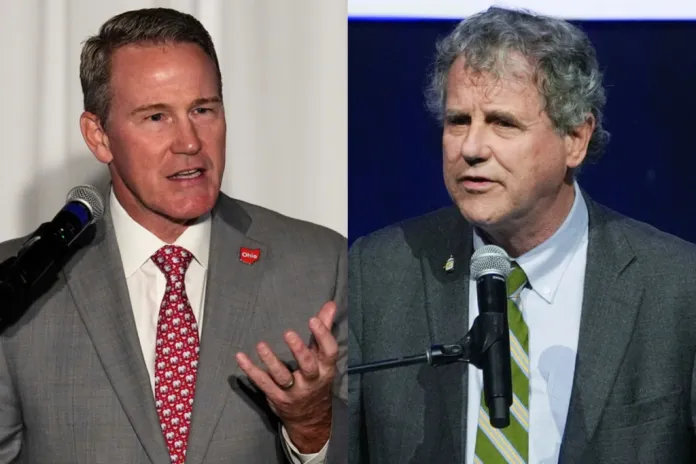
In Ohio, the battle for the U.S. Senate seat vacated by JD Vance has introduced a different political pressure point: the rapid development of artificial intelligence data centers. Democratic nominee Sherrod Brown is positioning himself as a vocal critic of the industry's influence on local infrastructure and energy prices. Brown characterizes the rapid expansion of these facilities as a rigging
of the system, arguing that out-of-state interests and incumbent Republican Sen. Jon Husted have fast-tracked projects without sufficient local input.
During a recent stop in Ironton, Brown emphasized the need for local autonomy, stating, The people in Lawrence County and Scioto County and Pike County should be making this decision.
Brown’s campaign has utilized advertisements to claim that data centers gobble up energy and cause electricity rates to rise for average residents.
Incumbent Jon Husted has defended his support for the data center industry by highlighting its potential for job creation and Ohio’s status as a regional tech hub. Husted has pointed to his participation in federal efforts, such as the White House roundtable regarding the Ratepayer Protection Pledge, to argue that he is working to safeguard Ohio families from rising energy costs. The contest, which the Cook Political Report recently moved to a toss-up, remains highly volatile. While polling shows a tight race, observers note that many voters remain undecided, and both campaigns appear to be operating with a degree of risk-aversion regarding media exposure as the November special election approaches.
Archypedia is dedicated to independent, evidence-backed reporting. This briefing was synthesized from primary source reporting, corroborated across independent newsrooms, and verified against our Editorial Standards.
Transparency record
Evidence behind this report
This report synthesizes 5 distinct sources. Open the source ledger below to compare the underlying coverage.
Prepared under the Archypedia Editorial Policy by the Mara Ionescu editorial desk profile. AI-assisted tools may support drafting and verification; public accountability remains with Archypedia. Report an error.

