Asteroid Donaldjohanson is Wobbly, Peanut-Shaped Object with Watery Past, Scientists Say – Sci.News
NASA’s Lucy spacecraft discovered that Asteroid Donaldjohanson is a wobbly, peanut-shaped object with a watery past, according to data released by NASA Science and reported by Sci.News. The double-lobed asteroid exhibits non-principal axis rotation, meaning it tumbles as it spins, providing new evidence regarding the chemical evolution and collision history of the early solar system.
What are the physical characteristics of Asteroid Donaldjohanson?
Data from the Lucy spacecraft reveals that Asteroid Donaldjohanson is not a sphere, but a “double-lobed” body. According to reports from Sky & Telescope and NASA Science, the object resembles a peanut, consisting of two distinct masses that have merged into a single entity. This structure suggests the asteroid is a “contact binary,” a result of two separate objects colliding at low velocity and sticking together rather than shattering.
The spacecraft’s flyby provided high-resolution imagery and spectroscopic data that allowed researchers to map the asteroid’s surface. Phys.org notes that the peanut shape is a critical indicator of the asteroid’s formation process, showing how small bodies in the outer solar system aggregated during the primordial stages of planetary development.
Key physical attributes identified by the mission include:
- Morphology: Double-lobed or “peanut-shaped” geometry.
- Rotational State: Non-principal axis rotation (tumbling).
- Composition: Presence of volatiles and hydrated minerals.
- Classification: Part of the Jupiter Trojan asteroid group.
Why does Asteroid Donaldjohanson wobble as it rotates?
Most asteroids rotate around a single, stable axis. However, Asteroid Donaldjohanson exhibits what scientists call “non-principal axis rotation.” According to Phys.org, this means the asteroid wobbles or tumbles as it moves through space, rather than spinning smoothly like a top.
This instability is often the result of external forces. NASA Science indicates that such tumbling can be caused by collisions with other space debris or the gravitational influence of larger nearby bodies. For a double-lobed object like Donaldjohanson, the uneven distribution of mass makes it more susceptible to these perturbations. The wobble provides a “fingerprint” of the asteroid’s kinetic history, allowing scientists to calculate the energy of past impacts that knocked it off its stable axis.
The complexity of this rotation presented a challenge for the Lucy mission’s imaging team. Because the asteroid was tumbling, the spacecraft had to account for a constantly shifting orientation to capture clear images of both lobes. This data helps researchers understand the internal strength of the asteroid; if it were a loose “rubble pile,” the tumbling forces might have caused it to break apart over millions of years.
How did scientists determine the asteroid had a “watery past”?
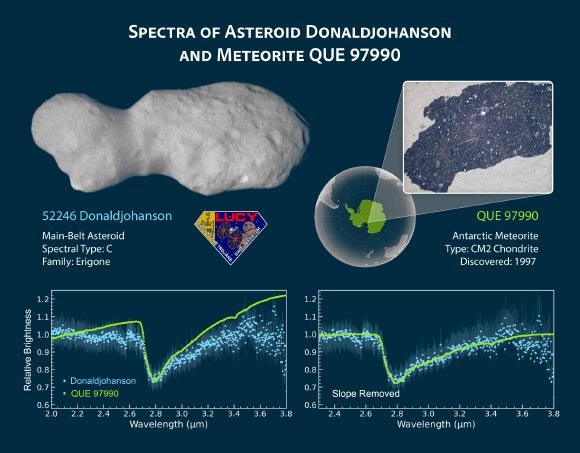
The claim that Asteroid Donaldjohanson has a “watery past” stems from spectroscopic analysis conducted during the flyby. According to Sci.News and NASA Science, the spacecraft detected signatures of hydrated minerals on the asteroid’s surface. These minerals contain hydroxyl (OH) groups or water molecules trapped within the crystal structure of the rock.

The presence of these minerals suggests that the asteroid formed in a region of the solar system where water ice was stable, or that it underwent a period of aqueous alteration. Aqueous alteration occurs when ice inside an asteroid melts—often due to the decay of radioactive isotopes like aluminum-26—and reacts with the surrounding rock to create hydrated minerals.
This finding is significant because it links the Jupiter Trojans to the volatile-rich materials found in the Kuiper Belt or the outer reaches of the asteroid belt. It suggests that Donaldjohanson is not just a dry piece of rock, but a remnant of a time when water was a primary driver of chemical change in the early solar system.
| Feature | Observation | Scientific Implication |
|---|---|---|
| Shape | Double-lobed (Peanut) | Low-velocity collision / Contact binary |
| Rotation | Wobbling / Tumbling | History of external impacts/perturbations |
| Chemistry | Hydrated Minerals | Early exposure to liquid water or ice |
| Origin | Jupiter Trojan | Possible migration from the outer solar system |
What is the significance of the Lucy mission’s flyby?
The flyby of Asteroid Donaldjohanson is a milestone for the Lucy mission, which is designed to explore the Jupiter Trojans. These asteroids share Jupiter’s orbit, clustering in two groups known as the L4 and L5 Lagrangian points. According to Space, these objects are considered “fossils” of the early solar system because they have remained relatively undisturbed for billions of years.
By studying Donaldjohanson, NASA aims to determine if the Trojans are indigenous to Jupiter’s orbit or if they were captured from elsewhere, such as the primordial disk that formed the giant planets. The discovery of water-bearing minerals on a “wobbly” peanut-shaped object suggests that these asteroids are chemically diverse. This supports the theory that the Trojan population is a mixture of objects from different regions of the early solar nebula.
The Lucy mission’s approach differs from previous asteroid missions like OSIRIS-REx or Psyche. Instead of orbiting a single body, Lucy performs a series of flybys. This allows the spacecraft to compare multiple asteroids across different groups, creating a broader map of how the solar system’s building blocks were distributed. This comparative approach is essential for understanding why some asteroids are dry and metallic while others, like Donaldjohanson, show evidence of a watery history.
How does Donaldjohanson compare to other known asteroids?
When compared to other double-lobed asteroids, such as 67P/Churyumov–Gerasimenko (visited by the Rosetta mission), Donaldjohanson shares a similar “contact binary” morphology. However, the rotational instability observed in Donaldjohanson is less common than the stable rotation seen in many larger asteroids. According to Phys.org, the tumbling state is more frequently observed in smaller, irregularly shaped bodies where the center of mass is significantly offset from the geometric center.

Furthermore, the “watery past” identified by Sci.News distinguishes Donaldjohanson from the S-type (stony) asteroids common in the inner belt, which are typically devoid of volatiles. Instead, its composition aligns more closely with C-type (carbonaceous) asteroids, which are known for their high carbon content and hydrated minerals. This contrast highlights the chemical gradient of the solar system, where water becomes more prevalent the further one moves from the Sun.
Researchers are now comparing the data from Donaldjohanson with upcoming targets in the Lucy mission’s itinerary. By analyzing whether other Trojans also exhibit tumbling or hydration, scientists can determine if Donaldjohanson is an anomaly or a representative sample of the Trojan population.
Common misconceptions about “watery” asteroids
A frequent misunderstanding regarding the “watery past” of asteroids is the idea that they once possessed oceans or liquid lakes on their surface. According to NASA Science, the “water” found on asteroids like Donaldjohanson is not in the form of open bodies of water. Instead, it exists as hydroxyl groups bound to minerals or as subsurface ice that reacted with rock.
Another misconception is that “wobbling” implies the asteroid is unstable and likely to break apart. In reality, non-principal axis rotation is a stable state of motion for many small bodies. While it indicates a chaotic history of collisions, it does not necessarily mean the object is currently disintegrating. The “peanut” shape is similarly stable; contact binaries are common in the solar system and can persist for billions of years without merging into a sphere or splitting apart.
Key distinctions in asteroid composition:
- Hydrated Minerals: Not liquid water, but chemical bonds involving hydrogen and oxygen within the rock.
- Tumbling: A complex rotational state, not a sign of imminent structural failure.
- Contact Binary: Two objects that touched and stayed, not a single object that stretched.
What are the next steps for the Lucy mission?
Following the encounter with Asteroid Donaldjohanson, the Lucy spacecraft continues its trajectory toward other Trojan asteroids. The data gathered from this flyby will be used to refine the instruments’ calibration for future targets. According to Space, the mission is designed to provide a comprehensive survey of the Trojan population, which may include dozens of individual objects over the next several years.
Scientists will continue to process the spectroscopic data to determine the exact ratio of hydrated minerals to anhydrous rocks. This will help refine models of the “snow line”—the distance from the Sun beyond which water ice could freeze—and how the movement of giant planets like Jupiter and Saturn pushed these ice-rich bodies into their current orbits.
The mission’s findings are expected to contribute to the broader understanding of how water was delivered to Earth. If Jupiter Trojans are rich in volatiles and were frequently knocked inward toward the inner solar system, they may have played a role in seeding the early Earth with the water and organic compounds necessary for life.
For more on the mechanics of asteroid movement, readers may find a related explainer on orbital resonance useful in understanding how the Trojans remain trapped in Jupiter’s gravity.
Frequently Asked Questions
What is a “double-lobed” asteroid?
A double-lobed asteroid, often called a contact binary, consists of two separate asteroid bodies that collided at very low speeds and fused together. This results in a shape that resembles a peanut or a dumbbell rather than a sphere.
Why is the “wobble” of Asteroid Donaldjohanson important?
The wobble, or non-principal axis rotation, tells scientists about the asteroid’s history of collisions. Because it doesn’t spin on a single axis, researchers can infer that external forces, such as impacts from other space rocks, have altered its rotation over time.

Does “watery past” mean there was once an ocean on the asteroid?
No. A “watery past” refers to the presence of hydrated minerals, where water molecules are chemically bound to the rock. This usually happens when internal ice melts and reacts with the mineral composition of the asteroid, not through the presence of surface oceans.
What is the Lucy mission’s primary goal?
The Lucy mission aims to explore the Jupiter Trojan asteroids to understand the origins of the solar system. By studying these “fossils,” NASA hopes to learn how the giant planets formed and migrated.
How did the Lucy spacecraft detect these features?
The spacecraft used a combination of high-resolution imaging to determine the peanut shape and rotation, and spectroscopy to analyze the light reflecting off the surface, which revealed the chemical signature of hydrated minerals.
