China’s CSST Space Telescope: The Next Giant Leap in Cosmic Discovery and Astrobiology
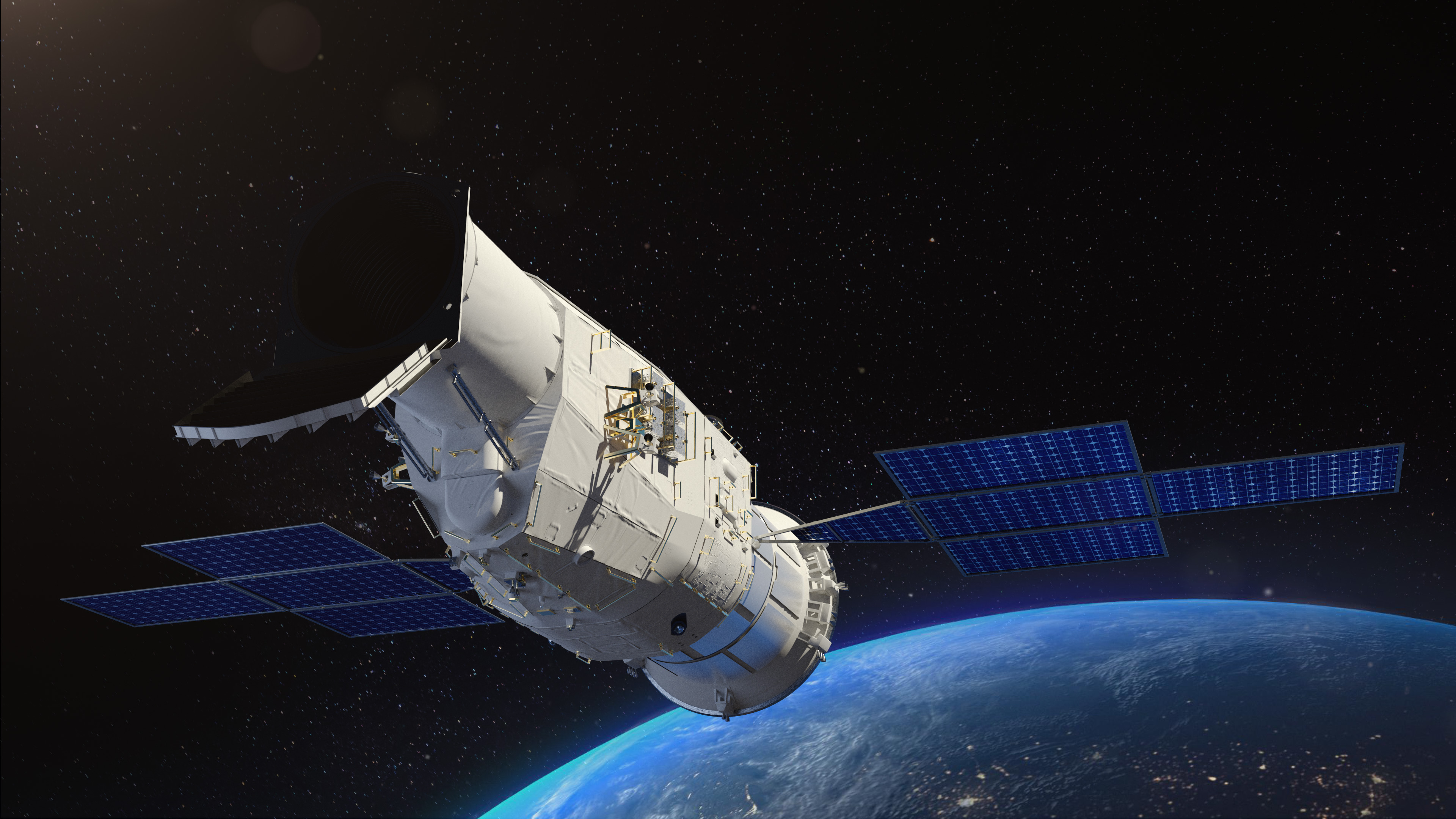
China’s upcoming Chinese Space Station Survey Telescope (CSST), set for launch in 2028, will be the world’s most advanced wide-field astronomical observatory—capable of mapping the universe with unprecedented precision and speed. Unlike previous space telescopes, the CSST will operate in tandem with China’s Tiangong space station, offering astronomers a 24/7 window into the cosmos while also advancing the search for habitable exoplanets and dark matter. With a field of view 300 times wider than the Hubble Space Telescope, the CSST is poised to redefine our understanding of cosmic evolution, galaxy formation, and the potential for life beyond Earth.
Officially approved in 2021 and currently under development by the Chinese Academy of Sciences (CAS), the CSST will be positioned at the L2 Lagrange point—1.5 million kilometers from Earth—where gravitational forces allow it to maintain a stable orbit while minimizing interference from Earth’s atmosphere. Its primary mission spans four key scientific goals: dark matter and dark energy research, galaxy formation and evolution, solar system exploration, and the search for Earth-like exoplanets. According to the CAS, the telescope’s 2-meter primary mirror and 4.2-billion-pixel camera will generate a staggering 5 petabytes of data annually, making it one of the most data-intensive astronomical projects in history.
What sets the CSST apart from other major telescopes like the James Webb Space Telescope (JWST) or the Vera C. Rubin Observatory is its unique integration with China’s Tiangong space station. While the JWST operates independently, the CSST will benefit from the station’s crewed missions, allowing for real-time adjustments, maintenance, and even potential upgrades—something no other space telescope has achieved. This synergy could extend the CSST’s operational lifespan far beyond the 5–10-year design life of most observatories.
For astrobiologists, the CSST’s most exciting capability may be its ability to detect and characterize exoplanets in the habitable zones of nearby stars. Using a technique called transit photometry, the telescope will monitor the brightness of thousands of stars, identifying dips that suggest the presence of orbiting planets. While it won’t directly image these worlds, it will provide critical data on their sizes, orbits, and potential atmospheres—laying the groundwork for future missions like China’s planned Earth 2.0 telescope, which aims to capture direct images of Earth-like exoplanets.
Yet the CSST’s ambitions extend far beyond exoplanets. Its surveys will map the distribution of dark matter in the universe, a mysterious substance that makes up roughly 27% of the cosmos but has never been directly observed. By studying gravitational lensing—the bending of light around massive objects—the CSST could help scientists refine their models of dark matter’s behavior, potentially unlocking clues about its true nature.
With international collaboration limited by geopolitical tensions, the CSST represents China’s boldest standalone contribution to global astronomy in decades. While NASA’s JWST relies on partnerships with the European Space Agency (ESA) and Canadian Space Agency, the CSST is primarily a Chinese-led endeavor, with data access initially restricted to domestic researchers before being shared with the international community after a proprietary period.
—
###
How Will the CSST Compare to Other Major Space Telescopes?
The CSST’s design reflects a deliberate choice to prioritize wide-field survey capabilities over the deep, narrow-field imaging of telescopes like the JWST. While the JWST can peer into the earliest galaxies with infrared precision, the CSST will scan vast swaths of the sky in visible and near-ultraviolet light, creating a dynamic, time-sensitive map of the universe.
| Telescope | Primary Mirror | Field of View | Key Mission | Launch Date |
|---|---|---|---|---|
| Hubble Space Telescope | 2.4 meters | Small (deep-field focus) | Ultraviolet and visible light imaging | 1990 |
| James Webb Space Telescope (JWST) | 6.5 meters | Narrow (deep infrared focus) | First light of the universe, exoplanet atmospheres | 2021 |
| Vera C. Rubin Observatory (LSST) | 8.4 meters | Ultra-wide (10-square-degree field) | Dark matter mapping, near-Earth objects | 2025 |
| Chinese Space Station Survey Telescope (CSST) | 2 meters | 300x wider than Hubble | Galaxy evolution, dark matter, exoplanets | 2028 (planned) |
One key advantage of the CSST is its synergy with China’s Tiangong space station. While the JWST and Hubble operate independently, the CSST will be serviced by astronauts aboard Tiangong, allowing for repairs, upgrades, and even the potential deployment of secondary instruments. This could extend its operational life well beyond the 5–10 years typical for uncrewed observatories.
However, the CSST’s visible and near-ultraviolet wavelength focus means it won’t match the JWST’s infrared capabilities for studying the earliest galaxies or the atmospheres of distant exoplanets. Instead, it will complement these telescopes by providing a broader, more dynamic view of the universe—similar to how the Vera C. Rubin Observatory’s Legacy Survey of Space and Time (LSST) will operate.
Key Point: The CSST is not a replacement for the JWST but a complementary tool, designed to fill gaps in wide-field survey astronomy while advancing China’s independent space science capabilities.
—
###
Why Does the CSST Matter for Astrobiology and the Search for Life?
For astrobiologists, the CSST’s most critical contribution may be its role in identifying potentially habitable exoplanets. Using transit photometry, the telescope will monitor the brightness of millions of stars, detecting the tiny dips in light that indicate a planet passing in front of its host star. While it won’t confirm the presence of life, it will provide precise measurements of a planet’s size, orbit, and potential atmosphere—critical data for future missions.
According to Dr. Li Ran, chief scientist of the CSST project at the National Astronomical Observatory of China (NAOC), the telescope will focus on stars within 1,000 light-years of Earth, prioritizing those similar to the Sun. “We expect to discover thousands of exoplanets, including a significant number in the habitable zone,” Li told state media in 2022. “This will be a goldmine for follow-up studies with more powerful telescopes.”
The CSST’s data will also feed into China’s broader Earth 2.0 initiative—a planned mission to directly image Earth-like exoplanets using a dedicated space telescope in the 2030s. By narrowing down the most promising candidates, the CSST will help prioritize targets for this next-generation observatory.
Beyond exoplanets, the CSST’s surveys will probe the chemical composition of galaxies, helping scientists understand how elements like carbon, oxygen, and nitrogen—essential for life—are distributed across the universe. This could provide insights into the building blocks of life and how they evolve over cosmic time.
Expert Insight: “The CSST will be particularly valuable for studying the Milky Way’s structure and the distribution of dark matter,” says Dr. Xue Suijian, a professor at the University of Science and Technology of China. “Its wide-field capabilities will allow us to trace the universe’s large-scale structure with unprecedented detail, which is crucial for testing theories of dark energy.”
—
###
China’s Space Station Telescope: A Geopolitical and Scientific Milestone
The CSST is more than just a scientific instrument—it’s a symbol of China’s growing ambition in space. While the U.S. and its allies dominate deep-space astronomy with the JWST and upcoming missions like the Nancy Grace Roman Space Telescope, China has been rapidly expanding its independent capabilities. The CSST’s development reflects a broader strategy to reduce reliance on foreign partnerships, particularly in light of geopolitical tensions.
Unlike the International Space Station (ISS), which is a collaborative effort, China’s Tiangong space station is entirely its own. The CSST’s integration with Tiangong underscores this independence, allowing China to conduct long-duration astronomical observations without depending on other nations. This self-sufficiency extends to data access: while international researchers will eventually gain access to CSST data, an initial proprietary period will give Chinese scientists a head start in analysis.
Yet the CSST’s success will depend on overcoming significant technical challenges. The telescope’s 24/7 observation capability—enabled by its position at the L2 Lagrange point—requires precise thermal management to prevent instrument degradation. Additionally, the sheer volume of data (5 petabytes per year) will demand advanced computational infrastructure, which China is currently building through its Sky Eye supercomputing initiative.
Political Context: The CSST’s development has drawn mixed reactions from the international scientific community. While some researchers welcome the opportunity for broader collaboration, others note that restrictions on data access during the early years may limit its immediate global impact. “The CSST is a remarkable achievement, but the lack of early international access is a missed opportunity for collaborative science,” said Dr. Sara Seager, an exoplanet expert at MIT, in a 2023 interview.
China has responded by emphasizing its commitment to open science after the proprietary period. The NAOC has stated that data will be released to the global community within five years of the telescope’s launch, aligning with practices at other major observatories.
—
###
What Are the Biggest Scientific Questions the CSST Will Address?
The CSST’s four primary science goals reflect some of the most pressing questions in modern astronomy. Here’s how it will tackle them:
- Dark Matter and Dark Energy:
The CSST will map the distribution of dark matter by studying gravitational lensing—the distortion of light from distant galaxies by massive objects like galaxy clusters. By comparing these observations with theoretical models, scientists hope to refine their understanding of dark matter’s properties and its role in the universe’s expansion. - Galaxy Formation and Evolution:
With its wide-field surveys, the CSST will track how galaxies change over time, from their early formation to their modern structures. This will help astronomers test theories about how supermassive black holes influence galaxy growth and how mergers between galaxies drive star formation. - Exoplanets and the Search for Life:
By monitoring the brightness of stars, the CSST will detect thousands of exoplanets, including those in the habitable zone. While it won’t confirm biosignatures, it will provide critical data for future missions aiming to directly image these worlds. - Solar System Exploration:
The telescope will also study objects within our own solar system, including near-Earth asteroids, comets, and the outer planets. Its surveys could reveal new details about the Kuiper Belt and the Oort Cloud, shedding light on the solar system’s formation.
Key Challenge: The CSST’s data will be so vast that analyzing it will require new machine-learning techniques. Chinese researchers are already developing algorithms to automatically classify galaxies, detect exoplanets, and identify transient events like supernovae.
—
###
What’s Next for the CSST and China’s Space Program?
The CSST remains on track for a 2028 launch, though exact timelines depend on the success of China’s upcoming Long March 5 rocket missions. Once operational, it will join a new generation of space telescopes, including the Euclid Space Telescope (ESA, 2023) and the Nancy Grace Roman Space Telescope (NASA, 2027), in reshaping our understanding of the cosmos.
For astrobiologists, the CSST’s most immediate impact will be in identifying exoplanet candidates for follow-up studies. NASA’s JWST has already begun analyzing the atmospheres of known exoplanets, but the CSST will provide the initial targets—potentially accelerating the search for signs of life.

China’s space ambitions don’t stop with the CSST. The country has outlined plans for a lunar research station in the 2030s and a Mars sample-return mission by 2030. The CSST’s success could pave the way for even more ambitious projects, including a space-based solar observatory to study the Sun’s activity in real time.
One question looms large: Will the CSST’s data be fully opened to international researchers? While China has pledged to share data after an initial period, the lack of early access could limit its immediate global impact. If restrictions persist, it may create a divide in astronomical research, with Chinese scientists gaining a first-mover advantage in analyzing the CSST’s discoveries.
For now, the CSST stands as a testament to China’s growing influence in space science—a project that could redefine our cosmic horizons.
—
###
Frequently Asked Questions About the Chinese Space Station Survey Telescope
Q: How does the CSST differ from the James Webb Space Telescope?
A: The CSST focuses on wide-field surveys in visible and near-ultraviolet light, while the JWST specializes in deep infrared imaging. The CSST will map vast areas of the sky quickly, whereas the JWST studies specific targets in extreme detail. The CSST also benefits from servicing by China’s Tiangong space station, potentially extending its lifespan.
Q: Will the CSST help find alien life?
A: Not directly. The CSST will identify exoplanets in habitable zones and study their atmospheres indirectly, but it won’t detect biosignatures like the JWST can. Future missions, such as China’s Earth 2.0 telescope, will build on the CSST’s discoveries to search for signs of life.
Q: How much will the CSST cost, and who is funding it?
A: The total cost is estimated at $1.5 billion USD, funded primarily by China’s Ministry of Science and Technology and the Chinese Academy of Sciences. Development is led by the National Astronomical Observatory of China (NAOC) in collaboration with universities and aerospace firms.
Q: When will the CSST’s data be available to international researchers?
A: China has stated that data will be released to the global community within five years of launch, though an initial proprietary period will allow Chinese scientists to publish first findings. This timeline aligns with practices at other major observatories like the Vera C. Rubin Observatory.
Q: Can the CSST observe Earth or other planets in our solar system?
A: Yes. While its primary mission is deep-space astronomy, the CSST will also study near-Earth asteroids, comets, and the outer planets. Its wide-field surveys could reveal new details about the Kuiper Belt and the Oort Cloud, enhancing our understanding of the solar system’s formation.
Q: How does the CSST avoid Earth’s atmospheric interference?
A: The CSST will be positioned at the L2 Lagrange point, 1.5 million kilometers from Earth, where gravitational forces allow it to maintain a stable orbit. This location minimizes atmospheric distortion and provides a continuous view of the cosmos, similar to the JWST’s position at L2.
Q: What happens if the CSST fails or malfunctions?
A: Unlike the Hubble Space Telescope, which was serviced by Space Shuttle missions, the CSST will rely on robotic repairs and potential astronaut servicing from China’s Tiangong space station. If a critical failure occurs, China may attempt to deploy a repair mission, though the telescope’s remote location makes this more challenging than for Earth-orbiting observatories.
