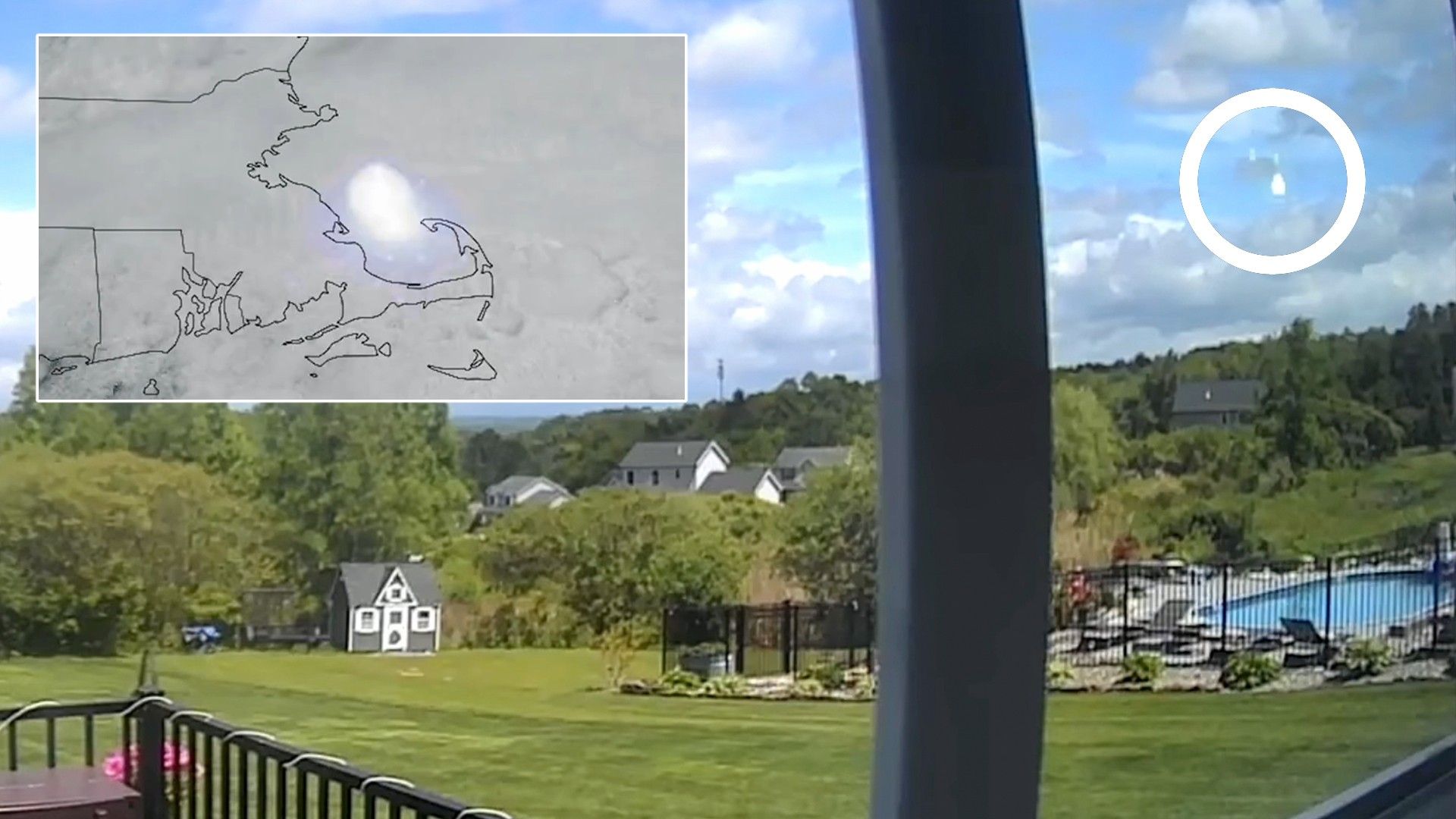
Massive Boom Over Northeastern US Confirmed as Meteor Explosion With Energy of 300 Tons of TNT
Residents across the northeastern United States, particularly in Massachusetts, were recently startled by a series of powerful sonic booms and physical vibrations that rattled windows and sparked widespread alarm. Following an investigation into the atmospheric disturbance, NASA has confirmed that the cause was a massive meteor explosion. The energy released during the event was estimated to be as powerful as 300 tons of TNT, transforming a piece of space debris into a high-energy atmospheric event.
The incident, which centered over Massachusetts and extended its impact toward Cape Cod, serves as a vivid reminder of the constant interaction between Earth’s atmosphere and the remnants of the early solar system. While such events are relatively common in a cosmic sense, the sheer scale of the energy release in this instance—equivalent to hundreds of tons of explosives—highlights the volatility of Near-Earth Objects (NEOs) as they enter the terrestrial environment.
The Event: A Shockwave Across the Northeast
The event began with a sudden, blinding flash of light as a meteorite entered the Earth’s atmosphere at hypersonic speeds. For many observers in the northeastern US, the visual spectacle was quickly followed by a physical sensation. Reports from the region describe a “massive boom” that was felt as much as it was heard, with some residents describing a distinct vibration that shook their homes.
Footage captured during the event shows the meteorite streaking across the sky, leaving a luminous trail before disintegrating in a violent burst of energy. This process, known as a bolide explosion, occurs when the pressure building up in front of the falling object exceeds the structural strength of the rock, causing it to fragment instantaneously and release a massive shockwave.
Key details of the event include:
- Primary Location: Massachusetts and the surrounding northeastern US region.
- Physical Impact: Loud sonic booms and ground-level vibrations reported by residents.
- Energy Release: Confirmed by NASA to be equivalent to 300 tons of TNT.
- Landing Zone: Current NASA updates suggest the remnants may have landed in the Cape Cod area.
“I felt a vibration,” noted one resident describing the moment the meteor exploded over Massachusetts, illustrating the physical intensity of the atmospheric shockwave.
Understanding the Power: What Does “300 Tons of TNT” Actually Mean?
When NASA describes an explosion in terms of “tons of TNT,” they are referring to the energy yield of the event. Here’s a standard measurement used by scientists to quantify the energy released by explosions, whether they are chemical, nuclear, or kinetic (as in the case of a meteor).
Kinetic Energy and Atmospheric Friction
A meteor does not contain explosive chemicals; rather, its “explosive” power comes from kinetic energy. Kinetic energy is the energy an object possesses due to its motion, calculated based on its mass and its velocity squared ($KE = frac{1}{2}mv^2$). Because meteors enter the atmosphere at speeds ranging from 11 to 72 kilometers per second, even a relatively compact object carries an immense amount of energy.
As the meteorite hits the denser layers of the atmosphere, it compresses the air in front of it. This creates a “bow shock” of extremely hot plasma. The friction and pressure generate intense heat, causing the outer layers of the rock to melt and vaporize (ablation). However, if the object is large enough or moving fast enough, the pressure becomes so great that the rock can no longer hold itself together, leading to a catastrophic fragmentation.
The Mechanics of a Bolide Explosion
The “boom” heard by residents is the result of this fragmentation. When the meteor shatters, its surface area increases exponentially in a fraction of a second. This causes a sudden, massive transfer of kinetic energy into the surrounding air, creating a supersonic shockwave. This is effectively a massive sonic boom that can travel for miles, rattling windows and shaking the ground long after the visual flash has disappeared.
To put 300 tons of TNT into perspective, this is significantly more powerful than most conventional industrial explosions, though it is smaller than the energy released by large-scale tectonic events or strategic weaponry. Nevertheless, for an atmospheric event occurring over a populated area, it is a substantial release of energy.
Tracking the Impact: From Atmosphere to Cape Cod
Following the explosion, the primary goal for NASA and other scientific bodies is to locate the fragments that survived the descent. Not all of the meteor vaporizes during the explosion; some pieces, known as meteorites, manage to reach the surface.
The Hunt for the Meteorite
NASA has provided updates indicating that the trajectory of the meteorite suggests it may have landed in the vicinity of Cape Cod. Locating these fragments is a complex process that involves several steps:
- Triangulation: Using security camera footage, dashcam videos and witness reports to establish multiple lines of sight to the object.
- Trajectory Modeling: Calculating the angle of entry and the point of fragmentation to predict the “strewn field”—the area where fragments are likely to have fallen.
- Field Recovery: Searching the predicted landing zone for scorched rocks or metallic fragments that differ from local geology.
Finding the meteorite is critical because these rocks act as “time capsules,” containing chemical signatures from the early formation of the solar system. Analyzing the composition of the Cape Cod fragments can tell scientists whether the object was a stony meteorite, an iron-nickel alloy, or a rare combination of both.
| Stage of Event | Physical Phenomenon | Human Perception |
|---|---|---|
| Atmospheric Entry | Ablation and Plasma Formation | Blinding flash of light / “Fireball” |
| Fragmentation | Kinetic Energy Release (300 tons TNT) | Massive boom / Shockwave |
| Descent | Terminal Velocity Fall | Falling debris / Meteorite landing |
The Science of Near-Earth Objects (NEOs)
To understand why this event occurred, it is helpful to distinguish between the different terms used to describe these space rocks. While often used interchangeably in casual conversation, they refer to different stages of the same journey.
Meteoroids vs. Meteors vs. Meteorites
- Meteoroid: A small rocky or metallic body traveling through outer space. They can range in size from a grain of dust to small asteroids.
- Meteor: The streak of light seen when a meteoroid enters the atmosphere and vaporizes. This is the “shooting star” phenomenon.
- Meteorite: The fragment of a meteoroid that survives the atmospheric passage and actually strikes the Earth’s surface.
Why Some Meteors Explode and Others Reach the Ground
Whether a space rock survives to become a meteorite depends on three main factors: composition, size, and angle of entry.

A fragile, “rubble-pile” asteroid is more likely to explode high in the atmosphere, creating a loud boom but leaving no fragments. A solid iron-nickel meteorite is much more likely to survive the heat and pressure, potentially causing a localized impact crater. The Massachusetts event was a middle-ground scenario: the object was sturdy enough to penetrate deep into the atmosphere but succumbed to pressure, resulting in a high-energy explosion that still left potential fragments for recovery near Cape Cod.
For those interested in how these objects are tracked before they enter the atmosphere, a related explainer on Near-Earth Object detection provides more detail on the radar and optical surveys used by astronomers.
NASA’s Role in Monitoring and Planetary Defense
The confirmation of the 300-ton TNT energy yield is a result of NASA’s ongoing efforts to monitor the skies. While this specific meteor was likely too small to be detected before entry, the agency maintains a robust infrastructure for “Planetary Defense.”
NASA’s planetary defense strategy focuses on two primary goals: Detection and Mitigation.
Detection and Tracking
NASA uses a network of ground-based telescopes and space-based sensors to catalog asteroids and comets. By tracking the orbits of these objects, scientists can predict potential collisions years or even decades in advance. The goal is to eliminate “blind spots” in our cosmic neighborhood, particularly those objects coming from the direction of the sun, which are harder to spot.
Mitigation Strategies
In the event that a significantly larger object—one far more powerful than 300 tons of TNT—is found to be on a collision course with Earth, NASA explores various mitigation techniques. One such method is the “kinetic impactor” approach, where a spacecraft is crashed into an asteroid to slightly nudge its orbit, ensuring it misses Earth entirely.
Events like the Massachusetts meteor explosion provide valuable “real-world” data. By studying the shockwave patterns and the energy release of smaller bolides, NASA can better model how larger objects would behave upon atmospheric entry, improving our ability to protect the planet from more significant threats.
Common Misconceptions About Meteor Explosions
When news of a “massive boom” and “TNT equivalence” breaks, several common myths often circulate. It is important to clarify the science behind these events to avoid unnecessary alarm.
Myth 1: The meteor “exploded” like a bomb
Many people assume there was a chemical explosion. In reality, it was a mechanical failure. The “explosion” is actually the result of extreme pressure and heat causing the rock to shatter. There is no combustion in the traditional sense; it is the conversion of motion (kinetic energy) into sound and heat.
Myth 2: All sonic booms mean a crash is imminent
A sonic boom occurs because the object is traveling faster than the speed of sound. While a boom often accompanies a meteorite, it does not always mean a large piece of rock hit the ground. In many cases, the object is completely vaporized during the explosion, and the boom is simply the “ghost” of the energy released in the upper atmosphere.
Myth 3: This was a man-made object or “space junk”
While satellites and rocket stages do re-enter the atmosphere and can create loud booms, NASA’s confirmation of this as a “meteor explosion” indicates that the object was of natural origin. Space debris typically has a different thermal signature and fragmentation pattern than a solid piece of asteroid or cometary material.
Frequently Asked Questions
Was anyone injured during the meteor explosion over Massachusetts?
While the reports mention loud booms and vibrations that shook buildings, there have been no official reports of widespread injuries or structural damage. The primary impact was acoustic and vibrational.

How can I tell if I found a piece of the meteorite?
Meteorites often look like ordinary rocks but have a few distinguishing features: they are typically heavier than Earth rocks (due to iron content), have a “fusion crust” (a thin, dark, glassy coating from atmospheric heating), and are often magnetic. If you suspect you have found a fragment, it is best to contact a local university or museum.
Why didn’t NASA warn us before the meteor hit?
Small meteors, like the one that caused the boom over the northeastern US, are often too small to be detected by telescopes before they enter the atmosphere. They are essentially “stealth” objects that only become visible once they begin to burn up upon entry.
Is a 300-ton TNT explosion dangerous?
The danger depends entirely on the altitude of the explosion. Because this meteor exploded high in the atmosphere, the energy was dissipated over a wide area, resulting in sound and vibrations rather than a devastating ground impact. Had it exploded at ground level, the damage would have been significant.
Where exactly did the meteorite land?
NASA’s current updates suggest the landing area is in the vicinity of Cape Cod, though a precise “ground zero” is still being determined through trajectory analysis and field searches.
The event serves as a powerful reminder of the dynamic nature of our solar system. While the sonic booms over Massachusetts were startling, they provide a rare opportunity for scientists to study the composition of the cosmos and refine the systems designed to keep Earth safe from larger celestial threats. As recovery efforts continue near Cape Cod, the scientific community hopes to secure fragments that could unlock secrets of the early universe.
