
Misophonia Sufferer Says ‘Noises Make Me So Angry’: Understanding the Science of Sound Sensitivity
For most people, the sound of someone chewing, a pen clicking, or a heavy breather is merely a background nuisance—something to be ignored or perhaps found slightly annoying. However, for a growing number of individuals, these everyday sounds trigger an immediate, intense, and often uncontrollable surge of rage, anxiety, or disgust. This visceral reaction is the hallmark of misophonia, a condition that transforms ordinary auditory stimuli into emotional catalysts. When a misophonia sufferer says “noises make me so angry,” they are not describing a lack of patience or a mood swing; they are describing a neurophysiological response that can derail their professional life, strain their most intimate relationships, and lead to profound social isolation.
The public conversation surrounding this condition has intensified as more people share their experiences, highlighting a significant gap between the lived reality of the disorder and its current status in official medical diagnostic manuals. While not yet formally classified as a distinct psychiatric disorder in the most widely used clinical guides, the impact of misophonia is undeniable, manifesting as a “fight-or-flight” response to sounds that others perceive as harmless.
Defining Misophonia: More Than Just a Dislike of Sound
Misophonia, literally translating to “hatred of sound,” is a disorder characterized by a decreased tolerance to specific sounds. Unlike hyperacusis, where sounds are perceived as physically too loud or painful, misophonia is about the emotional response to the sound. The noise itself may be soft—such as the ticking of a clock or the sound of someone swallowing—but the brain’s reaction is disproportionately powerful.
Those affected often describe the experience as an “instant trigger.” The moment the sound occurs, the individual may feel an overwhelming urge to leave the room, a sudden spike in heart rate, or an intense flash of anger directed at the source of the noise. This is not a conscious choice; it is an involuntary reaction of the nervous system.
The Distinction Between Misophonia and Other Auditory Issues
To understand why misophonia is so debilitating, it is essential to distinguish it from other sound-related conditions. Many people confuse these three, but they are biologically and psychologically distinct:
| Condition | Primary Characteristic | Emotional Response | Physical Sensation |
|---|---|---|---|
| Misophonia | Specific “trigger” sounds (e.g., chewing) | Intense anger, rage, or disgust | Fight-or-flight activation |
| Hyperacusis | General sensitivity to volume | Irritation or distress | Physical pain or ear discomfort |
| Phonophobia | Fear of loud sounds | Anxiety or panic | Fear of potential harm/damage |
Common Triggers and the Anatomy of a Reaction
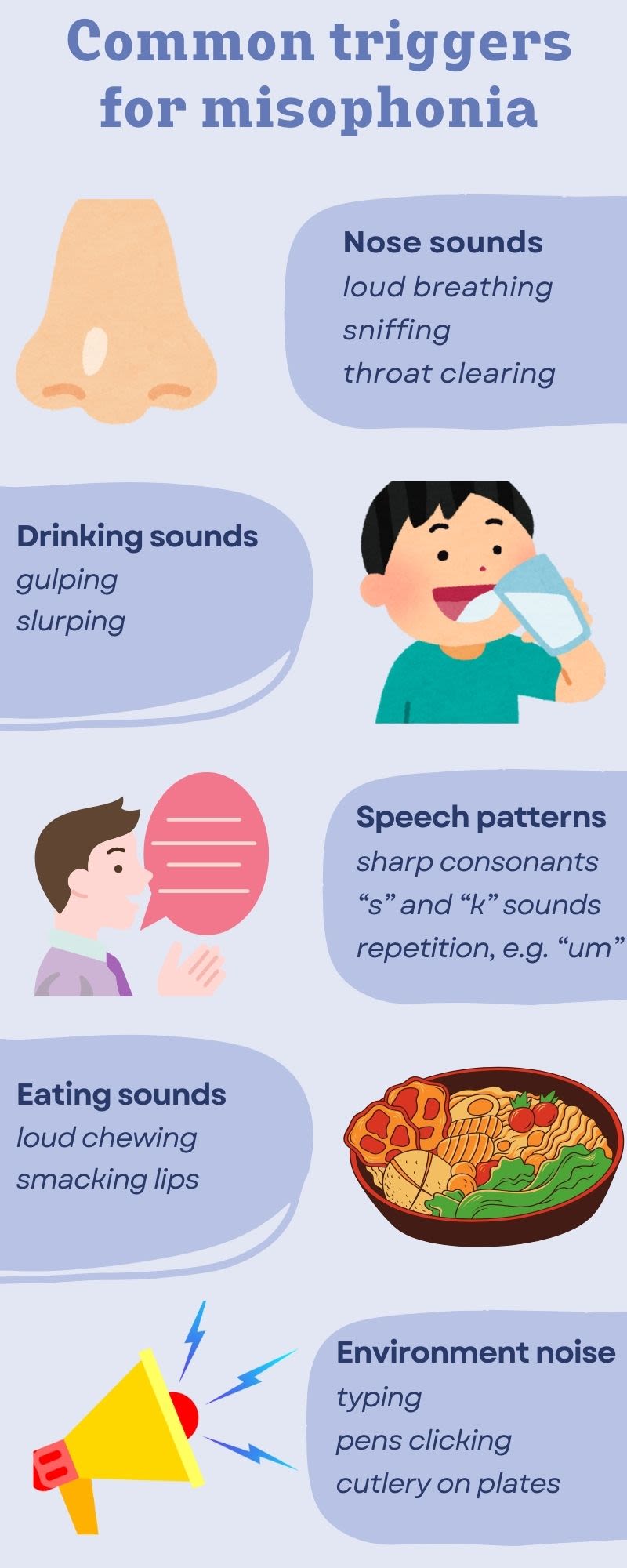
While every individual with misophonia has a unique set of triggers, most sounds fall into a few primary categories. These triggers are often repetitive or produced by other humans, which adds a layer of social complexity to the disorder.
Oral and Nasal Sounds
The most common triggers are associated with the mouth and nose. These include:
- Eating sounds: Chewing, crunching, slurping, or the sound of cutlery hitting a plate.
- Respiratory sounds: Heavy breathing, sniffing, coughing, or whistling through the nose.
- Oral habits: Lip smacking or the sound of someone swallowing.
Environmental and Repetitive Sounds
Beyond human biology, certain mechanical or behavioral sounds can be equally triggering:
- Repetitive motions: Pen clicking, finger tapping, or foot shaking.
- Environmental drones: The hum of a fluorescent light or the rhythmic ticking of a wall clock.
- Specific textures: The sound of scratching or rubbing certain materials.
The “Trigger-Response” Cycle
When a sufferer encounters a trigger, the brain does not process the sound through the normal auditory pathway alone. Instead, there is evidence of an over-connectivity between the auditory cortex and the parts of the brain responsible for emotion and the autonomic nervous system, such as the amygdala. This causes the brain to perceive a harmless sound as a direct threat, triggering an immediate physiological response: increased cortisol levels, rapid heartbeat, and a surge of adrenaline.
The emotional volatility associated with misophonia is not a behavioral choice but a neurological reflex. The “anger” reported by sufferers is the result of the brain’s survival mechanism being activated by a non-threatening stimulus.
The Psychological and Social Toll of Sound Sensitivity
The most challenging aspect of misophonia is often not the sound itself, but the social consequences of the reaction. Because the triggers are often produced by loved ones—spouses, parents, or children—the disorder can create a cycle of guilt and resentment.
The Strain on Intimate Relationships
Imagine sitting at dinner with a partner and feeling an uncontrollable surge of rage because of the way they chew. The sufferer often feels a deep sense of shame for their reaction, knowing that the other person is doing nothing “wrong.” However, the intensity of the anger can lead to outbursts or a sudden need to withdraw, which the partner may interpret as coldness, irritability, or a lack of affection.
Social Isolation and Avoidance
To survive in a world filled with triggers, many people with misophonia develop complex avoidance strategies. This might include:
- Avoiding social gatherings: Skipping dinners, parties, or meetings where triggers are likely.
- Strategic seating: Positioning themselves near exits or away from known “noisy” individuals.
- Constant use of hearing protection: Relying on earplugs or noise-canceling headphones even in safe environments.
Over time, these coping mechanisms can lead to severe social isolation. The world begins to feel like a minefield of potential triggers, leading to chronic anxiety and, in some cases, depression.
Impact on Professional Life
In an open-office environment, misophonia can be a significant barrier to productivity. The sound of a colleague typing, humming, or breathing can make it impossible for a sufferer to concentrate. This often leads to “presenteeism,” where the employee is physically present but mentally exhausted from the effort of suppressing their emotional response to the environment.
The Gap in Clinical Recognition
Despite the profound impact on quality of life, misophonia remains in a clinical gray area. It is not currently listed as a standalone diagnosable condition in the DSM-5-TR (Diagnostic and Statistical Manual of Mental Disorders) or the ICD-11 (International Classification of Diseases). This lack of official recognition creates several hurdles for patients:
- Difficulty in Diagnosis: Many patients spend years believing they are “crazy” or “irritable” before discovering the term misophonia.
- Lack of Insurance Coverage: Without a formal ICD code, it can be difficult to get insurance to cover specialized therapies.
- Medical Dismissal: Some healthcare providers may dismiss the condition as simple “pickiness” or a symptom of general anxiety, overlooking the specific neurophysiological nature of the disorder.
However, research is evolving. The consensus in the scientific community is moving toward recognizing misophonia as a distinct perceptual processing difference. Understanding that this is a brain-based response rather than a behavioral flaw is the first step toward effective management.
Management and Coping Strategies
While there is currently no “cure” for misophonia, there are various strategies to manage the intensity of the reactions and improve daily functioning. A combination of environmental control, technological aids, and psychological therapy typically yields the best results.
Environmental and Technological Interventions
Controlling the auditory environment is the most immediate way to reduce stress.
- Active Noise Cancellation (ANC): High-quality noise-canceling headphones can filter out consistent background drones, reducing the overall sensory load on the brain.
- White Noise Machines: Using “sound masking” (such as white, pink, or brown noise) can help blend trigger sounds into the background, making them less prominent.
- Earplugs: High-fidelity earplugs that lower decibel levels without muffling sound can be useful in public spaces.
Psychological and Behavioral Approaches
Since misophonia involves a conditioned emotional response, certain therapies can help “rewire” the brain’s reaction to triggers.
- Cognitive Behavioral Therapy (CBT): CBT can help individuals identify the thought patterns that amplify their anger and develop healthier coping mechanisms to manage the emotional surge.
- Exposure and Response Prevention (ERP): In some controlled settings, gradual exposure to triggers combined with positive reinforcement can reduce the intensity of the reaction.
- Mindfulness and Grounding: Techniques that focus the mind on the present moment can help a sufferer “ride out” the wave of anger without reacting impulsively.
Communication and Boundary Setting
Education is a powerful tool for those with misophonia. By explaining the condition to partners, family, and employers, sufferers can move from a place of “hidden struggle” to “supported management.”
Effective communication strategies include:
- Using “I” statements: “I am feeling overwhelmed by the sound right now; I need to step away for five minutes to calm down,” rather than “You are chewing too loudly.”
- Establishing “Safe Zones”: Designating certain areas of the home or office as trigger-free zones.
- Creating a Signal: Agreeing on a non-verbal signal (like a hand gesture) to let a partner know a trigger is occurring without causing a scene.
Common Misconceptions About Misophonia
Because the symptoms of misophonia are emotional, it is often misunderstood by those who do not experience it. Correcting these myths is essential for the mental health of the sufferer.
Myth 1: “You’re just being dramatic/sensitive.”
Reality: The reaction is a physiological event. Brain imaging has shown that people with misophonia have different activations in the anterior insular cortex—a region associated with emotional processing—when exposed to trigger sounds. It is not a choice; it is a biological response.
Myth 2: “If you just ignore it, it will go away.”
Reality: For someone with misophonia, the brain is hyper-focused on the trigger. Attempting to ignore the sound often increases the internal tension and leads to a more explosive emotional release later.
Myth 3: “It’s just another form of OCD or Anxiety.”
Reality: While misophonia can co-occur with OCD or anxiety, it is a distinct auditory processing issue. An anxious person may be on edge generally; a person with misophonia can be perfectly calm until a specific sound triggers a sudden, acute state of rage.
Frequently Asked Questions
What is the most common trigger for misophonia?
While triggers vary, oral sounds—such as chewing, slurping, and lip-smacking—are reported most frequently. Other common triggers include repetitive noises like pen clicking or heavy breathing.
Can misophonia be cured?
Currently, there is no known cure that completely removes the sensitivity. However, many people successfully manage their symptoms through a combination of noise-masking technology, cognitive behavioral therapy, and environmental adjustments.
Is misophonia hereditary?
There is evidence suggesting a genetic component, as it often runs in families. However, the exact cause is still being studied, and it is believed to be a combination of neurological predisposition and environmental factors.
How do I explain misophonia to someone who doesn’t have it?
Use analogies. Explain that for you, a specific sound is not just “annoying” but feels like a physical alarm bell going off in your brain, triggering an automatic “fight-or-flight” response that you cannot simply switch off.
Does misophonia get worse with age?
Onset typically occurs in childhood or adolescence. For some, the sensitivity may fluctuate or improve over time; for others, it remains constant. Stress and fatigue often exacerbate the intensity of the reactions.
Living with misophonia requires a constant balancing act between managing one’s internal emotional state and navigating an external world that is rarely quiet. By shifting the narrative from “irritability” to “neurological sensitivity,” sufferers can find the tools and the support necessary to lead fulfilling lives, turning the volume down on the anger and increasing the volume on understanding and empathy. For those seeking more information on auditory health, a related explainer on sensory processing disorders may provide further context on how the brain interprets the world around us.
