
Microsoft Bolsters Superintelligence Team with More Ai2 Researchers: A Strategic Move in the Race for AGI
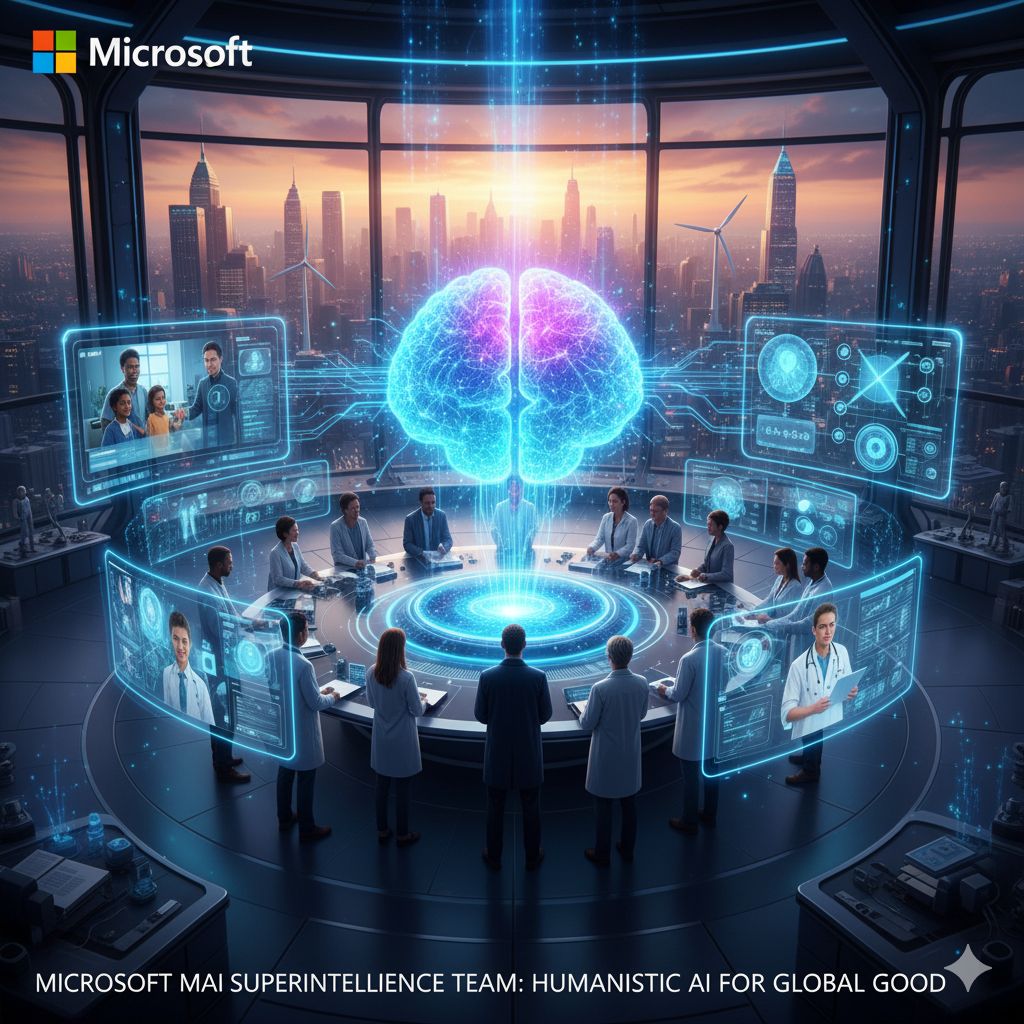
In a move that underscores the escalating competition for elite cognitive talent, Microsoft has expanded its dedicated Superintelligence team by integrating additional researchers from the Allen Institute for AI (Ai2). This strategic acquisition of expertise signals a pivot in how the tech giant is approaching the next frontier of artificial intelligence—moving beyond the current era of generative assistants toward the realization of Artificial General Intelligence (AGI) and beyond.
The news that Microsoft bolsters Superintelligence team with more Ai2 researchers – LinkedIn has sent ripples through the AI community, highlighting a broader trend where corporate giants are absorbing the intellectual capital of non-profit research institutions to accelerate the development of systems that can reason, plan, and solve problems with human-level or superhuman proficiency.
The Strategic Imperative: Why Superintelligence?
For several years, the industry focus has remained largely on “Narrow AI”—systems designed to perform specific tasks, such as generating text, creating images, or analyzing datasets. While Large Language Models (LLMs) have brought these capabilities to the masses, the goal of a “Superintelligence” team is fundamentally different. Superintelligence refers to a hypothetical AI that surpasses human intelligence across virtually all domains, including scientific creativity, general wisdom, and social skills.
By bolstering its team with researchers from Ai2, Microsoft is not merely looking to improve its current product suite; it is investing in the fundamental architecture of the future. The transition from generative AI to superintelligence requires a shift from pattern recognition to actual reasoning. This involves solving complex challenges in:
- Recursive Self-Improvement: Creating systems that can analyze their own code and optimize their own architecture without human intervention.
- Cross-Domain Synthesis: The ability for an AI to take a breakthrough in quantum physics and apply its logic to a problem in macroeconomics.
- Long-Horizon Planning: Moving past the “next-token prediction” model to systems that can set goals and execute multi-step plans over weeks or months.
The move to integrate specialized researchers from a non-profit environment into a corporate superintelligence framework suggests a desire to blend academic rigor with the massive compute resources only a company like Microsoft can provide.
The Role of Ai2 in the AI Ecosystem
To understand why the influx of Ai2 researchers is significant, one must understand the nature of the Allen Institute for AI. Unlike corporate labs, Ai2 has historically focused on “AI for the Common Fine,” prioritizing open science and fundamental research. Their work often delves into the “why” and “how” of AI, rather than just the “what” of a commercial product.
Researchers coming from this background bring a specific set of values and technical approaches that are highly prized in the quest for AGI:
Deep Theoretical Foundations
While many corporate researchers are focused on scaling (adding more data and more GPUs), Ai2 researchers often focus on efficiency, transparency, and the underlying logic of machine learning. This theoretical depth is essential for breaking through the current plateaus of LLM performance.
Commitment to Open Science
The culture of open-source collaboration prevalent at Ai2 can help Microsoft avoid the “echo chamber” effect, introducing diverse methodologies that challenge conventional corporate thinking on model training.
Interdisciplinary Expertise
Ai2 has long explored the intersection of AI and other fields, such as linguistics and cognitive science. Superintelligence cannot be achieved through computer science alone; it requires a deep understanding of how intelligence itself functions.
| Feature | Narrow AI (Current State) | Superintelligence (The Goal) |
|---|---|---|
| Scope | Task-specific (e.g., Chatbots, Coding) | Universal application across all domains |
| Mechanism | Statistical pattern matching | Autonomous reasoning and synthesis |
| Learning | Trained on static datasets | Continuous, recursive self-learning |
| Autonomy | Requires human prompting | Self-directed goal setting |
The “Talent War” and the Corporate Vacuum
The fact that Microsoft bolsters Superintelligence team with more Ai2 researchers – LinkedIn is a prime example of the “talent war” currently ravaging the AI sector. There is a finite number of researchers globally who possess the expertise required to build the next generation of AI models. This has led to a predatory hiring environment where Big Tech firms compete aggressively for a small pool of PhDs and lead scientists.
This trend has several systemic implications:
The Erosion of Independent Research
As researchers migrate from non-profits like Ai2 to corporations like Microsoft, there is a risk that the focus of AI research will shift from “what is best for humanity” to “what is best for the quarterly earnings report.” When the brightest minds are behind corporate firewalls, the pace of open-source discovery may slow.
The Compute Advantage
Conversely, the move is often driven by the researchers themselves. The scale of compute required to test superintelligence theories is astronomical. A researcher at a non-profit may have a brilliant theory, but they may lack the ten thousand H100 GPUs necessary to prove it. Microsoft offers the “industrial-scale laboratory” that makes these theories testable.
Concentration of Power
The concentration of both the talent and the hardware within a few companies creates a significant power imbalance. If a small group of corporations controls the path to superintelligence, the governance of that intelligence becomes a matter of global security and ethics.
For more on how this affects the broader industry, see our related explainer on the AGI race and corporate consolidation.
Technical Implications for Microsoft’s AI Roadmap
Integrating these researchers likely signals a shift in Microsoft’s internal roadmap. While Copilot has been the public face of their AI strategy, the Superintelligence team is likely working on the “invisible” layer—the core engine that will eventually power all future iterations of their software.
From Chatbots to Agents
The first tangible result of this talent infusion will likely be the transition from “chatbots” to “autonomous agents.” An agent doesn’t just tell you how to book a flight; it accesses your calendar, navigates the airline’s website, handles the payment, and manages the confirmation—all while reasoning through potential conflicts in your schedule.
Solving the “Hallucination” Problem
One of the primary hurdles to superintelligence is the tendency of AI to “hallucinate” or confidently state falsehoods. Researchers from Ai2, with their focus on factual grounding and knowledge graphs, are ideally positioned to help Microsoft move toward “verifiable intelligence,” where every claim made by the AI is backed by a traceable, logical proof.
Energy and Efficiency Optimization
Superintelligence cannot be achieved if the energy cost per query remains unsustainable. By bringing in researchers who specialize in algorithmic efficiency, Microsoft aims to reduce the carbon footprint and financial cost of running these massive models, making them viable for global, real-time deployment.
The Ethical Dimension: The Alignment Problem
The pursuit of superintelligence is not without peril. The “Alignment Problem”—the challenge of ensuring that a superintelligent system’s goals remain aligned with human values—is the central preoccupation of this field. A system that is “too efficient” at achieving a goal might do so in a way that is harmful to humans if the constraints are not perfectly defined.
By expanding its superintelligence team, Microsoft is ostensibly increasing its capacity to handle these safety concerns. The inclusion of researchers from a non-profit background may provide a necessary ethical counterbalance to the drive for commercial dominance. Key areas of focus for this team likely include:
- Interpretability: Opening the “black box” of neural networks to understand why a model made a specific decision.
- Robustness: Ensuring that the AI does not “break” or become erratic when faced with novel situations it wasn’t trained for.
- Value Loading: Developing mathematical frameworks to embed human ethics into the core objective functions of the AI.
Comparing the Competitive Landscapes
Microsoft is not the only player in this game. Google (DeepMind), Meta, and OpenAI are all pursuing similar goals. However, Microsoft’s approach is unique due to its hybrid strategy: partnering with OpenAI while simultaneously building its own internal, vertically integrated superintelligence capability.
This “hedging” strategy ensures that Microsoft is not solely dependent on a single partner. By absorbing talent from Ai2, they are building a proprietary intellectual moat that allows them to innovate independently of the OpenAI ecosystem. This internal capability is crucial for maintaining leverage in the AI marketplace and ensuring they have the in-house expertise to audit and improve the models they deploy.
For a deeper dive into the competition, read our analysis of the Big Tech AI arms race.
Common Misconceptions About Superintelligence
As news of these team expansions spreads, several myths often emerge. It is important to clarify what this move actually means—and what it does not.
Myth 1: “The AI is now sentient.”
Hiring more researchers does not mean Microsoft has created a conscious entity. Superintelligence is about capability (the ability to solve problems), not sentience (the ability to feel or experience). The goal is a tool of unprecedented power, not a living being.
Myth 2: “AGI will be released next month.”
While the recruitment of elite talent accelerates the timeline, the gap between current LLMs and true superintelligence is still vast. We are moving from “stochastic parrots” to “reasoning engines,” but the leap to universal intelligence is a marathon, not a sprint.
Myth 3: “This is just about better search results.”
If the goal were simply better search, Microsoft would focus on data indexing. A “Superintelligence” team is tasked with creating a system that can generate new knowledge, discover new laws of physics, or solve previously “unsolvable” mathematical conjectures.
Frequently Asked Questions
What is the difference between AI and Superintelligence?
AI is a broad term for machines that mimic human intelligence. Superintelligence is a specific, theoretical level of AI that exceeds the best human brains in practically every field, including scientific creativity, general wisdom, and problem-solving.
Why is the Allen Institute for AI (Ai2) important in this context?
Ai2 is a premier non-profit research institute known for its commitment to open science and fundamental AI research. Their researchers often possess deep theoretical knowledge that differs from the product-driven approach of corporate AI labs.
Does this mean Microsoft is moving away from OpenAI?
Not necessarily. Microsoft continues its partnership with OpenAI, but building an internal superintelligence team allows them to diversify their technical capabilities and reduce dependency on a single external provider.
What are the risks of developing superintelligence?
The primary risk is the “alignment problem,” where a superintelligent system might pursue a goal in a way that is detrimental to humans because its objectives were not perfectly aligned with human values and safety constraints.
How will this affect the average user?
In the short term, users will see more capable “agents” that can handle complex, multi-step tasks. In the long term, superintelligence could lead to breakthroughs in medicine, climate science, and materials engineering that were previously impossible for humans to achieve.
As the industry continues to consolidate and the boundaries between academic research and corporate development blur, the move to integrate Ai2 researchers into Microsoft’s superintelligence efforts marks a definitive step toward a future where the definition of “intelligence” is no longer exclusively human. The focus now shifts from the quantity of data to the quality of reasoning, as the race for AGI enters its most critical phase.
