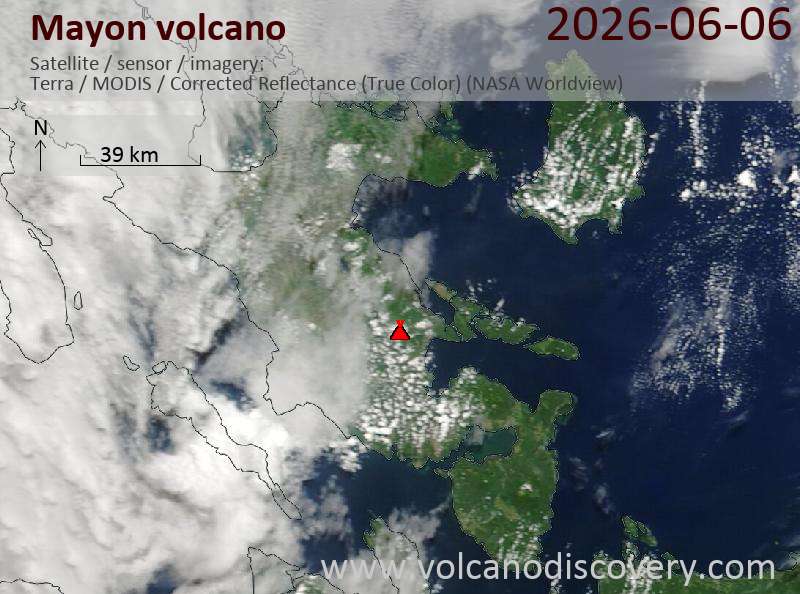
Mayon Volcano Volcanic Ash Advisory: ERUPTION AT 20260606/1854Z FL090 REPORTED OBS VA DTG: 06/1900Z – Volcano Discovery
Mayon Volcano issued a Volcanic Ash Advisory on June 6, 2026, after an eruption was recorded at 18:54Z. Observed volcanic ash (VA) was reported at flight level 090 (FL090) by 19:00Z. The Philippine National Police (PNP) has since heightened disaster readiness and alerted local units as the volcano continues its 152nd day of effusive eruption.
What happened during the June 6 Mayon eruption?
A new eruption event occurred on June 6, 2026, triggering a technical alert known as the Mayon Volcano Volcanic Ash Advisory: ERUPTION AT 20260606/1854Z FL090 REPORTED OBS VA DTG: 06/1900Z – Volcano Discovery. This specific advisory indicates that the eruption took place at 18:54Z, with volcanic ash observed at an altitude of flight level 090 (approximately 9,000 feet) by 19:00Z.
The eruption is part of a prolonged period of unrest that has seen the volcano maintain a steady state of effusive activity. While the ash plume reached significant heights, the primary characteristic of this phase has been the continuous flow of lava and the emission of gas and ash plumes.
Key details of the June 6 activity include:
- Eruption Time: 18:54Z
- Ash Observation: Confirmed at 19:00Z
- Ash Altitude: FL090 (Flight Level 090)
- Current Status: Day 152 of the ongoing effusive eruption
Current seismic activity and monitoring data
Monitoring stations have recorded a spike in geological unrest coinciding with the recent ash emissions. According to recent reports, 24 volcanic earthquakes and 364 rockfalls were recorded at Mayon Volcano. These figures suggest a high level of internal pressure and instability within the volcano’s conduit.
When compared to data from the Global Volcanism Program for the period of May 28 to June 3, 2026, the current rockfall count of 364 sits at the very top of the previously recorded daily range of 223 to 364 rockfalls. This indicates that the volcano is currently operating at the upper limit of its recent seismic intensity.
| Metric | June 6 Observation | Late May/Early June Average |
|---|---|---|
| Volcanic Earthquakes | 24 | 7–35 daily |
| Rockfalls | 364 | 223–364 daily |
| SO2 Emissions | Not specified for June 6 | 1,083–2,747 tonnes/day |
How is the Philippine government responding to the unrest?
The Philippine National Police (PNP) has taken a proactive stance in response to the intensifying unrest. The agency has officially alerted disaster units and heightened disaster readiness across the affected regions. This mobilization is designed to ensure that emergency response teams are positioned to act quickly if the eruption escalates or if pyroclastic density currents (PDCs) threaten populated areas.
The PNP’s focus is on coordinating with local government units (LGUs) to maintain clear evacuation routes and ensure that residents in high-risk zones are aware of the current alert status. This readiness follows a pattern of cautious management by Philippine authorities, who have had to manage displaced families from communities including Camalig, Malilpot, and Tabaco City since the eruption began earlier this year.
“PNP heightens disaster readiness amid Mayon Volcano’s renewed activity,” as reported by the Philippine News Agency, highlighting the shift toward active emergency preparation.
The timeline of the 2026 Mayon eruption sequence
The current episode of activity is not an isolated event but the result of a months-long eruptive cycle. The eruption began on January 6, 2026, and has evolved through several stages of intensity.
In the early stages, the Philippine Institute of Volcanology and Seismology (PHIVOLCS) noted increased rockfalls and inflation of the mountain’s upper slopes. By January 6, the alert level was raised to three on a five-level scale. This escalation occurred after lava began flowing from the crater and pyroclastic flows—hot clouds of ash and debris—started moving down the volcano’s flanks.
A notable event occurred in February 2026, when a pyroclastic flow traveled approximately 4 kilometers through the Mi-isi Gully on the southeast flank. This event underscored the danger of PDCs, which are among the most lethal volcanic hazards due to their speed and temperature.
As of June 6, the volcano has been in an effusive state for 152 days. This means that while there are explosive bursts of ash (as seen in the latest Volcanic Ash Advisory), the eruption is characterized by the steady extrusion of lava rather than a single, massive cataclysmic explosion.
Why is Mayon’s “perfect cone” shape significant?
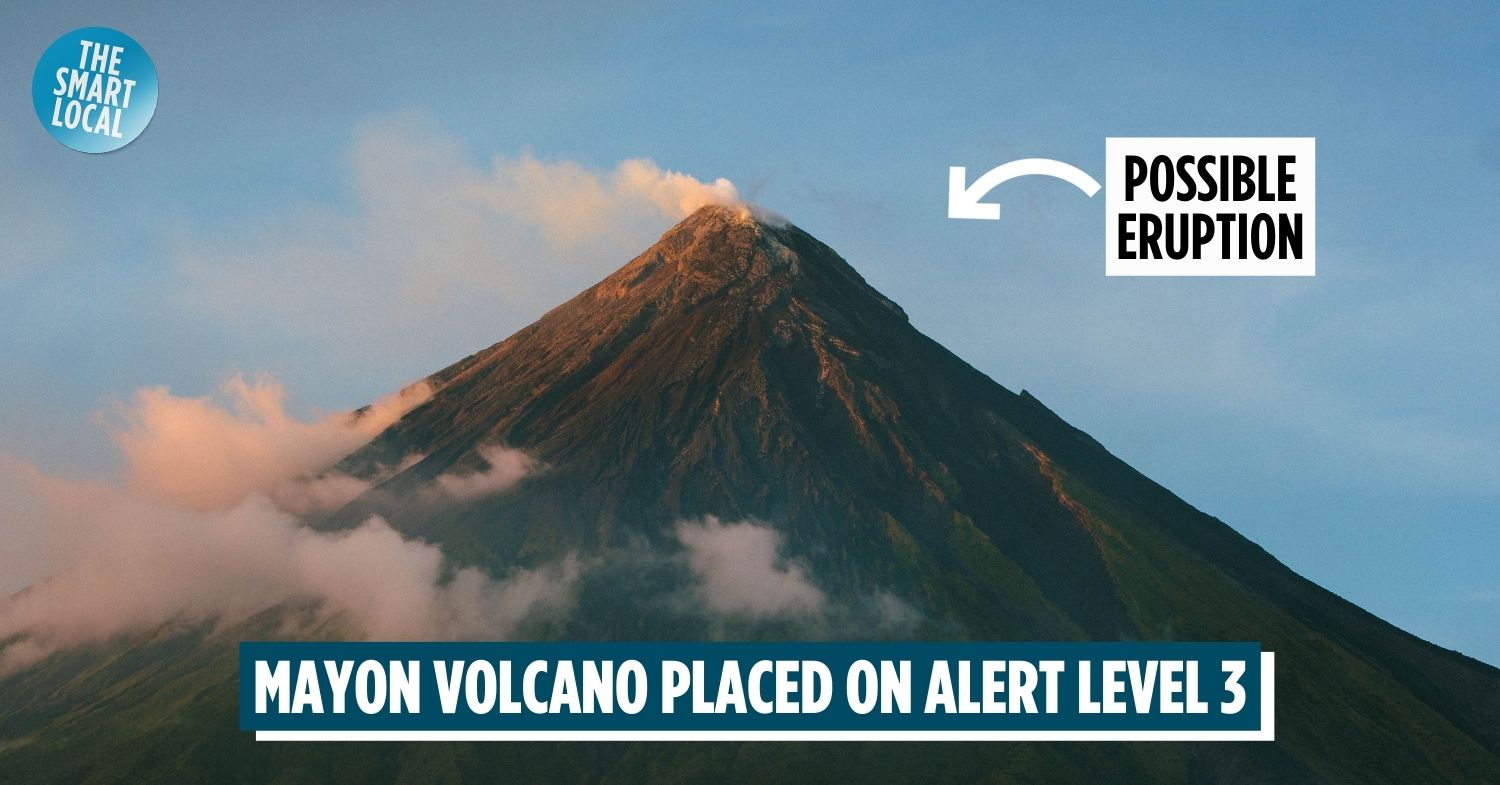
Mayon is world-renowned for its nearly symmetrical conical shape, often referred to as the “perfect cone.” While aesthetically striking, this shape is a direct result of its classification as a stratovolcano. Stratovolcanoes are built up by many layers (strata) of hardened lava, tephra, pumice, and volcanic ash.
This structure influences how Mayon erupts. The steep slopes facilitate the rapid descent of pyroclastic density currents and lava flows. Because the volcano is the centerpiece of the Albay Biosphere Reserve and a nominated World Heritage Site, the environmental and social stakes of any eruption are exceptionally high.
The danger zone is typically managed via a 6-kilometer radius around the crater. This perimeter is critical because it protects residents from the most immediate threats: lava flows and PDCs. The current activity on June 6, involving ash reaching FL090, expands the risk beyond the immediate radius, as volcanic ash can affect air travel and respiratory health over a much wider area.
Comparing Effusive vs. Explosive Activity
It is important to distinguish between the “effusive eruption” mentioned in recent reports and the “volcanic ash advisory” issued on June 6. An effusive eruption involves the relatively slow outpouring of lava. However, Mayon often exhibits a mixed behavior. The June 6 event, which produced an ash plume, is a more explosive manifestation, even if the overall trend of the last 152 days has been effusive.
This duality is what makes Mayon one of the most active and dangerous volcanoes in the Philippines. The transition from lava flows to ash-producing explosions can happen rapidly, necessitating the constant vigilance of PHIVOLCS and the PNP.
FAQ: Understanding the Mayon Volcanic Ash Advisory
What does “FL090” mean in the ash advisory?
FL090 stands for Flight Level 090. In aviation terms, flight levels are expressed in hundreds of feet. Therefore, FL090 indicates that the volcanic ash reached an altitude of approximately 9,000 feet above sea level. This information is critical for pilots to avoid flying through ash clouds, which can damage jet engines.
What is the difference between a lava flow and a pyroclastic flow?
A lava flow is molten rock that pours out of the volcano and moves relatively slowly across the landscape. A pyroclastic flow (or pyroclastic density current) is a fast-moving, extremely hot cloud of gas, ash, and rock fragments. While lava flows are destructive to property, pyroclastic flows are far more lethal due to their speed and heat.
Why was the alert level raised to three?
According to PHIVOLCS, the alert level was increased to three on January 6, 2026, after lava began flowing from the crater and pyroclastic flows were observed moving down the mountain. This level indicates a high probability of an eruption or a continuing eruption that could cause hazardous volcanic activity.
Who is at risk during the current Mayon unrest?
The highest risk is to those living within the 6-kilometer permanent danger zone. However, the June 6 ash advisory indicates that residents in a wider area may be affected by ashfall, which can impact agriculture, water quality, and respiratory health.
How long has Mayon been erupting in 2026?
The current eruptive episode began on January 6, 2026. As of the reports on June 6, the volcano has been in a state of eruption for 152 days.
For those seeking further information on volcanic hazards, a related explainer on pyroclastic density currents may provide more technical insight into the risks associated with stratovolcanoes.
