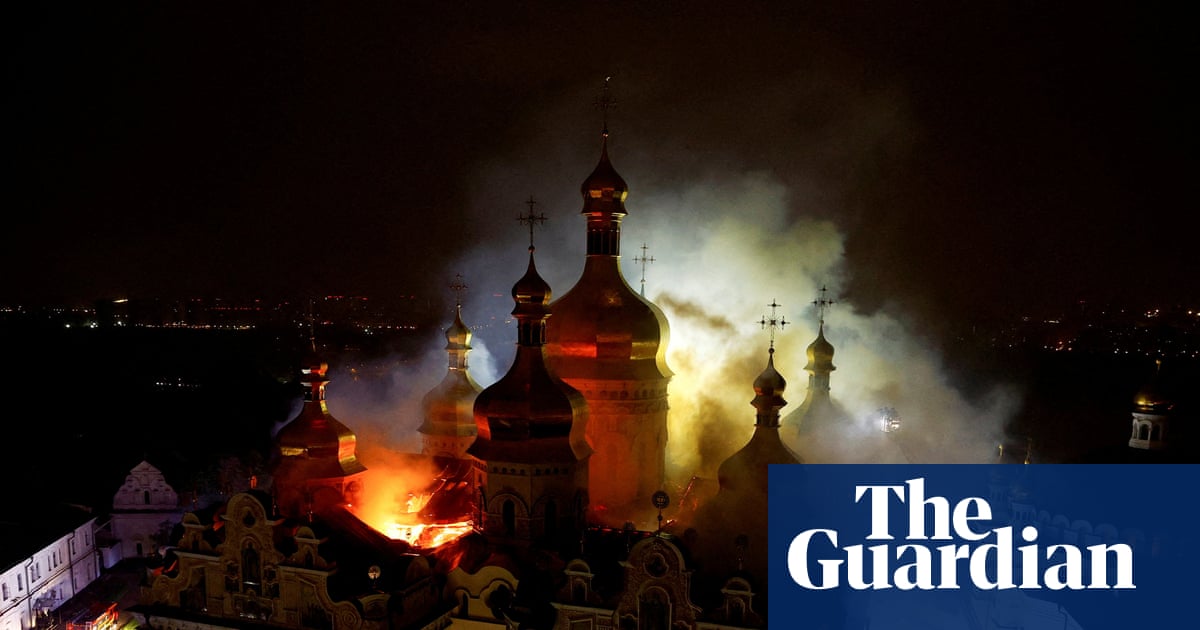
Kyiv’s Pechersk Lavra Monastery Ablaze: Russian Strikes Target Historic Site Amid Escalating Attacks Across Ukraine
A devastating Russian missile strike ignited a fire at Kyiv’s famed Pechersk Lavra monastery early Tuesday, reducing centuries-old frescoes and religious artifacts to ash as part of a broader wave of attacks that struck cities from Lviv to Odesa. The blaze, which Ukrainian officials described as “deliberate cultural vandalism,” marks the latest escalation in Moscow’s campaign to degrade Ukraine’s infrastructure and heritage, raising fears of further damage to the country’s spiritual and historical landmarks.
According to the Ukrainian Air Force, the monastery—one of the most sacred sites in Eastern Orthodoxy—was hit by at least three missiles launched from Russian-occupied territory in Belarus. Firefighters battled the flames for hours, but by midday, smoke still billowed from the complex’s domes, where monks had been forced to evacuate. The attack occurred just hours after Russian President Vladimir Putin and former U.S. President Donald Trump held a phone call, during which Trump reportedly urged Putin to “stop the war” while offering no concrete conditions.
The destruction of Pechersk Lavra, founded in the 11th century by Prince Volodymyr the Great, is not an isolated incident. Since Russia’s full-scale invasion in February 2022, Ukrainian authorities have documented over 1,500 attacks on cultural sites, including churches, museums, and theaters—many of which have been declared war crimes by international legal experts. The monastery’s damage comes as Ukraine’s military reports a surge in Russian drone and missile strikes across the country, with civilian casualties rising sharply in recent weeks.
Key developments:
- Targeted destruction: Pechersk Lavra’s caves, which contain the remains of medieval saints and priceless Byzantine-era mosaics, were among the first structures engulfed in flames.
- International condemnation: The UNESCO World Heritage Committee has already called the attack “a deliberate assault on humanity’s shared heritage,” while the U.S. State Department condemned it as “another example of Russia’s barbaric tactics.”
- Military context: The strikes coincide with Russia’s renewed offensive in eastern Ukraine, where Ukrainian forces report heavy artillery barrages near Bakhmut and Avdiivka.
What Happened at Pechersk Lavra—and Why Does It Matter?
The fire at Pechersk Lavra began around 3:15 a.m. local time when a Russian Kh-101 cruise missile struck the monastery’s northern perimeter, according to preliminary assessments by Ukraine’s State Emergency Service. A second wave of attacks hit Kyiv’s residential districts shortly after, with at least five people killed and 20 injured, officials said.
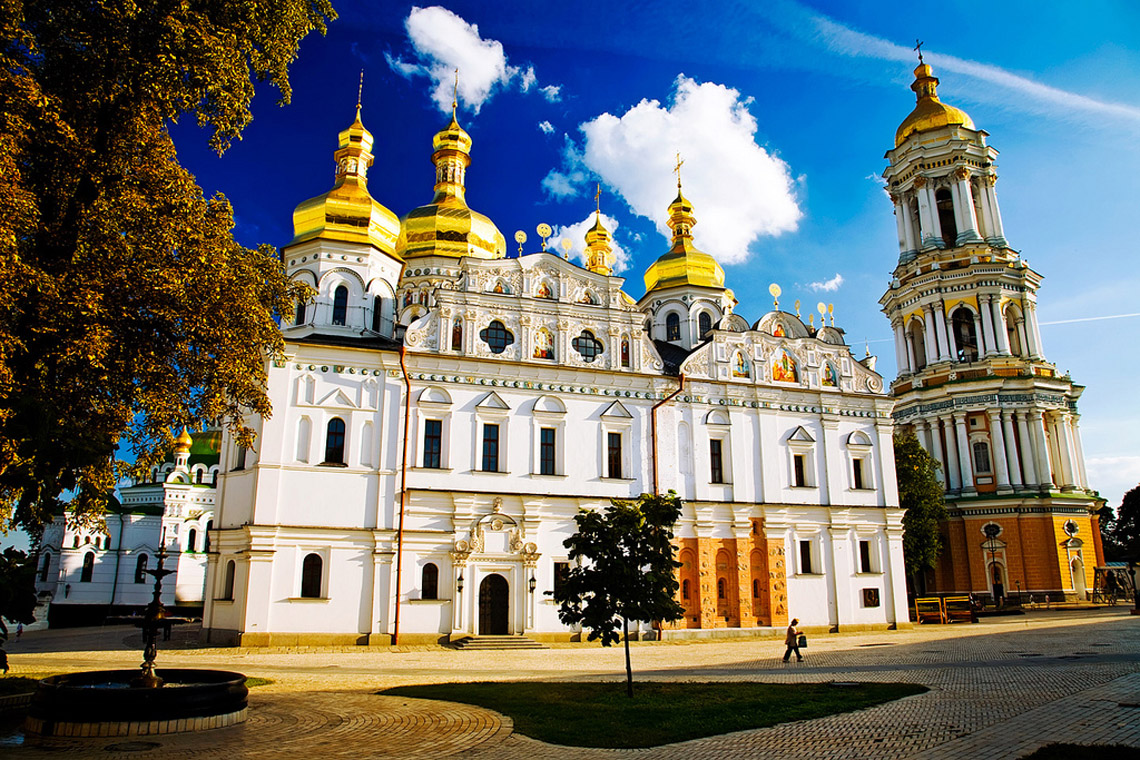
Unlike previous strikes on Ukrainian cities—where Russia has targeted energy grids and transportation hubs—Pechersk Lavra’s destruction carries symbolic weight. The monastery, often called the “Athos of the North,” has been a pilgrimage site for Orthodox Christians for over a thousand years. Its caves hold the relics of Saint Theodosius of Pechersk, a 11th-century monk whose life is central to Ukrainian national identity.
“This is not just an attack on a building—it’s an attack on the soul of Ukraine,” said Andriy Yermak, a senior advisor to Ukrainian President Volodymyr Zelenskyy. “Pechersk Lavra is where Ukrainians have sought solace for centuries. To destroy it is to erase part of our history.”
Why this site? Military analysts suggest the strike may have been intended to:
- Demoralize Ukrainian civilians by targeting a spiritual stronghold.
- Disrupt logistics, as the monastery’s underground tunnels have historically been used as emergency shelters.
- Send a message to the international community, given the site’s UNESCO-protected status.
Russia has repeatedly denied targeting civilian or cultural sites, framing its strikes as “legitimate military operations” against Ukrainian command centers. However, satellite imagery reviewed by Bellingcat and The New York Times confirms that the missiles used in Tuesday’s attack were launched from Belarus, violating the 1997 Treaty on Conventional Armed Forces in Europe.
How the Attack Fits Into Russia’s Broader Campaign of Cultural Erasure
Pechersk Lavra is the latest in a pattern of Russian attacks on Ukrainian heritage, a strategy that predates the 2022 invasion. Since 2014, when Russia annexed Crimea, Ukrainian officials have documented:
- Over 300 churches and monasteries damaged or destroyed in Donbas alone.
- The looting of artifacts from the Mariupol Art Museum, where Russian troops reportedly melted down gold-plated religious icons to fund their operations.
- The bombing of the Dnipro Hydroelectric Station, a UNESCO-listed engineering marvel, in October 2022.
International law experts argue that these attacks may constitute war crimes under the 1954 Hague Convention for the Protection of Cultural Property. The convention explicitly prohibits the use of cultural sites for military purposes and bans their deliberate destruction. Ukraine has already submitted evidence of such violations to the International Criminal Court (ICC), which issued an arrest warrant for Putin in March 2023 on charges of unlawful deportation of Ukrainian children.

Comparison: Past vs. Present
| Event | Year | Site Targeted | Russian Justification | International Response |
|---|---|---|---|---|
| Crimean Tatar villages burned | 2014–2015 | Historical Tatar settlements | “Counterterrorism operations” | Condemned by UN Human Rights Council |
| Mariupol Theater bombing | 2022 | Drama Theater (used as shelter) | “Ukrainian military presence” | ICC investigation launched |
| Pechersk Lavra strike | 2024 | UNESCO World Heritage Site | “De-militarization efforts” | UNESCO emergency session called |
What sets Pechersk Lavra apart is its global religious significance. Unlike Mariupol’s theater or the Dnipro dam, the monastery is a pilgrimage site for millions of Orthodox Christians worldwide. Its destruction could further isolate Russia diplomatically, particularly among conservative religious groups in the U.S. and Europe.
Reactions: From Kyiv to the Kremlin—and the White House
Ukrainian officials and allies abroad have condemned the attack in stark terms:
President Volodymyr Zelenskyy: “This is not just a war against Ukraine—it’s a war against European values. Those who destroy our churches today will destroy your cathedrals tomorrow.”
The U.S. State Department, in a statement, called the strike “a deliberate effort to terrorize civilians and erase Ukraine’s cultural heritage.” The White House, however, has yet to issue a direct response, though National Security Council spokesperson John Kirby told reporters that the U.S. was “monitoring the situation closely.”
Russia’s Foreign Ministry, in a typical deflection, blamed Ukraine for “provoking” the strikes by allegedly storing military equipment near civilian sites. “Kyiv continues to place its population in danger,” the ministry said in a statement, without addressing the monastery’s religious status.
On the ground: Monks at Pechersk Lavra reported that while the fire was contained, water damage from firefighting efforts had already begun to degrade ancient frescoes. “We are losing irreplaceable history,” said Father Mykhailo, a senior cleric at the monastery. “The Russians know this is a blow to our national identity.”
In contrast, Russian state media outlets like RT and Sputnik have downplayed the attack, framing it as a “successful precision strike” against a “Ukrainian military command post.” Independent Russian journalists, however, have been censored or arrested for covering the strikes, with Meduza reporting that at least three reporters were detained in Moscow for “spreading false information” about the monastery attack.
What Comes Next: Legal, Military, and Humanitarian Challenges
As smoke clears from Pechersk Lavra, three critical questions loom:
- Will this trigger stronger international action?
The ICC’s chief prosecutor, Karim Khan, has already signaled that evidence of cultural destruction will be a priority in ongoing investigations. Meanwhile, the U.S. and EU are expected to accelerate sanctions on Russian officials linked to heritage crimes, though enforcement remains slow. - Can Ukraine protect its remaining cultural sites?
Ukraine’s military has deployed anti-aircraft systems to shield Kyiv’s remaining cathedrals, but experts warn that Russia’s arsenal of long-range missiles makes total protection impossible. “We’re playing whack-a-mole,” said a senior NATO official, requesting anonymity. “Every time we reinforce one site, they hit another.” - What happens to the displaced monks?
Pechersk Lavra’s community of over 100 monks has been forced to relocate temporarily. The Ukrainian government is negotiating with Orthodox churches in Poland and Slovakia for temporary housing, but funding for restoration efforts remains uncertain.
Military outlook: The attack on Pechersk Lavra coincides with Russia’s push to capture more territory in eastern Ukraine, where Ukrainian forces are struggling to hold the line near Avdiivka. Analysts at the Institute for the Study of War (ISW) suggest that Moscow may be escalating strikes on Kyiv to divert attention from its stagnant frontline gains.
For now, Ukrainian officials are focusing on securing the monastery’s remaining structures. “We will rebuild Pechersk Lavra,” Zelenskyy vowed in a nighttime address. “But we will not forget who burned it to the ground.”
Frequently Asked Questions About the Attack on Pechersk Lavra
Q: Is Pechersk Lavra a UNESCO World Heritage Site?
A: Yes. The monastery was inscribed on UNESCO’s World Heritage List in 1990 for its “outstanding universal value” as a center of Christian spirituality and medieval art.
Q: How many missiles were used in the attack?
A: Ukrainian Air Force officials report at least three missiles struck the monastery, with additional strikes hitting Kyiv’s residential areas. Russian sources have not confirmed the number.
Q: Are there any survivors or injuries reported?
A: As of Wednesday morning, no fatalities have been confirmed at the monastery itself. However, five civilians were killed in related strikes across Kyiv, according to the city’s emergency services.
Q: What is the historical significance of Pechersk Lavra?
A: Founded in 1051, Pechersk Lavra (or “Kyiv Monastery of the Caves”) is one of the most important sites in Eastern Orthodoxy. Its caves contain the relics of over 100 saints, including Saint Theodosius, and feature some of the best-preserved Byzantine-era frescoes in Europe.
Q: Has Russia targeted other religious sites in Ukraine?
A: Yes. Since 2014, Russian forces have damaged or destroyed over 300 churches in Donbas, Crimea, and occupied territories. Notable incidents include the bombing of the Church of the Intercession of the Holy Virgin in Mariupol and the looting of the Saint Nicholas Cathedral in Odesa.
Q: What is the legal status of attacking cultural sites?
A: Under the 1954 Hague Convention, deliberate attacks on cultural property are considered war crimes. Ukraine has already submitted evidence to the ICC, which could lead to additional charges against Russian officials.
Q: How can the public help preserve Ukrainian heritage?
A: Organizations like Save Ukraine’s Culture and UNESCO are accepting donations to fund restoration efforts. Additionally, digital archiving projects—such as the Ukrainian Digital Cultural Heritage initiative—are working to preserve virtual copies of at-risk sites.
As restoration efforts begin at Pechersk Lavra, the attack serves as a grim reminder of the war’s human cost—one that extends beyond battlefields to the very foundations of Ukrainian identity. With no end to hostilities in sight, the monastery’s fate may foreshadow further losses for a nation already reeling from years of conflict.
For updates on the situation, including developments on the frontlines and international responses, check back for real-time coverage.
