JWST Proves That Black Holes Really Do Come Before Galaxies – Large Think
For decades, the prevailing narrative of cosmic evolution followed a logical, linear sequence: first, vast clouds of gas collapsed to form the first stars. these stars clustered together to create the first galaxies; and eventually, the most massive of these stars collapsed into black holes, which then merged and grew over eons to become the supermassive giants we see at the centers of galaxies today. It was a “galaxy-first” model of the universe.
However, new data from the James Webb Space Telescope (JWST) is fundamentally dismantling this timeline. Recent observations have provided clear evidence that some supermassive black holes did not wait for a galaxy to form around them. Instead, they were enormous from the very beginning, existing as massive entities before their host galaxies had even reached a significant size. This discovery suggests that in some cases, the black hole came first, acting as the seed around which the rest of the galactic structure developed.
This revelation, often discussed in the context of “JWST proves that black holes really do come before galaxies – Big Think” analyses, represents more than just a minor correction to a textbook; it is a paradigm shift in our understanding of the early universe and the mechanisms that govern the birth of everything we see in the night sky.
The Discovery of the “Little Red Dot”
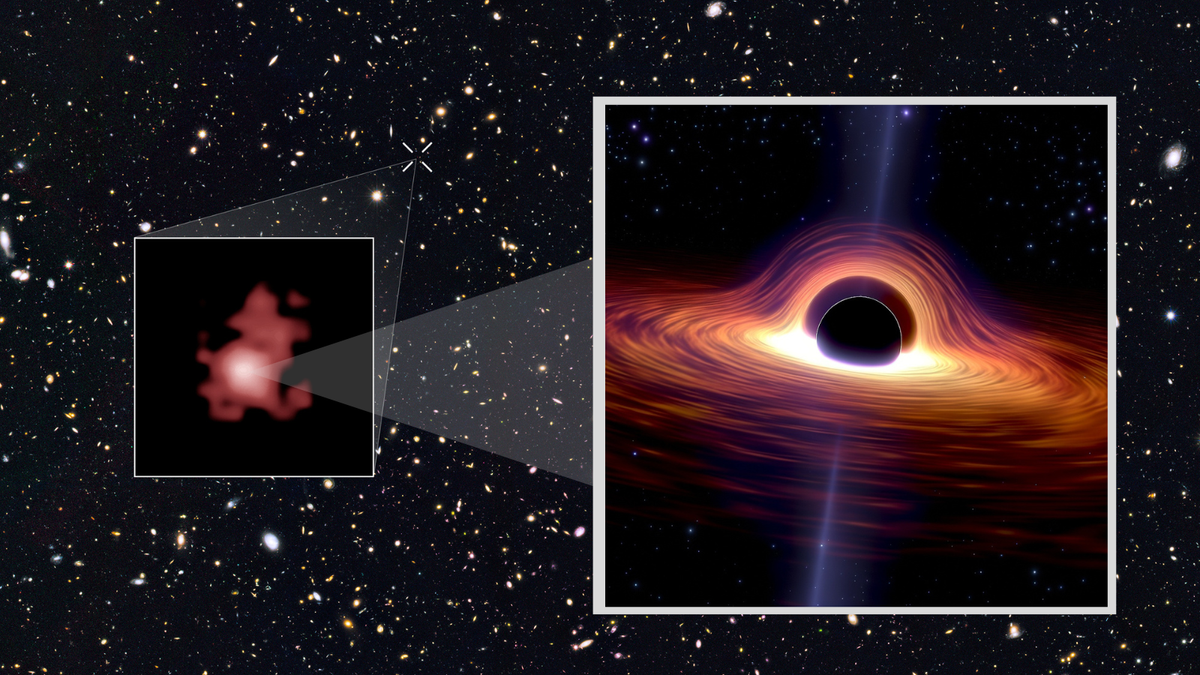
The catalyst for this shift in understanding is the observation of a specific, enigmatic object known as Abell2744-QSO1 (QSO1). Identified as a “prototypical Little Red Dot,” this object existed a mere 700 million years after the Big Bang—a period cosmologists refer to as the cosmic dawn.
Using the Near-Infrared Camera (NIRCam), JWST captured an image of QSO1 that was magnified and triply imaged by the gravity of the galaxy cluster Abell 2744 (also known as Pandora’s Cluster). This gravitational lensing effect acted as a natural magnifying glass, allowing astronomers to peer deeper into the early universe than ever before.
The data revealed something startling: a supermassive black hole that was far too large for the galaxy hosting it. Under the classical model, a black hole’s mass is typically proportional to the mass of its host galaxy. But QSO1 defied this ratio. The black hole was enormous, yet the surrounding galaxy was relatively small and underdeveloped. This discrepancy provided the “smoking gun” evidence that the black hole did not grow slowly via the consumption of stars within an established galaxy, but was instead born massive.
“Here’s a remarkable finding,” said Roberto Maiolino of University of Cambridge in the United Kingdom, co-author of studies published in Nature and the Monthly Notices of the Royal Astronomical Society. “It’s a paradigm shift, a total revisiting of the classical scenarios of how black holes form and grow.”
Classical Theory vs. The New JWST Evidence
To understand why this discovery is so disruptive, one must first understand the “classical scenario” that dominated astrophysics for years. The traditional view relied on a bottom-up approach to cosmic growth.
The Classical “Galaxy-First” Model
- Stellar Birth: Massive stars form from the collapse of primordial gas.
- Stellar Collapse: These stars exhaust their fuel and collapse into stellar-mass black holes.
- Accretion and Merging: These smaller black holes consume surrounding gas and merge with other black holes.
- Supermassive Growth: Over billions of years, this process creates a supermassive black hole at the center of a fully formed galaxy.
The JWST “Black Hole-First” Evidence
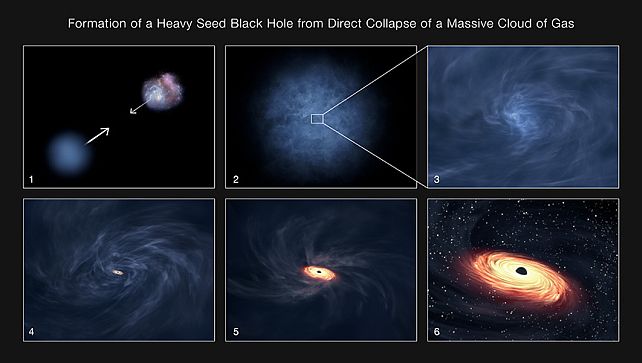
The observations of objects like Abell2744-QSO1 suggest a “top-down” or “direct” approach. The evidence indicates that some supermassive black holes formed without the intermediate step of stellar collapse. Instead of starting as a small seed from a single star, these entities may have formed from the direct collapse of massive clouds of gas, creating an enormous black hole almost instantaneously (in cosmic terms).
| Feature | Classical Model | JWST Findings (Direct Collapse) |
|---|---|---|
| Primary Seed | Death of a massive star | Direct collapse of massive gas clouds |
| Growth Rate | Unhurried, incremental accretion | Rapid, enormous from the start |
| Sequence | Galaxy $\rightarrow$ Black Hole | Black Hole $\rightarrow$ Galaxy |
| Mass Ratio | Proportional to host galaxy | Overmassive relative to host galaxy |
The Role of the James Webb Space Telescope in this Breakthrough
This discovery was not possible with previous technology. While the Hubble Space Telescope provided an incredible window into the universe, it lacked the specific capabilities required to see the “Little Red Dots” of the early universe. The JWST was designed specifically to solve these mysteries.
Infrared Sensitivity and the Cosmic Time Machine
Because the universe is expanding, light from the earliest stars and black holes is “redshifted”—stretched from visible light into the infrared spectrum. JWST’s primary mission is infrared astronomy, allowing it to peer back over 13.5 billion years to see the first luminous glows after the Big Bang.
The L2 Orbit and Thermal Protection
To detect these faint infrared signals, the telescope must be kept incredibly cold. Unlike Hubble, which orbits the Earth, JWST orbits the Sun at the second Lagrange point (L2), located 1.5 million kilometers (1 million miles) away from Earth. It is equipped with a massive five-layer sunshield that protects the instruments from the heat of the Sun, Earth, and Moon—providing a level of protection described as having an “SPF 1 million.”
NIRCam and the Analysis of QSO1
The Near-Infrared Camera (NIRCam) was instrumental in identifying Abell2744-QSO1. By mapping the gas composition and velocity of the material surrounding the black hole, researchers could determine its mass and the mass of the surrounding galaxy, revealing the “overmassive” nature of the black hole that challenged existing theories.
For those interested in the technical specifications of the observatory, a related explainer on JWST’s instruments can provide further detail on how NIRCam and NIRSpec work in tandem.
Why This Matters: Redefining the Early Universe
The realization that supermassive black holes can exist before their galaxies changes how we view the “scaffolding” of the universe. If black holes form first, they may act as gravitational anchors, pulling in gas and dark matter to accelerate the formation of galaxies.
Implications for Galactic Evolution
In the classical model, the galaxy is the parent and the black hole is the offspring. In the new model suggested by JWST, the black hole may be the architect. An early, massive black hole would create a powerful gravitational well, drawing in vast amounts of interstellar medium, which would then coalesce into stars and eventually a galaxy.
Solving the “Growth Problem”
Astronomers have long struggled to explain how supermassive black holes—some millions or billions of times the mass of the Sun—could exist so shortly after the Big Bang. There simply wasn’t enough time for a small stellar-mass black hole to grow that large through traditional accretion. The “direct collapse” theory, supported by the JWST data, solves this problem by removing the need for a slow growth phase; the black holes started big.
Key Takeaways on Cosmic Origins:
- Direct Collapse: Some supermassive black holes likely bypassed the stellar-collapse phase entirely.
- Host Independence: These black holes did not require a massive host galaxy to feed on to reach their size.
- Timeline Shift: The “cosmic dawn” was likely more chaotic and rapid than previously theorized.
- Gravitational Anchors: Black holes may have played a primary role in triggering the birth of galaxies.
Common Misconceptions About Early Black Holes
As news of the “black hole first” theory spreads, several oversimplifications have emerged. It is important to clarify the nuances of these findings.
Misconception 1: ALL black holes formed before galaxies.
The evidence does not suggest that every black hole followed this path. It is highly likely that both processes occurred: some black holes grew from stars within galaxies, while others (the “overmassive” ones) formed via direct collapse before the galaxy was established.
Misconception 2: These black holes “created” the Big Bang.
The Big Bang is the origin of the universe itself. These black holes formed after the Big Bang—specifically around 700 million years after—during the era of the first structures. They are a result of the Big Bang’s aftermath, not the cause of it.
Misconception 3: “Little Red Dots” are just small galaxies.
While they appear as small, red points of light, the “Little Red Dot” classification refers to objects that are compact and highly redshifted, often hiding a supermassive black hole that is disproportionately large compared to the visible stellar mass.
The Future of Early Universe Research
The discovery of Abell2744-QSO1 is just the beginning. With the JWST continuing its mission, astronomers expect to find more “Little Red Dots” and potentially map the distribution of these early supermassive black holes across the sky.
The next phase of research will likely focus on the gas composition and velocity of these early systems. By understanding how gas falls into these primordial black holes, scientists can determine exactly how “direct collapse” works and whether it was a common occurrence or a cosmic rarity. This will eventually lead to a unified theory of how the first structures in the universe—both galactic and singular—emerged from the void.
As we continue to analyze data from the L2 orbit, the boundary between “galaxy” and “black hole” continues to blur, revealing a universe that is far more complex and surprising than the linear models of the past suggested.
Frequently Asked Questions
What is a “Little Red Dot” in space?
A “Little Red Dot” is a term used by astronomers to describe compact, red-colored objects in the early universe detected by the JWST. These objects often turn out to be early galaxies containing supermassive black holes that are far more massive than expected for the size of their host galaxy.

How did JWST prove black holes came before galaxies?
JWST observed objects like Abell2744-QSO1, which existed 700 million years after the Big Bang. The data showed a supermassive black hole that was already enormous, despite being in a very small, underdeveloped galaxy. This suggests the black hole formed first, likely through the direct collapse of gas, rather than growing slowly from a dead star within a galaxy.
What is the “direct collapse” theory?
The direct collapse theory proposes that instead of a star collapsing into a small black hole, a massive cloud of primordial gas collapsed directly into a large black hole. This allows a supermassive black hole to exist very early in the universe’s history without needing millions of years of accretion.
Why couldn’t the Hubble Space Telescope see this?
Hubble primarily sees visible light, but the light from the early universe has been redshifted into the infrared spectrum due to the expansion of the universe. JWST is an infrared telescope, making it capable of seeing these distant, redshifted “Little Red Dots” that are invisible to Hubble.
Does this mean all galaxies started with a black hole?
Not necessarily. Astronomers believe there were likely multiple pathways to galaxy formation. While some galaxies may have been anchored by an early supermassive black hole, others may have formed through the classical process of stars clustering together first.
