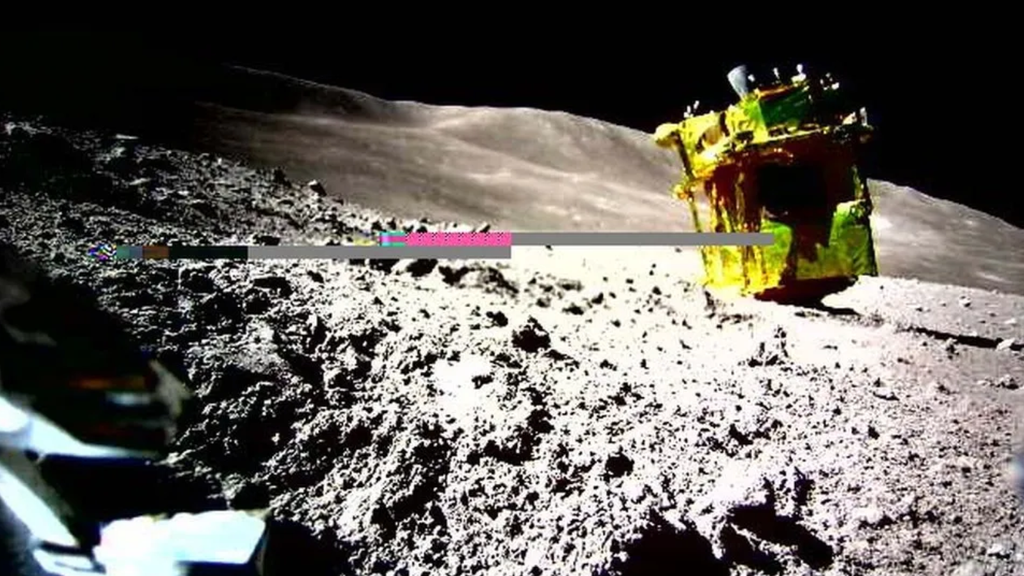
How a Shape-Shifting Tiny Rover Inspired by Japanese Toys Autonomously Explored the Moon
Japan’s SORA-Q rover, a transformable robot inspired by Japanese toys, successfully navigated the lunar surface following the SLIM lander’s historic touchdown, according to reports from Phys.org and Live Science. The rover employs a shape-shifting mechanism to move autonomously, allowing it to transition from a sphere to a crawling vehicle to traverse rugged lunar terrain.
How did the SORA-Q rover move across the lunar surface?
The SORA-Q rover operates by changing its physical configuration to adapt to the environment. According to Phys.org, the robot is primarily ball-shaped, which allows it to be deployed from the main lander with minimal risk of damage. Once on the surface, it transforms into a shape that enables it to “crawl,” a movement pattern that differs significantly from the wheeled locomotion used by previous lunar missions.
Live Science reports that this crawling motion allows the tiny rover to navigate obstacles that might stop a traditional wheeled vehicle. By shifting its center of mass and altering its form, the rover can push itself across the lunar regolith. This autonomy is critical because the distances involved make real-time remote control from Earth impossible due to signal lag.
The autonomous navigation system relies on onboard sensors to detect terrain changes. According to the provided reports, the rover does not follow a pre-programmed path but instead reacts to the physical characteristics of the moon’s surface to determine its movement.
Why was the rover’s design inspired by Japanese toys?
The engineering behind SORA-Q draws a direct parallel to “Transformers”-style toys that change shape to serve different functions. Gizmodo notes that this design philosophy was chosen to maximize versatility within a very small footprint. A spherical shape is ideal for the deployment phase, while a flattened or articulated shape is necessary for exploration.
This toy-inspired approach solves several aerospace engineering hurdles:
- Deployment Safety: A ball can be ejected or rolled out of a lander without needing complex ramps or cranes.
- Stability: By lowering its profile during exploration, the rover reduces the risk of tipping over on uneven slopes.
- Mechanical Simplicity: Reducing the number of independent wheels reduces the number of potential failure points caused by lunar dust.
According to Phys.org, the goal was to create a “tiny” but capable explorer that could perform high-value reconnaissance without the massive weight and cost of a full-sized rover.
What role did the SLIM lander play in the mission?
The SORA-Q rover was a secondary payload on the Smart Lander for Investigating Moon (SLIM). According to Live Science, the SLIM mission was designed to demonstrate “pinpoint” landing technology, aiming to land within 100 meters of a specific target. This precision is necessary for future missions that intend to land near specific mineral deposits or water-ice concentrations.
The lander acted as the primary transport and communication hub for the rover. Once SLIM achieved its landing, it deployed the SORA-Q rover to explore the immediate vicinity. Reports from Gizmodo indicate that the lander’s ability to survive the initial touchdown was a prerequisite for the rover’s deployment.
| Mission Component | Primary Function | Key Capability |
|---|---|---|
| SLIM Lander | Precision Transport | Pinpoint landing accuracy |
| SORA-Q Rover | Autonomous Exploration | Shape-shifting locomotion |
How does a transformable rover differ from traditional lunar vehicles?
Most lunar rovers, from the early Soviet Lunokhods to the NASA Perseverance rover on Mars, rely on wheels or tracks. According to Phys.org, these traditional systems are efficient on flat plains but can become bogged down in deep lunar dust or trapped by medium-sized rocks.
The SORA-Q rover represents a shift toward “soft” or “adaptive” robotics. Instead of fighting the terrain with torque and tire grip, the shape-shifting rover adapts its body to the terrain. Gizmodo highlights that this approach allows for a much smaller vehicle size, which reduces the fuel required for the launch and landing phases.
Key differences include:
- Locomotion: Traditional rovers roll; SORA-Q crawls/shifts.
- Scale: SORA-Q is significantly smaller than standard rovers, allowing for “swarm” deployment possibilities in future missions.
- Risk Profile: A failure in one wheel can disable a traditional rover; a shape-shifting body can often find alternative ways to move.
For more on the evolution of space robotics, see a related explainer on autonomous planetary probes.
What challenges did the autonomous rover face on the moon?
The lunar environment is hostile to small electronics and mechanical joints. Live Science notes that lunar regolith—the fine, abrasive dust covering the moon—is a primary threat. This dust can infiltrate gears and joints, potentially seizing the mechanisms that allow SORA-Q to change shape.
Furthermore, temperature extremes pose a significant risk. Without a thick atmosphere, the moon’s surface swings from scorching heat in the sun to extreme cold in the shade. According to Gizmodo, the rover’s ability to function depended on its thermal management systems, which must protect the battery and processors from these fluctuations.
Data released later regarding the rover’s performance suggests that the autonomy of the vehicle was tested by the unexpected orientation of the SLIM lander upon touchdown. The rover had to be deployed into an environment that was not perfectly level, testing the limits of its balance and shape-shifting capabilities.
Why this mission matters for future space exploration
The success of a shape-shifting rover proves that unconventional locomotion is viable in low-gravity environments. According to Phys.org, the ability to deploy multiple small, autonomous robots is more cost-effective than deploying one large, expensive vehicle. This “distributed” approach to exploration means that the loss of one small rover does not result in the failure of the entire mission.
This mission also provides a blueprint for exploring “unreachable” areas of the solar system, such as the deep crevices of lunar craters or the jagged surfaces of asteroids. Traditional wheels cannot navigate vertical drops or tight gaps, but a robot that can transform its shape can potentially squeeze into these areas to search for water ice or organic compounds.
According to Live Science, the data gathered by SORA-Q helps scientists understand how small-scale robotics interact with lunar soil, which will inform the design of the next generation of explorers for the Artemis program and beyond.
Common misconceptions about the SORA-Q rover
One common misconception is that the rover is “sentient” or possesses high-level artificial intelligence. According to Phys.org, the rover’s “autonomy” is actually a set of complex algorithmic responses to sensor data, not a conscious decision-making process. It follows a logic tree: if it detects an obstacle, it triggers a specific shape-shift to bypass it.
Another misconception is that the rover was designed for long-distance travel. Gizmodo clarifies that SORA-Q is a short-range scout. Its purpose is not to cross kilometers of the lunar surface, but to provide high-resolution data from the immediate landing zone, acting as a remote sensor for the lander.
Finally, some assume the “toy” inspiration was purely aesthetic. In reality, the design was a functional requirement. The “Transformers” approach was the most efficient way to combine the needs of a stable launch (sphere) with the needs of surface exploration (crawler).
Frequently Asked Questions
What is the SORA-Q rover?
SORA-Q is a small, shape-shifting autonomous rover developed by Japan. It was deployed as part of the SLIM mission to explore the lunar surface by transforming from a ball into a crawling robot, according to Phys.org.

How does a shape-shifting rover benefit lunar exploration?
According to Live Science, shape-shifting allows the rover to be deployed easily as a sphere and then adapt its form to crawl over rugged terrain that would trap traditional wheeled rovers.
Was the SORA-Q mission successful?
Reports from Gizmodo and Phys.org indicate that the rover successfully deployed and moved autonomously on the moon, providing critical data on lunar mobility and the effectiveness of transformable robotics.
Who developed the SORA-Q rover?
The rover was developed as part of a Japanese initiative involving JAXA (Japan Aerospace Exploration Agency) and associated partners to test precision landing and autonomous exploration, as reported by Live Science.
How is the rover different from NASA’s rovers?
Unlike NASA’s larger wheeled rovers, SORA-Q is much smaller and uses a transformable body to “crawl” rather than roll, making it better suited for specific, rugged terrains and low-cost deployment, according to Phys.org.
