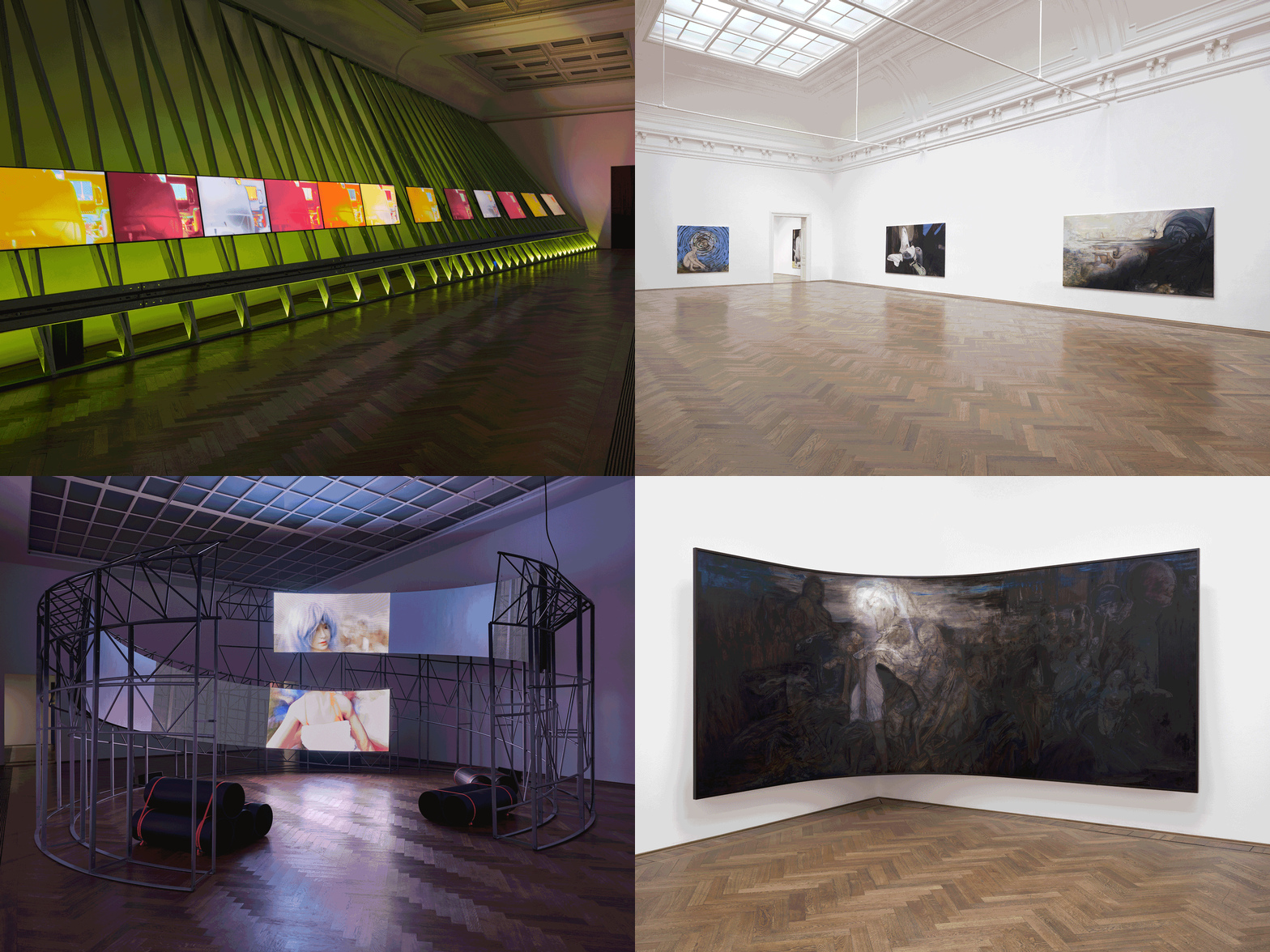
Janiva Ellis and Shuang Li Present ‘Geneva’ and ‘Alliance’ via e-flux
Janiva Ellis and Shuang Li have debuted their respective projects, Geneva and Alliance, through the e-flux platform. The exhibition examines the intersections of international diplomacy, systemic power, and strategic cooperation, utilizing conceptual frameworks to critique institutional structures and the nature of geopolitical neutrality.
What is the Janiva Ellis: Geneva / Shuang Li: Alliance project?
The presentation titled Janiva Ellis: Geneva / Shuang Li: Alliance – e-flux.com serves as a dual-artist exploration of how political and social systems organize human interaction. According to the project documentation, the exhibition does not function as a traditional gallery show but as a conceptual inquiry into the mechanisms of power, diplomacy, and collective agreement. Janiva Ellis focuses on the concept of “Geneva,” while Shuang Li investigates the nature of the “Alliance.”
The works are hosted by e-flux, a platform known for blending art distribution with theoretical discourse. By utilizing this digital and archival space, the artists remove the physical boundaries of a traditional museum, mirroring the borderless yet highly regulated nature of the diplomatic themes they explore.
Key components of the project include:
- Conceptual Mapping: Analysis of how cities and agreements act as metaphors for political stability.
- Institutional Critique: An examination of the “neutral” spaces that facilitate global governance.
- Relational Dynamics: A study of how alliances are formed, maintained, and dissolved in both political and personal spheres.
Analyzing Janiva Ellis: The ‘Geneva’ Framework
Janiva Ellis utilizes “Geneva” as a primary case study for neutrality and the paradox of the diplomatic zone. In the context of this work, Geneva represents more than a geographic location; it is a symbol of the international order and the perceived objectivity of global law. According to the project’s thematic guidelines, Ellis examines the friction between the ideal of neutrality and the reality of political influence.
The Paradox of Neutrality
Ellis argues that neutrality is rarely a passive state. Instead, the work suggests that “neutrality” is an active construction used by powerful entities to maintain a facade of impartiality while negotiating systemic control. By focusing on the architecture and the legal frameworks of Geneva, the artist highlights how specific spaces are designed to strip away national identity to facilitate a sterilized form of communication.
Spatial Diplomacy
The “Geneva” project looks at the physical and psychological boundaries of diplomatic missions. Ellis explores the concept of “extraterritoriality”—the legal status where a location is exempt from local laws. This creates a “bubble” of sovereignty that Ellis uses to question who truly benefits from these legal exemptions and how they mirror broader inequalities in global citizenship.

Analyzing Shuang Li: The ‘Alliance’ Framework
While Ellis focuses on the space of diplomacy, Shuang Li explores the bonds that hold these spaces together. The project Alliance investigates the tension between individual autonomy and the requirements of collective security. According to the exhibition’s conceptual framework, Li views an “alliance” as a contract that provides protection but demands a surrender of a portion of the self or the state.
The Mechanics of Cooperation
Li’s work examines the “cost of entry” for any alliance. Whether these are military pacts, economic trade blocs, or social contracts, the artist emphasizes that every alliance is built on a foundation of mutual suspicion and strategic need. The work posits that alliances are not born from genuine unity but from a shared fear or a calculated desire for dominance.
Fragility and Dissolution
A central theme in Alliance is the inevitable decay of agreements. Li examines the “break point” of a partnership—the moment when the cost of maintaining the alliance outweighs the benefits. This is presented through a lens of systemic fragility, suggesting that the more rigid an alliance is, the more violently it tends to collapse when the underlying interests shift.
Comparative Analysis: Geneva vs. Alliance
The juxtaposition of Ellis and Li’s work creates a dialogue between the where (Geneva) and the how (Alliance) of global power. Where Ellis examines the static, institutionalized environment of diplomacy, Li examines the fluid, often volatile relationships that populate those environments.
| Feature | Janiva Ellis: Geneva | Shuang Li: Alliance |
|---|---|---|
| Primary Focus | Institutional Neutrality | Relational Contracts |
| Core Metaphor | The Diplomatic Zone | The Strategic Pact |
| Key Question | Is neutrality possible? | What is the cost of unity? |
| Perspective | Spatial/Legal | Systemic/Psychological |
This contrast highlights a fundamental tension in modern geopolitics: the desire for a stable, neutral ground (Geneva) versus the necessity of forming exclusionary, protective blocs (Alliance). Together, the artists suggest that these two forces are not opposites but are two sides of the same mechanism of control.
The Role of e-flux in Conceptual Distribution
The decision to present Janiva Ellis: Geneva / Shuang Li: Alliance – e-flux.com on the e-flux platform is an integral part of the work’s meaning. e-flux is not merely a hosting site; it is a node in the global art network that prioritizes theory and discourse over the commercial sale of objects.
Digital Archiving as Art
By placing these projects in a digital archive, the artists avoid the “white cube” effect of traditional galleries, where art is often stripped of its political urgency to become a luxury commodity. The e-flux format allows for a non-linear exploration of the material, where the reader/viewer can move between Ellis’s spatial analysis and Li’s systemic critique without a prescribed path.
Accessibility and Global Reach
The digital nature of the presentation mirrors the themes of the work. Just as diplomacy and alliances operate across borders via communication networks, the art itself is distributed via the internet. This ensures that the critique of global power structures is available to a global audience, bypassing the gatekeeping of physical museum institutions.
“The intersection of these two projects reveals the invisible architecture of the modern world—the laws we agree to follow and the pacts we make to survive.”
Broader Implications for Contemporary Art and Politics
The work of Ellis and Li fits into a larger trend of “institutional critique,” a practice where artists analyze the very systems that support them. By examining the UN-centric model of Geneva and the strategic nature of alliances, the artists are asking the viewer to consider their own position within these systems.
Geopolitical Anxiety in Art
The focus on alliances and neutrality reflects a period of heightened global instability. As traditional international norms are challenged, the “Geneva” model of diplomacy is under scrutiny. Ellis and Li’s work captures this anxiety, presenting the structures of global order not as permanent fixtures, but as fragile agreements that can be rewritten.
The Shift Toward Theoretical Art
This project exemplifies the shift in contemporary art away from the “object” and toward the “idea.” The value of the work lies not in a physical painting or sculpture, but in the intellectual framework it provides for understanding power. This approach requires the viewer to be an active participant, synthesizing information and drawing conclusions about the nature of sovereignty and cooperation.
For those interested in how this mirrors other movements, a related explainer on conceptual art trends provides further context on the move toward archival and digital-first exhibitions.
Common Misconceptions About the Project
Due to the conceptual nature of the work, several misconceptions often arise regarding the goals of Ellis and Li.
- Misconception: It is a political protest. While the work is political, it is not a “protest” in the traditional sense. It is an analytical study. The goal is not to demand a specific policy change but to expose the logic behind how policies are formed.
- Misconception: It is only about the city of Geneva. The use of “Geneva” is metaphorical. While the city serves as the anchor, the project is actually about the concept of neutrality and how it is applied globally, from the UN to corporate mediation.
- Misconception: The “Alliance” refers to a specific military treaty. Li’s work is not a critique of a single organization (like NATO or the EU) but a study of the concept of the alliance itself—the psychological and systemic pressure to conform for the sake of security.
Frequently Asked Questions
What is the primary goal of Janiva Ellis: Geneva / Shuang Li: Alliance?
The project aims to critique the systems of international diplomacy and strategic cooperation. It explores how “neutral” spaces and “protective” alliances are used to manage power and control on a global scale.

Why is this project hosted on e-flux.com?
e-flux provides a theoretical and digital environment that aligns with the artists’ goals of institutional critique. It allows the work to exist as a discourse rather than a commercial object, reaching a global audience without the limitations of a physical gallery.
Who are Janiva Ellis and Shuang Li?
They are contemporary artists specializing in conceptual work. Their practices focus on the intersection of politics, law, and social structures, often using research-based methods to challenge established narratives of power.
How does “Geneva” differ from “Alliance” in this exhibition?
Geneva focuses on the spatial and legal aspects of neutrality and diplomacy (the “where”), while Alliance focuses on the relational and systemic aspects of cooperation and strategic bonds (the “how”).
Is this an exhibition you can visit in person?
The primary presentation is digital and archival via e-flux. While the artists may have associated physical installations, the core of this specific project is designed for digital consumption and intellectual engagement.
As the landscape of international relations continues to shift, the frameworks provided by Ellis and Li offer a lens through which to view the dismantling and rebuilding of global pacts. The project remains a critical point of reference for those studying the overlap of contemporary art and geopolitical theory. For further reading on the platforms used for such works, see an analysis of digital exhibition platforms.
