‘Black hole stars’—Webb finds strongest evidence yet – Phys.org: NASA’s Telescope Uncovers Cosmic Anomalies
NASA’s James Webb Space Telescope (JWST) has identified “little red dots” in the early universe that provide the strongest evidence to date for the existence of “black hole stars.” According to data analyzed by astrophysicists, these objects may be quasi-stars—massive, ancient stars powered by a central black hole rather than nuclear fusion alone.
What are the “little red dots” discovered by the James Webb Space Telescope?
The “little red dots” are compact, high-redshift objects detected in the deep infrared surveys of the James Webb Space Telescope. According to NASA science data, these objects appear as small, intensely red points of light that do not fit the profile of standard galaxies or typical stars from the early universe. Their color is a result of extreme redshift—where light is stretched as the universe expands—and the presence of dense dust clouds.
Researchers have noted that these objects are significantly more compact than typical galaxies but far more luminous than individual stars. This discrepancy led to the hypothesis that they are not galaxies at all, but rather a rare class of celestial object. The spectral signatures captured by JWST indicate that these dots possess a mass and energy output that suggests a concentrated power source at their center.
Key characteristics of these “little red dots” include:
- Extreme Redshift: Their light has shifted deep into the infrared spectrum, placing them in the very early stages of the universe’s history.
- Compact Size: They lack the extended structure of a traditional galaxy.
- High Luminosity: They emit more energy than can be explained by standard stellar populations of that era.
How does a “black hole star” differ from a normal star?
A “black hole star,” also known as a quasi-star, is a theoretical object that differs fundamentally from the stars seen in the modern universe. In a standard star, like the Sun, energy is produced through nuclear fusion in the core. According to astrophysical models, a quasi-star operates on a different mechanism: accretion.
In a quasi-star, a massive cloud of gas collapses in the early universe, forming a star of immense proportions. However, instead of a stable fusion core, the center collapses directly into a seed black hole. Rather than consuming the star instantly, the black hole begins to feed on the surrounding stellar material. This process of accretion releases vast amounts of energy, creating outward radiation pressure that prevents the rest of the star from collapsing.
The black hole acts as the engine, providing the luminosity and heat that keeps the outer layers of the star inflated, effectively masking the black hole within a massive stellar envelope.
This creates a hybrid object: a star that looks like a star from the outside but is powered by a black hole on the inside. This state is temporary, as the black hole eventually consumes the star or the outer layers are blown away by radiation, leaving behind a massive “seed” black hole.
Why is this the strongest evidence yet for black hole stars?
Previous evidence for quasi-stars was limited to mathematical models and theoretical simulations. The data from the James Webb Space Telescope provides the first observational evidence that aligns with these models. By analyzing the light spectra of the “little red dots,” researchers found that the luminosity and size of these objects match the predicted profiles of black hole stars.
According to the findings, the red color and the specific intensity of the light suggest a dense, hot environment consistent with a black hole accreting mass within a stellar shell. Other explanations, such as small, dust-filled galaxies or clusters of standard stars, fail to account for the extreme compactness and the specific energy output observed in these red dots.
The evidence is further strengthened by the timing of these discoveries. These objects are appearing in the “cosmic dawn,” the period when the first stars and black holes formed. The presence of these objects at this specific epoch supports the theory that quasi-stars were a primary mechanism for early cosmic evolution.
Comparing Observation Models
| Feature | Standard Star | Active Galactic Nucleus (AGN) | Black Hole Star (Quasi-star) |
|---|---|---|---|
| Energy Source | Nuclear Fusion | Black Hole Accretion | Internal Black Hole Accretion |
| Structure | Plasma Sphere | Galaxy with Central Hole | Stellar Envelope around Hole |
| Appearance | Point Source | Bright Core with Galaxy Disk | Compact, High-Luminosity “Dot” |
| Epoch | All Eras | Primarily Later Eras | Very Early Universe |
How do black hole stars solve the “supermassive black hole” paradox?
For years, astronomers have struggled with a paradox: the existence of supermassive black holes in the very early universe. According to observations, some black holes reached millions or billions of solar masses only a few hundred million years after the Big Bang. Under standard accretion models, black holes grow too slowly to reach such sizes in that timeframe.
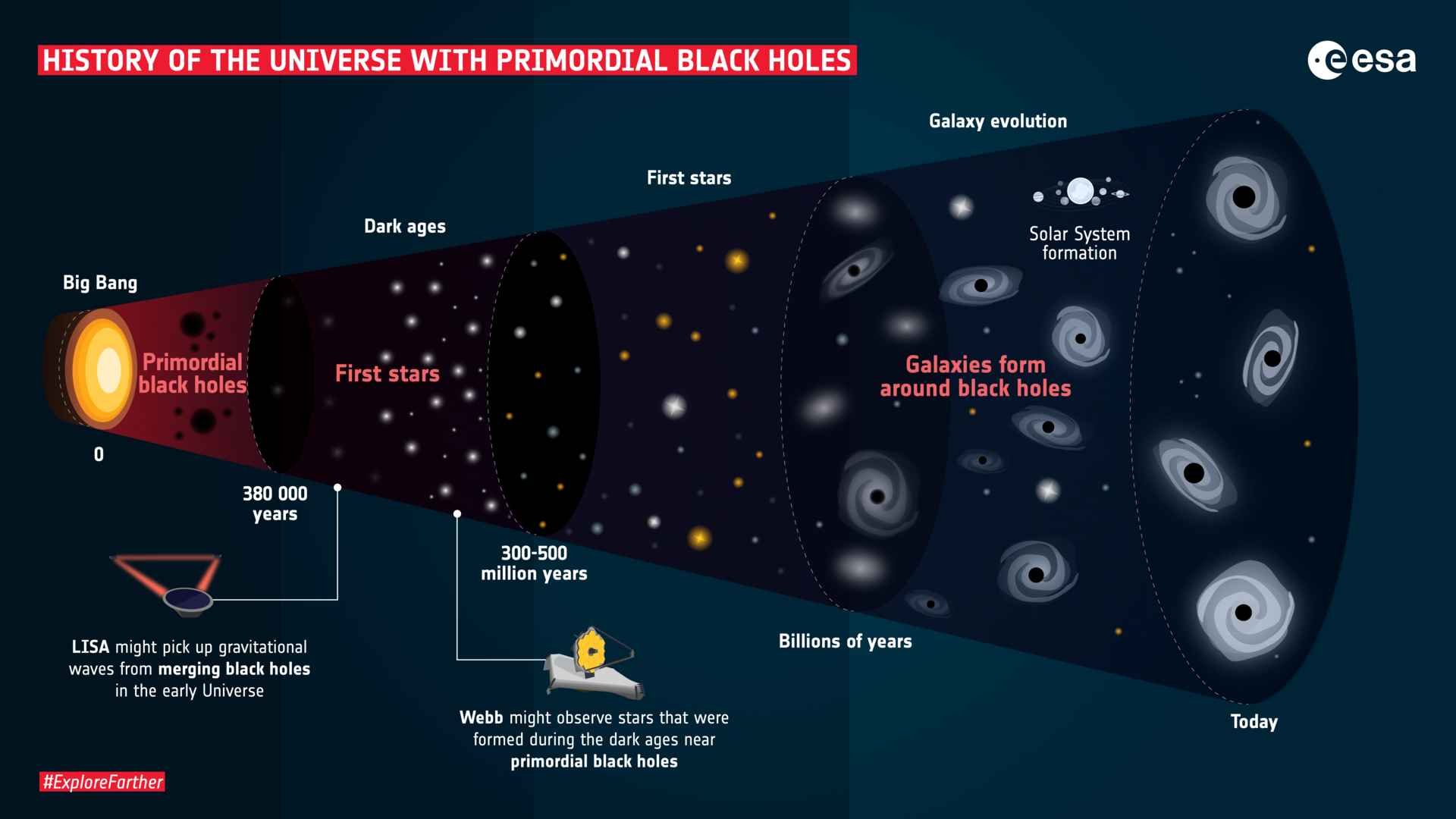
The discovery of black hole stars provides a potential solution. If a quasi-star forms, it allows a black hole to grow at an accelerated rate. Because the black hole is embedded within a massive reservoir of gas (the star itself), it can accrete matter much faster than a black hole floating in a vacuum or at the center of a sparse galaxy.
According to researchers, this process creates a “fast track” for black hole growth:
- Rapid Mass Accumulation: The internal black hole feeds on the star’s bulk, growing exponentially.
- Seed Formation: Once the stellar envelope is gone, the result is a “heavy seed” black hole, far larger than those created by the collapse of a single standard star.
- Jump-starting Galaxies: These heavy seeds then merge and accrete further gas, quickly becoming the supermassive black holes found at the centers of galaxies today.
This mechanism explains how the universe produced giants so quickly, transforming the “little red dots” from mere curiosities into the missing link of cosmic history.
What are the implications for our understanding of the early universe?
The confirmation of black hole stars would rewrite the timeline of the early universe. It suggests that the relationship between stars and black holes was more symbiotic and integrated than previously thought. Rather than black holes being the “afterlife” of stars, some of the largest black holes may have been born inside the first generation of stars.
This discovery also impacts how scientists search for the “First Light” of the universe. If quasi-stars were common, the early universe was likely filled with these hyper-luminous, red objects, which would have influenced the ionization of the surrounding gas and the formation of the first galaxies.
Furthermore, this research highlights the necessity of infrared astronomy. Because these objects are so distant and shrouded in dust, they are invisible to telescopes like Hubble. The ability of JWST to “see” through dust and capture redshifted light is the only reason these “little red dots” are now being analyzed.
For more on how the telescope operates, see a related explainer on JWST infrared sensors.
Common misconceptions about black hole stars
Because the term “black hole star” sounds like science fiction, several misconceptions often arise. It is important to distinguish these theoretical objects from other known phenomena.

Misconception 1: They are “dying” stars.
Standard black holes form when a massive star dies and collapses. A quasi-star is different; the black hole forms during the star’s early life. The star doesn’t die to create the black hole; the black hole powers the star’s existence.
Misconception 2: They are the same as Quasars.
While both are powered by black hole accretion, a quasar is a supermassive black hole at the center of a galaxy, often consuming gas from the entire galactic neighborhood. A quasi-star is a single, massive stellar object. A quasi-star could potentially evolve into a quasar over millions of years.
Misconception 3: They exist in our neighborhood.
Quasi-stars required the specific conditions of the early universe—namely, massive clouds of pristine hydrogen and helium without the heavy elements (metals) that characterize modern gas clouds. These conditions no longer exist, meaning black hole stars are likely extinct in the modern era.
FAQ: Understanding ‘Black hole stars’ and the Webb findings
What exactly is a “little red dot” in space?
A “little red dot” is a term used by astronomers to describe compact, highly luminous, red objects found in the early universe. Recent data from the James Webb Space Telescope suggests these are actually “black hole stars” or quasi-stars.
Can a black hole really be inside a star?
In the theoretical model of a quasi-star, yes. A seed black hole forms at the core of a massive gas cloud. The energy released as the black hole consumes the surrounding gas creates enough pressure to keep the star’s outer layers from collapsing, effectively housing the black hole inside a stellar shell.
How did the James Webb Space Telescope find this evidence?
JWST uses high-resolution infrared instruments to detect light that has been stretched (redshifted) over billions of years. By analyzing the spectra and brightness of these objects, scientists found they match the predicted characteristics of quasi-stars rather than standard galaxies.
Why does this matter for the history of the universe?
It solves the “seed problem” of supermassive black holes. It explains how black holes could grow to millions of solar masses so quickly after the Big Bang, as the quasi-star structure allows for much faster accretion than standard methods.
Are there any black hole stars in the Milky Way?
No. The conditions required to form quasi-stars—specifically the lack of heavy elements in the gas clouds—only existed in the very early universe. They are ancient objects that existed billions of years ago.
As researchers continue to analyze the deep-field data from the James Webb Space Telescope, the number of “little red dots” being identified is increasing. Each new detection provides more data to refine the models of how the first structures in the cosmos formed and how the supermassive black holes we see today began as tiny, hungry seeds inside the universe’s first giant stars.
