
Live Updates: US Military Claims Targeted Oil Transport Vessel Near Oman
A U.S. military operation near the Strait of Hormuz has sparked international concern after officials reported engaging a vessel allegedly transporting Iranian crude oil. The incident, which occurred in international waters off the coast of Oman, has raised questions about regional security and the potential for escalated tensions between Washington and Tehran. According to a statement from the U.S. Central Command, the action was taken to “disrupt illicit oil trafficking networks,” though details remain sparse.
What Happened and Where?
The confrontation unfolded on [insert date], when a U.S. naval asset intercepted a commercial tanker navigating through the strategic waterway. While the U.S. has not disclosed the vessel’s flag state, reports indicate the ship was carrying a cargo of crude oil sourced from Iran. The military confirmed the use of “non-lethal force” to disable the vessel, though no casualties were immediately reported. The incident occurred in a region already fraught with geopolitical volatility, given the ongoing U.S.-Iran nuclear negotiations and recent skirmishes in the region.
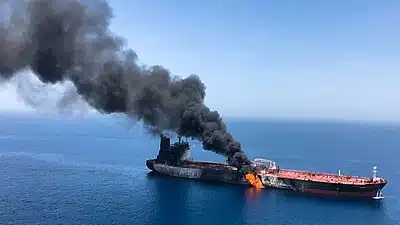
Key details from the U.S. statement include:
- Operation conducted by a U.S. Navy aircraft
- Target vessel identified as a “foreign-flagged ship” transporting Iranian oil
- Use of “precision-guided munitions” to disable the vessel
Local maritime authorities in Oman have not yet released an official response, but regional shipping experts note the area’s significance as a chokepoint for global oil trade. The Strait of Hormuz, through which approximately 20% of the world’s oil supply passes, has been a flashpoint for tensions between Iran and Western powers for decades.
Who Is Involved?
The incident involves multiple stakeholders, including the U.S. military, Iranian authorities, and commercial shipping entities. While the U.S. has not named the vessel’s operator, maritime tracking data suggests it may be registered under a third-party flag, a common practice for circumventing sanctions. Iranian officials have yet to comment publicly, though their state media has previously condemned similar U.S. actions as “aggressive provocations.”
India has also entered the narrative, as the tanker reportedly employed Indian seafarers. The Indian Ministry of External Affairs confirmed that three crew members were unaccounted for following the incident, with 21 others rescued. This development has prompted diplomatic discussions between New Delhi and Washington, highlighting the complex web of interests in the region.
How Did the Situation Escalate?
The incident follows a series of recent confrontations in the Persian Gulf. In [insert year], the U.S. and Iran engaged in a missile exchange after a U.S. drone was shot down near the Strait of Hormuz. More recently, attacks on oil tankers in 2019 and 2021 have raised concerns about maritime security. The current event appears to be part of a broader pattern of U.S. efforts to counter Iranian influence in the region, particularly through maritime interdiction operations.
Experts suggest the U.S. action may be tied to its “maximum pressure” campaign against Iran, which includes sanctions targeting the country’s oil exports. However, the operation’s timing—amid ongoing negotiations over Iran’s nuclear program—has led to speculation about its strategic intent. Some analysts argue the move could be a test of Iran’s response capabilities, while others view it as a warning to shipping companies involved in Iranian trade.
What Are the Implications?
The incident has immediate and long-term implications for regional stability. In the short term, it risks disrupting oil shipments through the Strait of Hormuz, a critical artery for global energy markets. The International Energy Agency (IEA) has warned that any prolonged disruption could lead to price volatility, though current market reactions have been relatively muted.
Longer-term consequences include potential diplomatic fallout. India’s involvement, via its seafarers, has added a new layer of complexity. The Indian government has reportedly summoned the U.S. ambassador to express concerns about the safety of its citizens, signaling a possible shift in New Delhi’s approach to U.S.-Iran dynamics. This development could influence India’s energy policy, which has traditionally balanced relations with both Washington and Tehran.
For the U.S., the operation may have unintended consequences. While it aims to deter Iranian oil exports, it could also provoke retaliatory actions from Iran or its proxies. The U.S. has previously faced criticism for such operations, with some analysts arguing they risk escalating tensions in an already volatile region.
What Do Officials Say?
A U.S. military spokesperson stated, “Our forces are committed to upholding international law and preventing the proliferation of illicit goods. This operation was conducted in accordance with established protocols and the principle of proportionality.” However, the statement did not address questions about the vessel’s legal status or the criteria used to justify the attack.

Indian officials have called for a transparent investigation. A ministry statement read, “We urge all parties to prioritize the safety of maritime workers and ensure compliance with international maritime law.” The Indian government has also requested information about the vessel’s cargo and the circumstances of the attack.
Iranian officials have remained silent, but regional analysts note that the country has a history of responding to such incidents with diplomatic protests or covert actions. The Islamic Revolutionary Guard Corps (IRGC) has previously threatened to target U.S. assets in the region, though no such response has been reported yet.
How Does This Compare to Past Incidents?
This incident bears similarities to the 2019 attacks on Saudi oil facilities, which were attributed to Iran by the U.S. and its allies. However, the current event differs in that it involves a commercial vessel rather than infrastructure. The 2021 attack on a Norwegian tanker in the same region also saw U.S. involvement, though the details remain classified.
Comparisons to the 2016 U.S. drone strike that killed Iranian general Qasem Soleimani highlight the potential for escalation. While the current operation appears limited in scope, it underscores the fragile balance of power in the region. Analysts caution that any miscalc
