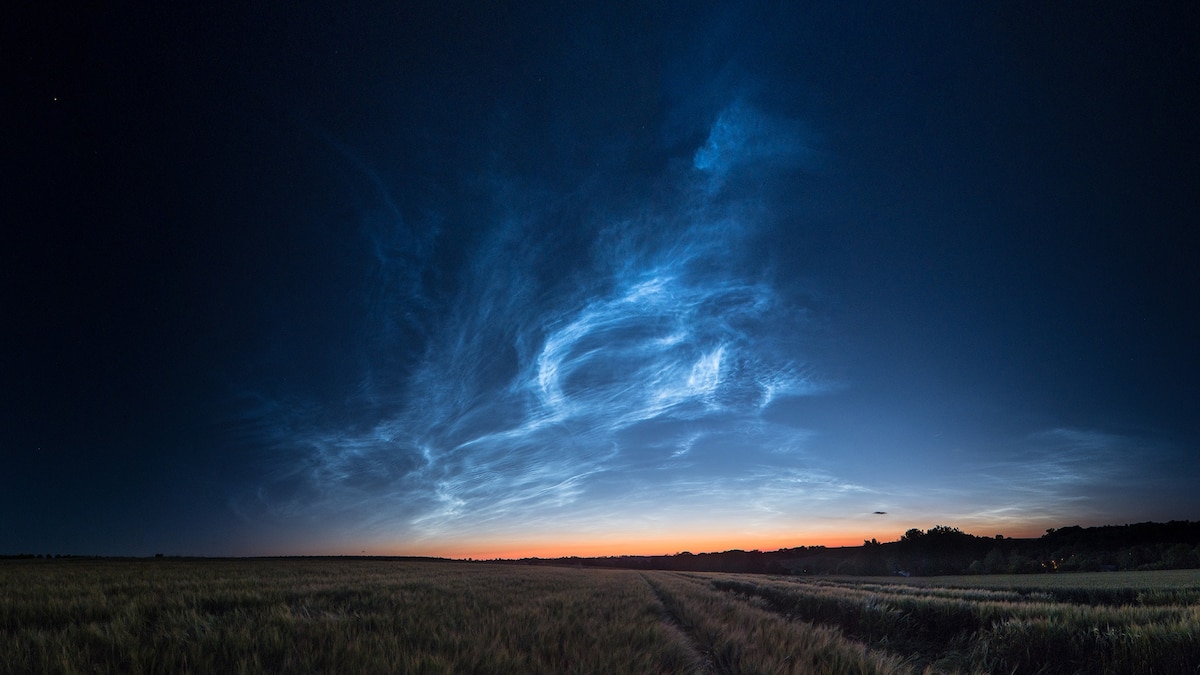
How to Spot These Electric-Blue Clouds That Form at the Edge of Space – National Geographic Guide
Noctilucent clouds, described as electric-blue and luminous, appear in the Northern Hemisphere’s upper atmosphere during summer months. According to reports from National Geographic, these “night-shining” clouds form in the mesosphere—the edge of space—and become visible after sunset when the sun illuminates them from below the horizon.
What are noctilucent clouds?
Noctilucent clouds (NLCs) are the highest clouds in Earth’s atmosphere. While standard clouds form in the troposphere, NLCs reside in the mesosphere, roughly 50 miles (80 kilometers) above the surface. The term “noctilucent” is derived from the Latin words nox (night) and lucens (shining), reflecting their ability to remain visible long after the sun has set for observers on the ground.
These clouds consist of tiny ice crystals that cling to particles of “space dust”—microscopic debris left behind by disintegrating meteors. Because of their extreme altitude, they remain in the sunlight even when the lower atmosphere is in total darkness. This creates a glowing, electric-blue or silvery effect against the dark night sky.
Key characteristics of these clouds include:
- Color: Typically a bright, electric-blue or shimmering silver.
- Texture: Often appear as thin, wavy filaments or undulating ripples.
- Altitude: Located in the mesosphere, far above the reach of weather balloons or commercial aircraft.
- Seasonality: Primarily visible during the summer months in high-latitude regions.
How to spot these electric-blue clouds that form at the edge of space?
Spotting noctilucent clouds requires a specific combination of timing, geography, and atmospheric conditions. According to National Geographic, the primary requirement is a clear view of the northern horizon after the sun has set.
To increase the chances of a sighting, observers should follow these specific steps:
1. Timing the Observation
Noctilucent clouds are only visible during a narrow window of time. They appear after sunset, but not in total darkness. The sun must be between 6 and 16 degrees below the horizon. At this angle, the sun is low enough to leave the ground in shadow but high enough to strike the ice crystals in the mesosphere.
2. Finding the Right Location
These clouds are most frequent at latitudes between 50° and 70° North. While they are most common in places like Scandinavia, Canada, and Russia, they have increasingly been spotted further south in the United States and Central Europe. Observers should face north to see the glow emanating from the edge of the planet.
3. Checking Atmospheric Conditions
A clear, cloudless sky in the lower atmosphere is mandatory. If there is heavy cloud cover in the troposphere, the view of the mesosphere will be blocked. High-pressure systems, which typically bring clear skies, provide the best viewing opportunities.
“Photographers capture the mysterious glow after sunset by looking for the luminous, space-like structures that emerge as the lower atmosphere darkens,” according to National Geographic reporting on the phenomenon.
Why do these clouds form at the edge of space?
The formation of noctilucent clouds is a result of extreme temperature drops and the presence of cosmic dust. The mesosphere is usually too dry for clouds to form, but during the summer, it paradoxically becomes the coldest place in the entire atmosphere.
According to atmospheric science, several factors must align for NLCs to manifest:
- Extreme Cold: Temperatures in the summer mesosphere can drop below -130 degrees Celsius (-200 degrees Fahrenheit), allowing water vapor to freeze.
- Water Vapor: Small amounts of water vapor must be present. Some of this vapor comes from methane in the lower atmosphere, which rises and oxidizes into water.
- Nucleation Sites: Ice crystals cannot form in a vacuum; they need a surface to latch onto. Meteoric smoke—tiny particles of dust from space—acts as the “seed” or nucleus for the ice crystals.
When these three elements combine, the water vapor freezes onto the space dust, creating the shimmering ice clouds that define the noctilucent phenomenon.
Where and when are noctilucent clouds most visible?
Visibility is strictly seasonal and geographic. In the Northern Hemisphere, the peak window occurs from June through August. This timing coincides with the period when the mesosphere reaches its minimum temperature.
The following table outlines the primary viewing parameters for those attempting to find these clouds:
| Factor | Optimal Condition | Reasoning |
|---|---|---|
| Hemisphere | Northern | More frequent and documented in high northern latitudes. |
| Season | June to August | Mesosphere reaches its coldest temperatures during this window. |
| Time of Day | Post-Sunset / Pre-Dawn | Sun must be below the horizon but still illuminating the upper atmosphere. |
| Direction | North | The clouds form in the high-latitude polar regions. |
| Latitude | 50°N to 70°N | The “sweet spot” for ice crystal stability and viewing angles. |
How do these clouds differ from standard clouds?
Most people confuse noctilucent clouds with cirrus clouds or the aurora borealis. However, NLCs are physically and chemically distinct from both.
Standard clouds, such as cumulus or cirrus, form in the troposphere (up to 12 miles high). They are composed of water droplets or ice crystals that are influenced by surface weather patterns. In contrast, noctilucent clouds are influenced by solar cycles and cosmic debris.
Compared to the Aurora Borealis, which is caused by charged particles from the sun interacting with the Earth’s magnetic field to create light, NLCs are not “light shows.” They are physical objects—ice crystals—that reflect existing sunlight. While the aurora often shifts in green and purple hues, NLCs maintain a steady electric-blue or silvery white glow.
For those interested in other atmospheric anomalies, a related explainer on the aurora borealis provides a comparison of light-based vs. matter-based sky phenomena.
What does the appearance of these clouds indicate about the atmosphere?
Scientists monitor noctilucent clouds because they serve as “canaries in the coal mine” for changes in the upper atmosphere. While they are a natural phenomenon, their increasing frequency and visibility at lower latitudes have raised questions among climate researchers.
According to research on atmospheric trends, two main drivers may be influencing the rise of NLCs:
Methane Levels and Water Vapor
Methane (CH4) is a potent greenhouse gas. When methane reaches the upper atmosphere, it undergoes a chemical reaction with hydroxyl radicals, which produces water vapor. An increase in methane emissions on the ground can lead to more water vapor in the mesosphere, providing more “fuel” for the formation of noctilucent clouds.
Temperature Shifts
While the lower atmosphere is warming due to the greenhouse effect, the upper atmosphere (the mesosphere) is actually cooling. This cooling is a predicted consequence of heat being trapped in the lower layers of the atmosphere. Cooler mesospheric temperatures make it easier for water vapor to freeze into ice crystals, increasing the likelihood of NLC sightings.
Consequently, the “mysterious glow” captured by photographers may be a visual indicator of long-term chemical and thermal changes in the Earth’s atmospheric layers.
Common misconceptions about night-shining clouds
Several myths persist regarding these luminous clouds. Correcting these helps observers identify the phenomenon accurately.
- Misconception: They are the same as “sun dogs” or halos.
Halos and sun dogs are caused by ice crystals in the troposphere reflecting light. NLCs are vastly higher and only visible when the sun is below the horizon. - Misconception: They are caused by pollution.
While some pollutants can act as nuclei for clouds, NLCs primarily rely on meteoric smoke (space dust) and water vapor. - Misconception: They are visible every night in summer.
They require a precise solar angle and a clear sky. Even in peak season, they may only appear for a few nights a month.
For photographers, capturing these clouds requires a tripod and a long exposure setting. Because the light is faint, a slow shutter speed allows the camera to gather enough of the electric-blue light to make the filaments pop against the dark background.
Frequently Asked Questions
Are noctilucent clouds dangerous?
No. Noctilucent clouds are a benign atmospheric phenomenon. They occur 50 miles above the Earth and have no direct impact on surface weather or human health.

Can I see noctilucent clouds in the Southern Hemisphere?
Yes, but they are significantly rarer. While they have been documented in the Southern Hemisphere, the atmospheric conditions and water vapor levels in the southern mesosphere are generally less conducive to their formation than in the north.
What is the difference between noctilucent clouds and nacreous clouds?
Nacreous clouds (polar stratospheric clouds) form in the stratosphere, which is lower than the mesosphere. Nacreous clouds are often more colorful (iridescent) and can be seen even when the sun is above the horizon, whereas noctilucent clouds specifically shine at night.
Why do they look blue?
The blue color is a result of the way the tiny ice crystals scatter sunlight. Similar to why the sky is blue during the day (Rayleigh scattering), the specific size of the ice crystals in the mesosphere preferentially scatters the shorter, blue wavelengths of light.
Do I need a telescope to see them?
No. Noctilucent clouds are visible to the naked eye, provided you are in the right location at the right time. A telescope is not necessary, though a camera with a wide-angle lens is helpful for capturing the scale of the formations.
As observers continue to track these phenomena, the data gathered by both citizen scientists and professional astronomers helps refine our understanding of the mesosphere. The presence of these electric-blue clouds remains one of the most visually striking reminders of the complex interaction between Earth’s atmosphere and the debris of the solar system.
