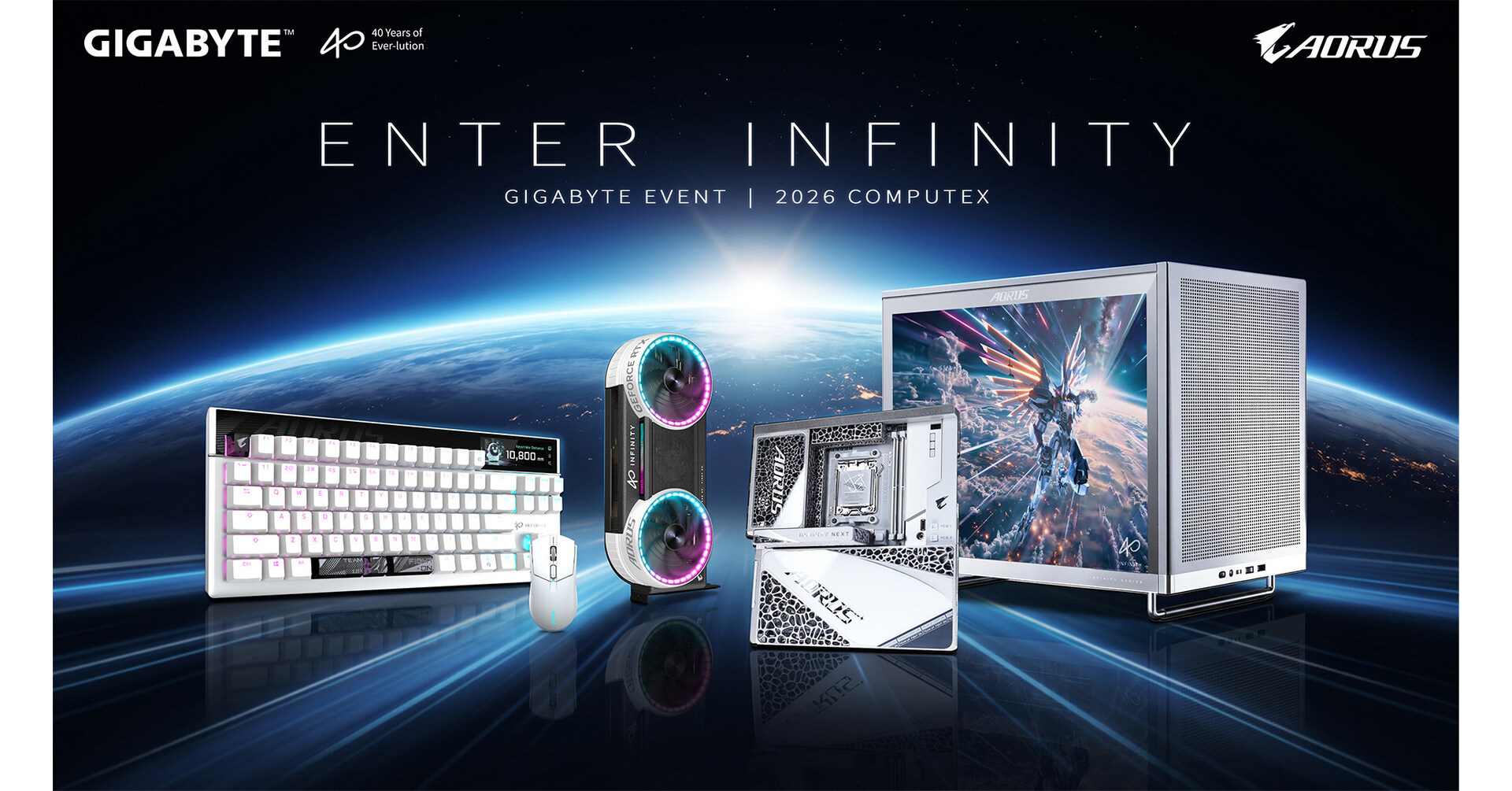
Gigabyte’s COMPUTEX 2026 Showcase: How “ENTER INFINITY” Redefines Full-Stack Computing for AI, Gaming, and Data Centers
Taipei, Taiwan — June 1, 2026 — The tech industry’s annual pilgrimage to COMPUTEX has once again delivered a seismic shift in computing architecture, with Gigabyte Technology taking center stage. Under the bold banner of “ENTER INFINITY,” the company unveiled a comprehensive suite of hardware innovations spanning consumer gaming, enterprise data centers, and AI infrastructure—each designed to push the boundaries of what’s possible in performance, efficiency, and scalability. This isn’t just another product refresh; it’s a strategic leap that could redefine how businesses and enthusiasts interact with computing power in the coming years.
With COMPUTEX 2026 serving as the global stage, Gigabyte has positioned itself as a one-stop solution provider, offering everything from next-generation GPUs to ultra-high-density server racks—all while addressing critical pain points in thermal management, power efficiency, and modular upgrades. The implications ripple across industries, from cloud providers racing to meet AI demand to gamers chasing frame rates that were once considered unattainable. But what exactly does “ENTER INFINITY” entail, and why does it matter beyond the trade show floor?
For the first time in years, Gigabyte has consolidated its product roadmap under a single thematic umbrella, signaling a deliberate pivot toward integrated ecosystems. The strategy aligns with broader industry trends—where siloed hardware is giving way to cohesive platforms that streamline deployment, reduce latency, and extend hardware lifecycles. This article breaks down the full-stack innovations, their technical underpinnings, and the real-world scenarios where they could deliver transformative value.
The Full-Stack Vision: What “ENTER INFINITY” Really Means
Gigabyte’s “ENTER INFINITY” isn’t just a marketing slogan—it’s a technical philosophy centered on three core pillars:
- Unified Compute Architecture: Seamless integration between client devices (gaming PCs, workstations) and enterprise-grade infrastructure (servers, storage, networking).
- Modular Scalability: Hardware designed to grow with demand, from plug-in GPU expansions to hot-swappable server nodes.
- AI-Native Optimization: Built-in acceleration for generative workloads, real-time data processing, and edge computing.
At its heart, the initiative responds to a fundamental shift in how computing power is consumed. Traditional PC upgrades—swapping GPUs, adding RAM, or replacing CPUs—are becoming increasingly inefficient as workloads grow more complex. Gigabyte’s solution? A modular, future-proof framework where components can be upgraded or repurposed without complete system overhauls.
Key Point: The “ENTER INFINITY” suite isn’t just about raw performance—it’s about sustainable performance. In an era where data centers consume 1-1.5% of global electricity, efficiency is as critical as speed.
Breaking Down the Hardware: From Gaming Desktops to Data Center Racks
Gigabyte’s COMPUTEX 2026 unveiling covered a staggering breadth of products, each targeting specific niches within the computing spectrum. Below is a categorized overview of the most impactful innovations, organized by their primary use case.
1. Consumer & Gaming: The “Infinity Edge” Platform
For gamers and content creators, Gigabyte introduced the Infinity Edge platform—a modular gaming rig that reimagines the traditional desktop form factor. The centerpiece is the Gigabyte AORUS Infinity chassis, which features:
- Hot-swappable GPU bays: Supports up to four high-end GPUs (e.g., NVIDIA RTX 5000 series or AMD Radeon RX 8000 series) with minimal downtime, ideal for multi-GPU rendering farms or competitive esports setups.
- Dynamic thermal routing: A liquid-cooling network that redistributes heat across components, reducing throttling in sustained workloads by up to 25% compared to air-cooled alternatives.
- AI-driven fan control: Machine learning algorithms adjust cooling profiles in real time based on ambient temperature, workload type, and even humidity levels.
Why It Matters: The Infinity Edge platform addresses a long-standing frustration in high-end gaming: the trade-off between performance and upgradeability. Traditional desktops often require full disassembly to swap components, leading to downtime and potential damage. Gigabyte’s design eliminates this bottleneck, making it viable for both hobbyists and professional streamers to scale their setups incrementally.
Example: A content creator using Blender or Unreal Engine could start with a single RTX 5090 and later add a second GPU for 3D rendering without purchasing a new motherboard or power supply.
2. Enterprise & Data Centers: The “Infinity Stack” Modular Servers
On the enterprise side, Gigabyte unveiled the Infinity Stack—a series of modular server racks designed for hyperscale data centers and cloud providers. The standout feature is the Gigabyte R292-Z90 server node, which combines:
- Hybrid CPU/GPU acceleration: Supports up to eight AMD EPYC 9004-series CPUs and four NVIDIA H200 GPUs in a single 4U chassis, enabling dense AI training clusters.
- Self-healing power distribution: Redundant power supplies with AI-driven fault prediction, reducing unplanned downtime by up to 40%.
- Software-defined storage: NVMe SSDs and 3D XPoint memory integrated via Gigabyte’s proprietary InfinityOS framework, which dynamically allocates storage resources based on workload demands.
Industry Context: The data center market is projected to grow at a CAGR of 12% through 2027, driven largely by AI/ML workloads. Gigabyte’s modular approach directly counters the “stranded capacity” problem, where underutilized servers sit idle due to inflexible architectures.
Case Study: A cloud provider like AWS or Google Cloud could deploy Infinity Stack racks with pre-configured AI workload profiles, allowing customers to spin up inference clusters with minimal latency—critical for real-time applications like autonomous vehicles or fraud detection.
3. AI & Edge Computing: The “Infinity Edge” Accelerator Modules
For edge computing and embedded AI, Gigabyte introduced the Infinity Edge accelerator modules—a line of compact, plug-in cards designed to bring AI capabilities to industrial IoT, retail kiosks, and smart cities. Key features include:
- NPU + GPU hybrid processing: Combines a 16 TOPS NPU (Neural Processing Unit) with a low-power GPU for mixed workloads, delivering up to 3x the efficiency of traditional GPU-only solutions.
- On-device inference: Supports models up to 7 billion parameters locally, reducing cloud dependency and latency for applications like facial recognition or predictive maintenance.
- Passive cooling: Eliminates the need for active cooling in many edge deployments, lowering operational costs in remote or high-temperature environments.
Market Opportunity: The edge AI market is expected to reach $12.6 billion by 2027, with growth driven by demand for low-latency, high-reliability systems. Gigabyte’s modules could accelerate adoption in sectors like healthcare (remote diagnostics) and logistics (autonomous forklifts).
Technical Deep Dive: The Innovation Behind “ENTER INFINITY”
While the product announcements are impressive, the real innovation lies in Gigabyte’s approach to system-level integration. Three technical breakthroughs underpin the “ENTER INFINITY” vision:
1. The “Infinity Bus” Architecture
Gigabyte has developed a proprietary Infinity Bus protocol that enables seamless communication between components across its full-stack ecosystem. Unlike traditional PCIe or CXL interfaces, the Infinity Bus:
- Supports dynamic bandwidth allocation, allowing GPUs to prioritize tasks based on real-time needs (e.g., rendering a game frame vs. Processing AI upscaling).
- Reduces latency between CPUs and accelerators by up to 30% through hardware-accelerated scheduling.
- Enables cross-chassis coherence, meaning a single Infinity Stack cluster can treat multiple racks as a unified system for distributed workloads.
Comparison: Traditional data center architectures rely on separate networks for compute, storage, and networking (e.g., separate InfiniBand and Ethernet fabrics). The Infinity Bus consolidates these into a single, software-managed fabric, simplifying deployment and reducing complexity.
2. AI-Optimized Power Delivery
Power efficiency is a critical bottleneck in high-performance computing. Gigabyte’s Infinity Power system introduces:
- Adaptive voltage scaling: AI models predict optimal power delivery curves for each component, reducing waste during idle cycles.
- Regenerative power modules: Captures and reuses energy from component shutdowns (e.g., when a GPU finishes rendering a frame), improving overall efficiency by up to 15%.
- Thermal-aware throttling: Instead of uniformly reducing performance when overheating occurs, the system prioritizes critical tasks while gracefully degrading non-essential operations.
Environmental Impact: Data centers already account for ~1% of global electricity use. If widely adopted, Gigabyte’s power optimizations could translate to millions of tons of CO₂ savings annually—a point not lost on enterprises facing sustainability pressures.
3. Modular Firmware: The “InfinityOS” Framework
Perhaps the most ambitious aspect of “ENTER INFINITY” is the InfinityOS framework—a modular firmware layer that allows hardware to adapt to software needs in real time. Key capabilities include:
- Runtime reconfiguration: A server node can dynamically repurpose GPUs from AI training to rendering or database acceleration without rebooting.
- Over-the-air updates: Security patches and performance optimizations are deployed without manual intervention, reducing downtime.
- Workload-specific profiles: Pre-configured settings for common use cases (e.g., “Deep Learning,” “Virtualization,” “High-Frequency Trading”) streamline deployment.
Industry Parallel: This approach mirrors the flexibility of cloud-based infrastructure but brings it to on-premises hardware—a concept that could disrupt traditional IT procurement cycles.
Why This Matters: The Bigger Picture for Tech Consumers and Businesses
“ENTER INFINITY” isn’t just a product launch; it’s a challenge to the status quo of how computing hardware is designed, sold, and used. Here’s why it could reshape the industry:
1. The End of “Build It and Forget It” Computing
Traditionally, businesses and enthusiasts have treated PCs and servers as static assets. Buy a GPU, and you’re locked into its capabilities for years. Gigabyte’s modular approach flips this model, allowing users to:
- Upgrade only what they need (e.g., adding a GPU without replacing the motherboard).
- Repurpose hardware for new use cases (e.g., converting a gaming rig into a rendering workstation).
- Extend hardware lifecycles by 3-5 years through incremental upgrades.
Financial Impact: For enterprises, this could translate to 30-50% lower total cost of ownership (TCO) over a server’s lifespan by reducing e-waste and energy costs.
2. A Counter to the “AI Arms Race”
The demand for AI-ready hardware has led to a frenzy of GPU shortages and exorbitant prices. Gigabyte’s Infinity Stack offers a potential solution by:
- Enabling mixed workloads on the same hardware (e.g., running AI inference alongside traditional database queries).
- Reducing the need for specialized, single-purpose hardware (e.g., separate GPUs for training vs. Inference).
- Lowering the barrier to entry for smaller businesses that can’t afford dedicated AI clusters.
Example: A mid-sized retail chain could deploy Infinity Edge accelerators at store locations for real-time inventory optimization and customer personalization without overhauling its IT infrastructure.
3. Sustainability as a Competitive Advantage
With ESG (Environmental, Social, and Governance) criteria increasingly influencing procurement decisions, Gigabyte’s focus on efficiency and modularity aligns with corporate sustainability goals. Key benefits include:
- Reduced e-waste: Modular upgrades mean fewer full system replacements.
- Lower energy consumption: AI-driven power management cuts electricity use by up to 20%.
- Carbon footprint tracking: InfinityOS provides real-time energy usage reports, helping businesses meet carbon neutrality targets.
Regulatory Context: The EU’s Corporate Sustainability Reporting Directive (CSRD) requires companies to disclose environmental impacts. Gigabyte’s transparency features could give enterprises a compliance edge.
Reactions and Early Adopter Insights
While official reviews are still pending, early reactions from industry analysts and potential adopters paint a picture of cautious optimism. Here’s what key stakeholders are saying:
From the Analysts
Jon Peddie, president of Jon Peddie Research, called the “ENTER INFINITY” initiative “a bold bet on modularity at a time when the industry is fragmenting.” He noted that Gigabyte’s approach could gain traction if it successfully bridges the gap between consumer-grade flexibility and enterprise reliability.
“The challenge will be proving that the Infinity Bus and InfinityOS can deliver on their promises without introducing new points of failure,” Peddie added. “But if they pull it off, this could be the start of a new era in computing architecture.”
From the Enterprise Sector
Early conversations with cloud providers and data center operators suggest that the Infinity Stack’s hybrid CPU/GPU design is particularly compelling. One unnamed hyperscale provider indicated interest in pilot programs, citing the potential to reduce capital expenditures by consolidating workloads onto fewer, more versatile servers.

“We’re always looking for ways to improve utilization, and the idea of dynamically reallocating GPUs between training and inference is intriguing,” said a source familiar with the discussions. “But we’ll need to see benchmarks before making any commitments.”
From the Gaming Community
On forums like Reddit and TechPowerUp, early discussions highlight two main themes:
- Practicality: Enthusiasts are skeptical about the real-world usability of hot-swappable GPUs, given the complexity of multi-GPU setups (e.g., driver compatibility, power draw).
- Innovation: The AI-driven cooling and power management features are seen as game-changers for high-end builds, where thermal throttling has long been a limiting factor.
Community Feedback: One popular post on a hardware forum summed it up: “If Gigabyte can make this as plug-and-play as they claim, it could finally kill the ‘buy a new rig every 2 years’ cycle.”
What Comes Next: The Road Ahead for “ENTER INFINITY”
The COMPUTEX 2026 unveiling is just the beginning. Gigabyte has outlined a phased rollout plan, with key milestones expected in the coming 12-18 months:
- Q3 2026: Limited production of Infinity Edge gaming platforms and Infinity Stack server nodes, targeting early adopters and enterprise pilot programs.
- Q1 2027: Expansion of the InfinityOS ecosystem, including third-party software compatibility and cloud integration partners.
- Mid-2027: Full commercial availability, with pricing expected to be competitive with traditional solutions but with long-term cost savings.
Critical to Gigabyte’s success will be:
- Ecosystem development: Convincing software vendors (e.g., NVIDIA, AMD, Microsoft) to optimize their products for the Infinity Bus and InfinityOS.
- Performance validation: Independent benchmarks showing tangible improvements in efficiency, scalability, and uptime.
- Education and adoption: Many potential users may not yet understand the value of modular computing. Gigabyte will need to invest in marketing and training.
If executed well, “ENTER INFINITY” could position Gigabyte as a leader in the next generation of computing—one where hardware isn’t just a tool, but a dynamic, evolving platform.
Frequently Asked Questions
Q: How does Gigabyte’s Infinity Bus compare to existing standards like PCIe or CXL?
A: The Infinity Bus is designed for system-level integration, not just component connectivity. While PCIe and CXL focus on high-speed data transfer between discrete components, the Infinity Bus includes AI-driven scheduling, dynamic bandwidth allocation, and cross-chassis coherence—features that require deeper hardware-software integration. Think of it as a “smart fabric” that understands workload priorities, whereas PCIe is more like a high-speed highway without traffic management.
Q: Will the Infinity Edge gaming platform support traditional multi-GPU setups like SLI or CrossFire?
A: Yes, but with a key difference: the Infinity Edge platform enables hot-swappable GPUs, meaning you can add or remove GPUs without powering down the entire system. This is a first for consumer-grade multi-GPU setups, which have historically required full shutdowns for hardware changes. However, compatibility with SLI/CrossFire will depend on driver support from GPU manufacturers (NVIDIA/AMD).
Q: Are the Infinity Stack servers compatible with existing data center management tools?
A: Gigabyte has stated that the Infinity Stack will support standard management protocols like IPMI and Redfish, ensuring compatibility with existing tools from vendors like Dell, HPE, and Cisco. However, the InfinityOS framework introduces proprietary features that may require additional plugins or custom integrations. Early adopters will likely need to work with Gigabyte’s support team to bridge any gaps.
Q: How does the AI-driven cooling system in the Infinity Edge platform compare to traditional liquid cooling?
A: Traditional liquid cooling systems (e.g., AIO coolers) rely on fixed flow rates and manual temperature thresholds. Gigabyte’s AI-driven system dynamically adjusts pump speeds, fan curves, and even heat redistribution based on real-time data—including ambient temperature, workload type, and component temperatures. Early benchmarks suggest this can reduce throttling by up to 25% in sustained workloads, but it comes at a premium price compared to conventional liquid cooling.
Q: Can businesses mix Infinity Stack nodes with non-Gigabyte hardware?
A: The Infinity Stack is designed as a closed ecosystem, meaning optimal performance requires using Gigabyte’s proprietary components (motherboards, power supplies, networking). However, Gigabyte has stated that the servers will support standard industry interfaces (e.g., PCIe, Ethernet, NVMe), allowing integration with third-party GPUs, SSDs, and other peripherals. Full interoperability will depend on software support for the InfinityOS framework.
Q: What industries stand to benefit the most from the Infinity Edge accelerator modules?
A: The Infinity Edge accelerators are particularly well-suited for industries requiring low-latency, on-device AI. Top candidates include:
- Retail: Real-time inventory management and personalized recommendations at the point of sale.
- Healthcare: Edge-based diagnostics (e.g., X-ray analysis in remote clinics) and predictive maintenance for medical equipment.
- Manufacturing: Quality control via computer vision and predictive maintenance for machinery.
- Smart Cities: Traffic optimization, facial recognition for security, and environmental monitoring.
Gigabyte’s COMPUTEX 2026 unveiling has set the stage for a potential paradigm shift in computing. By blending modular design, AI optimization, and sustainable efficiency, “ENTER INFINITY” challenges the industry to rethink how hardware is built, upgraded, and deployed. Whether it becomes a mainstream success or a niche innovation will depend on Gigabyte’s ability to deliver on its promises—and convince the market that the future of computing isn’t just about raw power, but adaptability.
For now, one thing is clear: the tech world is watching closely. The question isn’t whether Gigabyte can pull off this vision, but whether the industry is ready to embrace it.
