GW250114 Reveals Signatures of Post-Merger Black-Hole Horizon – Nature
The gravitational wave event GW250114 has provided the first detectable signatures of a black hole’s event horizon following a merger, according to research published in Nature. This detection identifies specific “fingerprints” in the gravitational waves emitted as two black holes collided and settled into a single entity, offering direct evidence of the region where gravity becomes so intense that nothing, including light, can escape.
What is GW250114 and why is it significant?
GW250114 is a specific gravitational wave signal captured by global detector networks. According to reports from ScienceAlert and Nature, this event is distinguished by the clarity of its “post-merger” phase. While previous detections focused on the inspiral—the process of two black holes orbiting each other—and the merger itself, GW250114 contains high-fidelity data regarding the resulting black hole’s stabilization.
The significance lies in the detection of the event horizon, often called the “point of no return.” For decades, the event horizon remained a theoretical necessity of General Relativity. While the Event Horizon Telescope (EHT) has provided visual “shadows” of black holes, GW250114 provides a dynamical signature. The Conversation describes this as a “direct wave” that reveals the physical properties of the horizon as it forms and vibrates.
Key aspects of the GW250114 event include:
- The Ringdown Phase: The period immediately after the merger where the new black hole “rings” like a bell, emitting specific frequencies of gravitational waves.
- Horizon Signatures: The specific patterns in those vibrations that correspond to the geometry of the event horizon.
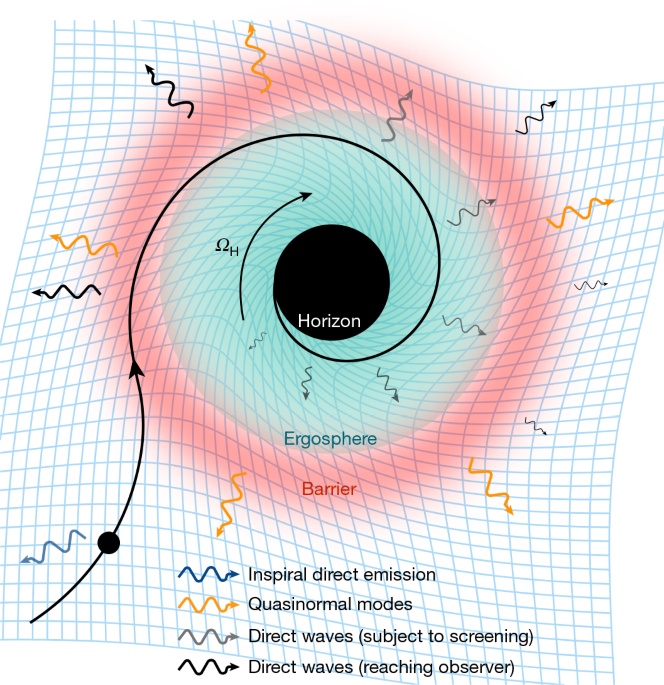
- Spacetime Distortion: The evidence of a “whirlpool” effect in the fabric of spacetime caused by the extreme mass and rotation of the merged object.
How do gravitational waves reveal a black hole’s event horizon?
Detecting a horizon is challenging because the horizon itself emits no light. Instead, scientists analyze the “ringdown” signal. According to Nature, when two black holes merge, the resulting object is initially distorted. To reach a stable, spherical or spheroidal state, it sheds excess energy through gravitational waves.
These waves carry information about the black hole’s mass and spin. If an event horizon exists, the waves should dampen in a very specific way. If the object were a different kind of ultra-compact object without a horizon (such as a boson star), the waves would behave differently, potentially “echoing” back from the center. The data from GW250114 shows a damping pattern consistent with a true event horizon, which ScienceAlert characterizes as the “fingerprints” of the black hole’s boundary.

The detection of these signatures suggests that the merged object possesses a boundary from which no information can return, confirming a core prediction of Einstein’s General Relativity.
To understand this process, it helps to view the merger in three distinct stages:
| Stage | Action | Signal Characteristic |
|---|---|---|
| Inspiral | Two black holes orbit each other, closing the gap. | Increasing frequency and amplitude (the “chirp”). |
| Merger | The horizons touch and fuse into one. | Peak gravitational wave intensity. |
| Ringdown | The new black hole settles into a stable shape. | Exponentially decaying oscillations (the “fingerprints”). |
How does this discovery differ from previous black hole imaging?
The public is familiar with the images of M87* and Sagittarius A* produced by the Event Horizon Telescope. However, as noted by The Conversation, those images are essentially “photographs” of the accretion disk—the glowing gas surrounding the black hole—and the dark shadow cast by the horizon. They show where the horizon is, but they do not show how the horizon behaves during a violent event.
GW250114 provides a different type of evidence. Rather than using light (electromagnetic radiation), it uses gravitational waves (ripples in spacetime). This allows scientists to probe the “strong-field” regime of gravity. While the EHT shows a static or slowly evolving shadow, GW250114 reveals the horizon’s response to a massive collision.
According to Courthouse News, this provides “new clues” about the point of no return because it tests whether the horizon behaves as a perfect absorber of energy. The lack of “echoes” in the GW250114 signal suggests that the horizon is indeed a one-way street, absorbing the energy of the merger without reflecting any of it back into space.
Comparative Analysis: EHT vs. GW250114
The difference in methodology creates two distinct types of proof for the existence of event horizons:
- Visual Proof (EHT): Relies on the absence of light (the shadow) and the presence of orbiting plasma. It is an observation of the environment around the horizon.
- Dynamic Proof (GW250114): Relies on the decay of spacetime vibrations. It is an observation of the physical properties of the horizon itself.
What are the ‘fingerprints’ of a spacetime whirlpool?
The term “whirlpool in spacetime” used by The Conversation refers to the frame-dragging effect. A rotating black hole doesn’t just pull matter toward it; it drags the very fabric of space around with it. When two black holes merge, the resulting rotation is extreme, creating a violent twisting of spacetime.
The “fingerprints” mentioned in ScienceAlert and Nature are the specific quasi-normal modes (QNMs) of the ringdown. These are essentially the “natural frequencies” of the black hole. Just as a wine glass rings at a specific pitch based on its shape and material, a black hole rings at a specific frequency based on its mass, spin, and the presence of an event horizon.
By analyzing the GW250114 signal, researchers can determine if these frequencies match the predictions of the “No-Hair Theorem.” This theorem suggests that a black hole is characterized entirely by its mass, charge, and spin. If the ringdown frequencies deviated from these predictions, it would suggest that either General Relativity is incomplete or that the object is not a black hole.
The data from GW250114 aligns with the No-Hair Theorem, reinforcing the idea that the post-merger object is a Kerr black hole—the standard mathematical model for a rotating black hole in General Relativity.
Why does the ‘point of no return’ matter for physics?
The event horizon is more than just a boundary; it is the site of a fundamental conflict in physics. General Relativity describes the horizon as a smooth region that an observer would fall through without noticing anything unusual. However, quantum mechanics suggests that the horizon should be a place of high energy, sometimes referred to as a “firewall.”
By detecting the signatures of the horizon in GW250114, scientists can begin to search for deviations that might hint at quantum effects. According to Nature, the precision of the GW250114 data allows for a more rigorous test of whether the horizon is “smooth” as Einstein predicted or “structured” as some quantum gravity theories suggest.
If future detections show subtle “echoes” or deviations in the ringdown, it could lead to a breakthrough in unifying gravity with quantum mechanics. For now, GW250114 confirms the classical view: the event horizon is a silent, absorbing boundary.
Potential Implications for Future Research
- Testing General Relativity: Every new merger event like GW250114 acts as a stress test for Einstein’s equations in the most extreme environments possible.
- Mapping Black Hole Populations: Understanding the post-merger phase helps astronomers determine how black holes grow over cosmic time.
- Gravitational Wave Astronomy: This event proves that current detectors (like LIGO and Virgo) are sensitive enough to capture the ringdown phase, not just the merger.
For those interested in how we detect these ripples, a related explainer on gravitational wave detectors provides a detailed look at the interferometry used to capture these signals.
Common Misconceptions About Black Hole Horizons
The reporting on GW250114 often uses metaphors like “fingerprints” or “whirlpools,” which can lead to misunderstandings about what was actually detected. It is important to clarify several points:
Misconception 1: We have “seen” the horizon.
We have not seen the horizon in the sense of a visual image. GW250114 is a measurement of spacetime strain. We are “hearing” the horizon through gravitational waves, not “seeing” it with light.
Misconception 2: The event horizon is a physical surface.
The event horizon is not a solid shell or a membrane. It is a mathematical boundary. The “signatures” detected in GW250114 are not reflections off a surface, but the way spacetime itself settles after being violently disturbed.
Misconception 3: This proves black holes are “vacuum cleaners.”
While the event horizon is the point of no return, black holes do not “suck” objects in from great distances any more than a star of the same mass would. The GW250114 event occurred because two black holes were already in a tight orbit, not because they were randomly pulled across the galaxy.
Frequently Asked Questions
What is GW250114?
GW250114 is the designation for a gravitational wave event caused by the merger of two black holes. It is notable because it provided clear data on the “ringdown” phase, allowing scientists to detect signatures of the resulting black hole’s event horizon.
What does it mean to detect “signatures” of an event horizon?
It means that the vibrations (gravitational waves) emitted after the black holes merged decayed in a pattern that matches the theoretical predictions for an event horizon. The absence of “echoes” suggests that the horizon absorbed the energy, confirming it as a one-way boundary.
Is this the first time an event horizon has been detected?
While the Event Horizon Telescope has imaged the “shadow” of black holes, GW250114 is cited by sources like ScienceAlert and Nature as providing the first direct signatures of the horizon’s dynamical behavior via gravitational waves.
Why is this called a “spacetime whirlpool”?
This refers to frame-dragging, where a rotating black hole twists the fabric of spacetime around itself. The gravitational waves from GW250114 carry the imprint of this twisting motion, which occurs most intensely near the event horizon.
Does this discovery change our understanding of gravity?
It reinforces the current understanding. The data from GW250114 strongly supports Albert Einstein’s General Relativity and the No-Hair Theorem, showing that the event horizon behaves exactly as predicted by classical physics.
As detector sensitivity improves, researchers expect to find more events like GW250114. Each new signal provides a tighter constraint on the nature of gravity and brings physicists closer to understanding what happens at the absolute limit of spacetime.
