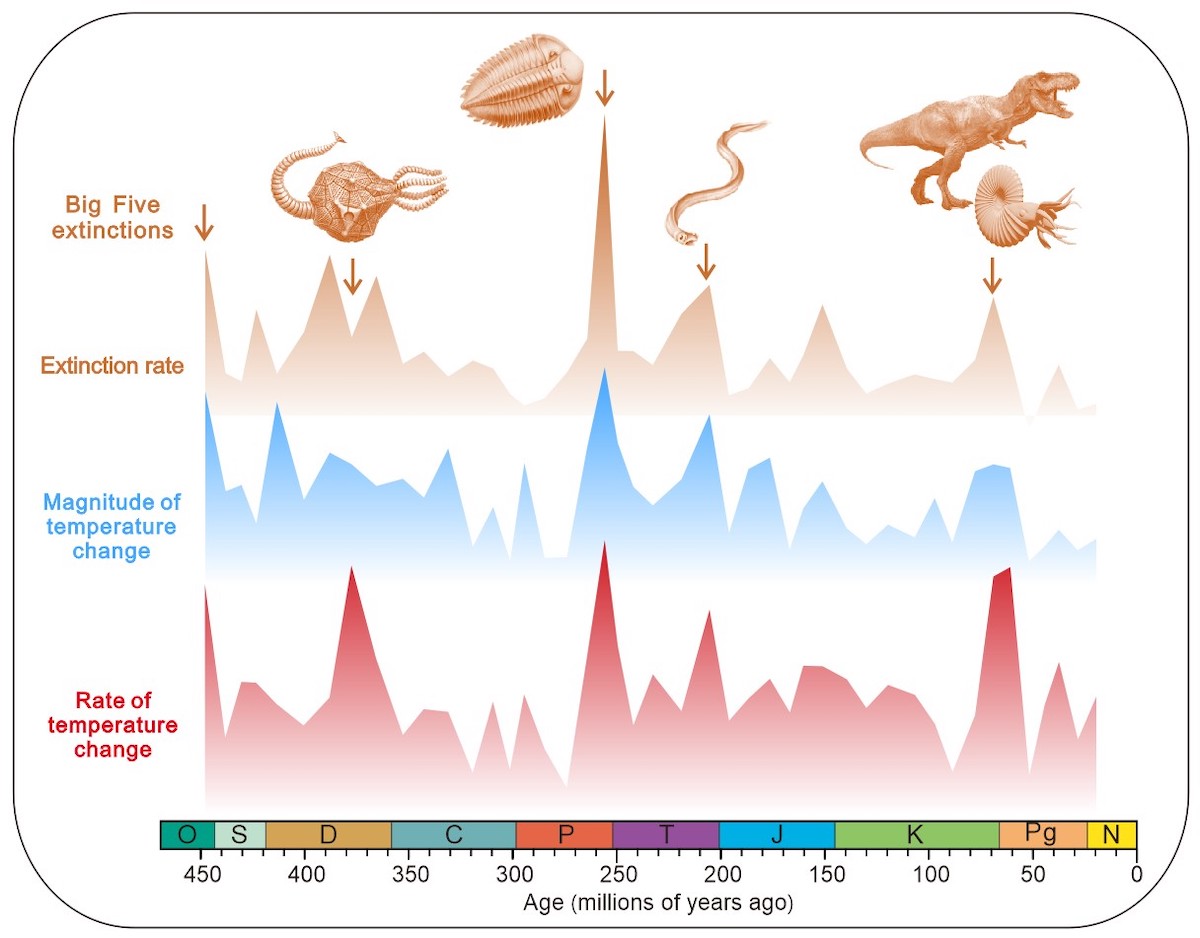
Did Gravitational Tides Cause Earth’s Extinctions? Analyzing Cosmic Triggers
Gravitational tides from the galactic plane and other celestial bodies may trigger mass extinctions on Earth by inducing extreme volcanic activity and destabilizing the planetary climate, according to research analyzed by Phys.org. This theory suggests that the solar system’s periodic movement through the Milky Way creates gravitational stresses that warp the Earth’s interior, potentially sparking the “flood basalt” eruptions linked to several of the planet’s greatest biological collapses.
How do gravitational tides trigger mass extinctions?
Gravitational tides are not limited to the ocean’s rise and fall caused by the moon. On a planetary scale, tidal forces occur when a gravitational gradient acts across a celestial body, stretching and compressing its physical structure. According to the research highlighted by Phys.org, these forces can penetrate deep into the Earth’s mantle and core.
When the solar system passes through denser regions of the galactic disk or interacts with massive external gravitational sources, the resulting “galactic tides” can create internal friction within the Earth. This process, known as tidal heating, converts gravitational energy into thermal energy. Scientists suggest that this heat can trigger the ascent of mantle plumes—massive columns of hot rock rising from the core-mantle boundary.
Once these plumes reach the crust, they result in Large Igneous Provinces (LIPs). These are not standard volcanic eruptions but catastrophic “flood basalts” that cover hundreds of thousands of square miles in lava. The resulting release of carbon dioxide and sulfur dioxide into the atmosphere leads to:
- Rapid Global Warming: Massive CO2 injections trigger a runaway greenhouse effect.
- Ocean Acidification: Carbon absorption by the oceans lowers pH levels, killing calcium-based marine life.
- Atmospheric Toxicity: Sulfur aerosols can block sunlight, causing “volcanic winters” followed by extreme heat.
The mechanism suggests a direct link between the solar system’s position in the galaxy and the geological instability of Earth, turning a cosmic orbit into a biological kill-switch.
What is the role of the galactic plane in these events?
The theory posits that the solar system does not move in a flat line through the Milky Way but rather “bobs” up and down through the galactic plane. As the sun and its planets cross the mid-plane of the galaxy, they encounter a higher density of stars and interstellar gas. According to the data, this increased mass increases the gravitational pull exerted on the solar system.
This periodic crossing happens on a cycle of roughly 30 to 35 million years. Researchers have noted a correlation between these crossings and the timing of several mass extinction events. The gravitational stress experienced during these crossings is believed to be the catalyst that pushes an already unstable mantle over the edge, initiating the volcanic events described above.
Key points regarding the galactic plane influence include:
- Gravitational Flux: The shift in gravitational potential as the solar system enters denser galactic regions.
- Oort Cloud Perturbation: These same tides may shake the Oort Cloud, sending a barrage of comets toward the inner solar system, potentially adding asteroid impacts to the volcanic chaos.
- Cyclical Timing: The alignment of extinction pulses with the orbital period of the sun around the galactic center.
Which mass extinctions are linked to gravitational tides?
While the Cretaceous-Paleogene (K-Pg) extinction is famously attributed to an asteroid, researchers suggest that gravitational tides may have played a role in the broader pattern of extinctions, including the Permian-Triassic “Great Dying.”
The Permian-Triassic extinction, which occurred roughly 252 million years ago, wiped out about 96% of marine species and 70% of terrestrial vertebrate species. The primary driver was the Siberian Traps—a massive volcanic event that released staggering amounts of greenhouse gases. Proponents of the tidal theory argue that the timing of the Siberian Traps aligns with a period of high galactic tidal stress.
To understand the scale of these triggers, consider the following comparison of extinction drivers:
| Extinction Event | Primary Observed Cause | Proposed Tidal Contribution | Resulting Geological Effect |
|---|---|---|---|
| Permian-Triassic | Siberian Traps Volcanism | Galactic Plane Crossing | Extreme Global Warming/Anoxia |
| Triassic-Jurassic | Central Atlantic Magmatic Province | Gravitational Flux | Rapid CO2 Increase |
| Cretaceous-Paleogene | Chicxulub Asteroid | Oort Cloud Perturbation | Impact Winter & Deccan Traps |
By analyzing these events, scientists can see a pattern where geological catastrophes are not random but occur in pulses. This suggests a related explainer on orbital dynamics may be necessary to fully understand the timing of Earth’s biological history.
How does this theory differ from the asteroid impact hypothesis?
The asteroid impact hypothesis, most notably applied to the dinosaur extinction, focuses on a single, external “hammer blow” to the planet. In contrast, the gravitational tide theory focuses on “internal pressure” triggered by external forces. The two theories are not necessarily mutually exclusive.
According to the research discussed via Phys.org, gravitational tides could act as a “double whammy.” First, the tides trigger massive volcanic eruptions from within the Earth. Second, the same gravitational forces perturb the Oort Cloud, increasing the probability of a large asteroid or comet striking the planet. In this model, the asteroid is not a random accident but a symptom of the solar system’s position in the galaxy.
Comparison of Mechanisms
Asteroid Impact:
- Source: External kinetic energy.
- Timeline: Immediate collapse followed by short-term climate shock.
- Evidence: Iridium layers, impact craters.
Gravitational Tides:
- Source: Internal thermal energy (tidal heating).
- Timeline: Prolonged volcanic activity over hundreds of thousands of years.
- Evidence: Large Igneous Provinces, cyclical extinction patterns.
What are the scientific criticisms of the tidal extinction theory?
Despite the compelling correlation, the theory faces skepticism from some members of the geological and astrophysical communities. The primary critique is the scale of the force involved. Some physicists argue that the gravitational gradient provided by the galactic plane is too weak to significantly deform the Earth’s mantle.
Critics suggest that the Earth’s internal heat is driven primarily by radioactive decay (potassium, uranium, and thorium) and residual heat from the planet’s formation. They argue that these internal processes are far more powerful than any external tidal force from the Milky Way. According to these skeptics, the alignment of extinctions with galactic crossings may be a statistical coincidence rather than a causal relationship.
However, supporters of the theory argue that the Earth’s mantle may be “primed” for eruption. In this view, the galactic tide does not provide all the energy for the eruption but acts as a trigger—the “last straw” that destabilizes a mantle plume that was already near its breaking point.
Why does this research matter for the future of Earth?
Understanding whether gravitational tides cause Earth’s extinctions allows scientists to move from a reactive understanding of history to a predictive one. If mass extinctions are tied to a 30-million-year galactic cycle, it implies that the Earth is subject to a cosmic clock.
This perspective shifts the focus of planetary defense. While we currently focus on tracking Near-Earth Objects (NEOs) to prevent asteroid impacts, a tidal-driven model suggests we must also monitor the solar system’s movement through the galaxy. If we are approaching a high-density region of the galactic plane, the risk of increased volcanism or comet showers may rise regardless of our ability to deflect a single asteroid.
Furthermore, this research highlights the fragility of the biosphere. It demonstrates that the Earth is not an isolated system but is deeply integrated into the dynamics of the Milky Way. A shift in the gravitational environment of the solar system can lead to a total reorganization of life on the surface.
Common misconceptions about gravitational tides and extinctions
One common misunderstanding is that “tides” only refer to water. In the context of the question “Did gravitational tides cause Earth’s extinctions? – Phys.org,” the term refers to gravitational gradients. These are differences in the strength of gravity across the diameter of a planet. While water is easily moved, the solid rock of the mantle is also subject to these forces, albeit with much more resistance, which generates the heat.
Another misconception is that these tides “pull” the Earth out of orbit. The galactic tides described in this research are not strong enough to move the Earth away from the sun or drastically change its orbit. Instead, they create a “squeezing” effect—similar to how a stress ball is compressed—which generates internal heat through friction.
Finally, some believe this theory replaces the role of climate change. In reality, the tidal theory explains the cause of the climate change. The tides trigger the volcanoes, and the volcanoes trigger the climate shift. The biological extinction is the final result of this chain reaction.
Frequently Asked Questions
Can gravitational tides happen today?
Yes, gravitational tides are constant. The moon and sun create tides every day. However, the “galactic tides” discussed in the context of mass extinctions occur on a much larger scale and over millions of years as the solar system moves through the galaxy.
Does this mean another mass extinction is inevitable?
The theory suggests that the conditions for mass extinctions recur periodically. However, “inevitable” is a strong word; the severity of an extinction depends on the Earth’s internal state and the resilience of the species living at the time.

Is there proof that the galactic plane causes volcanism?
There is strong correlative evidence—the timing of Large Igneous Provinces often matches the solar system’s crossing of the galactic plane. However, direct causal proof is difficult because we cannot conduct experiments on a galactic scale.
How does this differ from the “Milankovitch Cycles”?
Milankovitch Cycles refer to changes in Earth’s orbit and tilt that cause ice ages over thousands of years. Gravitational tides from the galaxy operate on a much larger scale (millions of years) and affect the Earth’s internal geology rather than just its sunlight exposure.
Are other planets affected by these galactic tides?
According to astrophysical models, any planet in a solar system would be subject to these gravitational gradients. However, the effect depends on the planet’s composition; a gas giant would react differently than a rocky planet like Earth.
