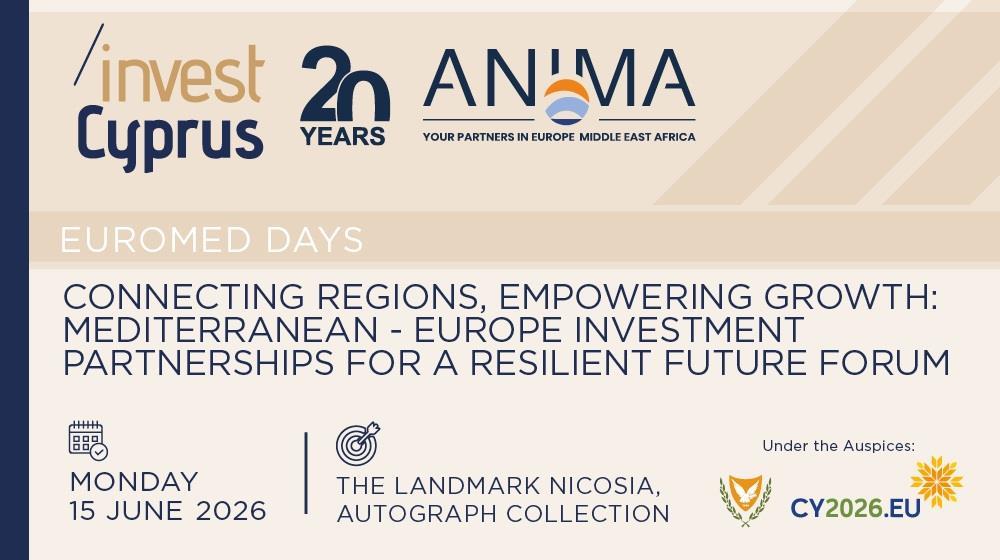
Euromed Days 2026: Nicosia to Welcome Investment Leaders from Three Continents
Nicosia will host Euromed Days 2026, a strategic investment summit designed to convene financial leaders, policymakers, and entrepreneurs from Europe, Asia, and Africa. According to reports from cbn.com.cy, the event aims to leverage Cyprus’s geographic position to foster cross-continental capital flows and strengthen economic cooperation within the Euro-Mediterranean region.
What is Euromed Days 2026 and why is Nicosia the host city?
Euromed Days 2026 is a high-level economic forum focused on attracting foreign direct investment (FDI) and building sustainable trade partnerships between the European Union and its Mediterranean neighbors. The event serves as a networking and negotiation hub where sovereign wealth funds, private equity firms, and government ministers align on infrastructure and development projects.
Nicosia was selected as the host city due to Cyprus’s role as a bridge between three continents. The city provides a neutral, EU-compliant environment that remains accessible to investors from the Middle East and North Africa (MENA) region as well as East Asia. By hosting the event in the capital, organizers intend to showcase Cyprus’s own investment climate, including its corporate tax frameworks and its status as a shipping and financial services hub.
Key objectives of the forum include:
- Capital Mobilization: Identifying new funding sources for Mediterranean infrastructure.
- Policy Alignment: Synchronizing regulatory standards between EU member states and non-EU Mediterranean partners.
- Strategic Networking: Creating a direct pipeline between Asian capital markets and European project developers.
Which investment leaders and continents are expected to participate?
The summit is structured to draw participation from three primary continental blocs. While the European Union provides the regulatory and institutional backbone, the invitation list extends significantly beyond EU borders to ensure a diverse capital pool.
Europe: Representatives from the European Commission, European Investment Bank (EIB), and major EU-based venture capital firms are expected. Their focus remains on the “Green Deal” and ensuring that Mediterranean investments align with EU sustainability and transparency standards.
Asia: The event targets sovereign wealth funds from the Gulf Cooperation Council (GCC) countries and institutional investors from East Asia. These entities often seek diversification in European real estate, energy infrastructure, and technology startups.
Africa: Leaders from North African economies are central to the forum. The focus here is on industrialization, energy exports, and the development of trade corridors that connect African resources to European markets.
“The goal is to transform the Mediterranean from a geographic boundary into an economic bridge,” according to the strategic framework outlined for EUROMED DAYS 2026: Nicosia to welcome investment leaders from three continents – cbn.com.cy.
The strategic importance of the Euro-Mediterranean economic corridor
The timing of Euromed Days 2026 coincides with a global shift toward “nearshoring”—the practice of moving supply chains closer to home to avoid the disruptions seen in long-distance Asian logistics. For the EU, the Mediterranean basin is the most logical region for this shift.
Cyprus sits at the center of this corridor. Its proximity to the Levant and its membership in the EU make it a primary entry point for goods and capital. The forum will likely address the “Global Gateway” initiative, the EU’s plan to invest in sustainable infrastructure globally to compete with other international development models.
Investment leaders will likely focus on the following strategic priorities:
- Energy Security: Developing undersea pipelines and LNG terminals to reduce dependence on single-source energy providers.
- Digital Connectivity: Expanding undersea fiber-optic cables to turn Nicosia and the wider region into a data hub for the East Med.
- Sustainable Tourism: Shifting from mass tourism to high-value, eco-friendly investment in hospitality.
| Investment Priority | Primary Source of Capital | Expected Outcome |
|---|---|---|
| Energy Infrastructure | GCC Funds / EU Grants | Diversified gas and renewable grids |
| Tech Hubs & Data Centers | Asian Venture Capital / EU Private Equity | Digital transformation of Med trade |
| Green Logistics | African Partnerships / EIB | Reduced carbon footprint in shipping |
How will this event impact Cyprus’s national economy?
For Cyprus, hosting an event of this scale is less about the immediate tourism revenue from delegates and more about long-term FDI. The government aims to use the summit to pitch Cyprus as a “safe harbor” for capital in a volatile geopolitical region.
The presence of investment leaders from three continents allows Cyprus to market its specific economic advantages. These include a competitive corporate tax rate, a legal system based on English Common Law (which is preferred by international investors), and a highly educated, multilingual workforce.
Potential economic ripples include:
- Real Estate Growth: Increased demand for commercial office space and luxury residential developments in Nicosia.
- Professional Services Boost: Higher demand for local law firms, accounting agencies, and consultancy groups to facilitate the deals struck during the forum.
- Sector Diversification: Moving the economy away from a heavy reliance on tourism toward fintech and energy services.
Critics of such forums often argue that “letters of intent” signed at summits do not always translate into actual cash flow. However, the specific focus on the Euro-Med corridor suggests a more targeted approach than general investment fairs, focusing on concrete projects like energy interconnectors and port expansions.
Comparing Euromed Days 2026 with previous regional forums
Past investment forums in the Mediterranean have often been fragmented, focusing either on EU-internal growth or bilateral agreements between a single European nation and a North African partner. Euromed Days 2026 differs by attempting a trilateral approach (Europe, Asia, Africa) in a single venue.
Unlike previous summits that focused heavily on diplomatic rhetoric, the 2026 event is positioned as a “deal-making” summit. The emphasis is on “investment leaders”—meaning the people who control the capital—rather than just political appointees.
A comparison of the shift in focus shows a clear trend:
- Old Model: Government-to-government (G2G) aid and grants.
- New Model (2026): Public-private partnerships (PPP) and direct equity investment.
- Old Focus: Trade in raw materials and agricultural goods.
- New Focus: Trade in energy, digital services, and sustainable technology.
This shift reflects a broader global trend where developed nations are moving away from traditional aid and toward “investment partnerships” that offer a return on capital while achieving geopolitical goals.
Potential challenges for cross-continental investment
Despite the optimism surrounding the event, several hurdles remain. The primary challenge is the geopolitical instability in the Eastern Mediterranean and the Middle East. Investment leaders from Asia and Africa may be hesitant to commit long-term capital if regional tensions escalate.
Another complication is the differing regulatory environments. EU investors must adhere to strict ESG (Environmental, Social, and Governance) criteria. Investors from some Asian or African markets may operate under different standards, creating a “compliance gap” that can stall deal-making.
To mitigate these risks, the forum is expected to feature workshops on:
- Risk Mitigation: Using political risk insurance to protect foreign investments.
- ESG Harmonization: Creating a “common language” for sustainability that satisfies both EU regulators and global investors.
- Legal Frameworks: Utilizing Nicosia’s legal infrastructure to create binding, enforceable cross-border contracts.
Furthermore, the “divided city” status of Nicosia adds a layer of complexity. While the business community operates across boundaries, the political reality of the city can be a talking point for international observers. Organizers are banking on the “business-first” mentality to override political friction.
What to watch for in the lead-up to the summit
As the date for Euromed Days 2026 approaches, several indicators will signal the event’s potential success. The first is the confirmation of “anchor investors”—major sovereign wealth funds or multinational corporations that commit to attending. Their presence usually triggers a cascade of smaller investors.
Secondly, the announcement of specific “project pipelines” will be critical. If the forum provides a list of pre-vetted infrastructure projects (e.g., a specific wind farm in Cyprus or a port upgrade in North Africa), the likelihood of actual investment increases.
Finally, the level of cooperation between the Cypriot government and the European Commission will determine if the summit has the institutional weight necessary to move beyond a networking event. If the EU offers specific incentives or guarantees for projects discussed in Nicosia, the summit could become a turning point for regional economics.
For those following the development of the region, keeping an eye on related explainers on Mediterranean energy politics will provide necessary context for the deals likely to be brokered in 2026.
Frequently Asked Questions about Euromed Days 2026
What is the primary goal of Euromed Days 2026?
The primary goal is to attract investment leaders from Europe, Asia, and Africa to Nicosia to create economic partnerships and fund infrastructure projects across the Euro-Mediterranean region.
.jpg "Frequently Asked Questions about Euromed Days 2026")
Why is Nicosia, Cyprus, the chosen location?
Nicosia is strategically located at the crossroads of three continents and offers a stable, EU-compliant legal and tax environment, making it an ideal neutral ground for international investors.
Who are the “investment leaders” mentioned in the reports?
This term refers to managers of sovereign wealth funds, CEOs of private equity firms, venture capitalists, and high-ranking government ministers responsible for economic development and finance.
Which sectors are expected to see the most investment?
The most anticipated sectors include energy (specifically natural gas and renewables), digital infrastructure (data centers and fiber optics), and sustainable “green” tourism.
How does this event differ from a standard trade fair?
Unlike a trade fair, which focuses on selling products, Euromed Days 2026 is an investment summit focused on large-scale capital allocation, policy alignment, and the creation of long-term financial partnerships.
Will the event focus only on Cyprus?
No. While Cyprus is the host and a primary beneficiary, the scope of the event is the entire Euro-Mediterranean region, including partnerships between EU members and countries in North Africa and Asia.
