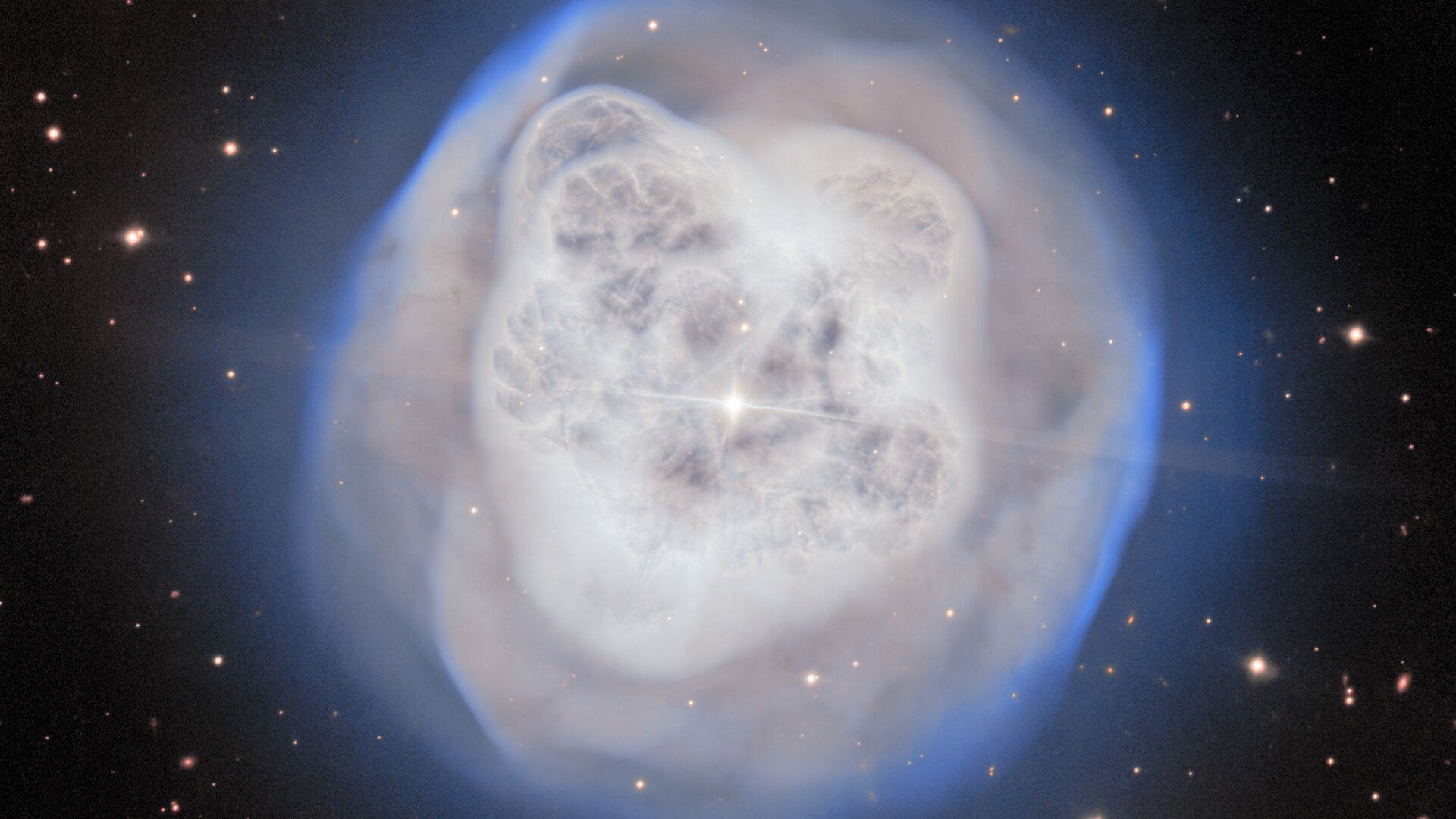
Astronomers See a Vision of the Sun’s Death While Gazing Deep into the ‘Crystal Ball Nebula’
In a breathtaking intersection of art and astrophysics, a new series of deep-space images has provided humanity with a hauntingly beautiful preview of its own solar future. By analyzing the intricate structures of the Crystal Ball Nebula, also known as NGC 1514, researchers have uncovered a celestial mirror that reflects the eventual fate of our own Sun. This cosmic phenomenon, characterized by its luminous, spherical glow and billowing gas clouds, serves as a laboratory for understanding the violent yet graceful transition of a star from its prime to its inevitable end.
The revelation that astronomers see a vision of the sun’s death while gazing deep into the ‘Crystal Ball Nebula’ – Live Science and other astronomical reports suggest—is not merely a poetic observation but a scientific deduction based on the lifecycle of low-to-intermediate mass stars. As we peer into the depths of NGC 1514, we are witnessing the “death throes” of a star that shares many fundamental characteristics with the G-type main-sequence star at the center of our own system.
Decoding the Mystery of NGC 1514: The Crystal Ball Nebula
Located thousands of light-years away, the Crystal Ball Nebula is not a traditional nebula in the sense of being a nursery for new stars. Instead, it is a remnant—a ghostly shroud of gas and dust cast off by a star that has exhausted its primary nuclear fuel. The “crystal ball” appearance is created by the way the surrounding interstellar medium is illuminated and sculpted by the intense radiation of the stars within.
What makes this particular nebula a focal point for modern astronomy is the complexity of its internal engine. While it appears as a single, glowing orb from a distance, high-resolution imaging reveals a far more chaotic environment. The nebula is sculpted by a binary star system, where two stars orbit one another in a gravitational dance that fundamentally alters the way the dying star sheds its outer layers.
The Role of the Binary System
In a solitary star’s death, the shedding of outer layers is often more symmetrical. However, in the case of NGC 1514, the presence of a companion star introduces gravitational perturbations. This interaction creates “shocks” in the outflowing gas, carving out the billowing, asymmetric structures that give the nebula its unique, translucent quality.
- Gravitational Stripping: The companion star pulls material away from the dying star, creating a concentrated stream of gas.
- Radiation Pressure: Intense ultraviolet light from the hot core pushes the gas outward, creating the “bubble” effect.
- Interstellar Interaction: As the nebula expands, it crashes into the surrounding cold gas of the galaxy, creating the glowing edges seen in telescope imagery.
A Cosmic Mirror: Why This Predicts the Sun’s Fate
To understand why this nebula is viewed as a “vision” of our own Sun’s demise, one must look at the mechanics of stellar evolution. Our Sun is a medium-sized star. It will not end its life in a spectacular supernova explosion—a fate reserved for the behemoths of the universe. Instead, it will follow a path very similar to the star at the heart of the Crystal Ball Nebula.
The process begins when the Sun runs out of hydrogen in its core. Once the hydrogen is depleted, the core will contract and heat up, causing the outer layers to expand outward. The Sun will transform into a Red Giant, potentially swallowing Mercury, Venus, and possibly Earth.
“The Crystal Ball Nebula is essentially a snapshot of the ‘Planetary Nebula’ phase. It represents the moment a star ceases to be a fusion engine and becomes a glowing ember, shedding its skin to seed the universe with heavy elements.”
The Transition from Red Giant to White Dwarf
Following the Red Giant phase, the star will eventually eject its outer atmosphere entirely. This discarded shell of gas expands into space, creating a planetary nebula—exactly what we see in NGC 1514. At the center remains the core: a white dwarf. This is a dense, earth-sized object that no longer performs fusion but glows with residual heat for billions of years.

| Stellar Stage | Process | Outcome for the Sun/NGC 1514 |
|---|---|---|
| Main Sequence | Hydrogen fusion in core | Stable, yellow-white glow (Current state of Sun) |
| Red Giant | Hydrogen shell burning; expansion | Enormous size; consumption of inner planets |
| Planetary Nebula | Ejection of outer layers | Creation of structures like the Crystal Ball Nebula |
| White Dwarf | Core collapse; cooling | Slight, ultra-dense, fading ember |
The Time-Travel Aspect: Seeing 1,500 Years into the Past
One of the most mind-bending aspects of the recent observations of the Crystal Ball Nebula is the temporal lag. Because light takes time to travel across the vast distances of space, astronomers are not seeing the nebula as it exists “now,” but as it existed centuries ago. Some calculations suggest that the light we are currently capturing was emitted by the dying star roughly 1,500 years ago.
This “light echo” allows scientists to study the chronology of stellar death. By analyzing the distance the gas has traveled from the central star and comparing it to the speed of light, researchers can map out the timeline of the star’s collapse. This provides a historical record of the star’s final moments, allowing us to predict the timing and intensity of the Sun’s future transition with greater precision.
For those interested in the broader timeline of the universe, this is a related explainer on cosmic time scales that helps put the billions of years of the Sun’s life into perspective.
Technological Breakthroughs in Imaging the Nebula
The clarity of the images that have sparked this discussion is the result of advanced astronomical instrumentation. Capturing the “billowing” effect of the Crystal Ball Nebula requires more than just a powerful lens; it requires sophisticated filtering and long-exposure techniques.
Multi-Spectral Analysis
Astronomers use different filters to isolate specific elements. For example, hydrogen-alpha filters highlight the glowing red gas, while oxygen-III filters reveal the hotter, blue-green regions. By layering these images, scientists can create a composite that shows the temperature gradients within the nebula. This reveals where the “shocks” are occurring and how the binary stars are pushing the gas into its spherical shape.

The Role of Adaptive Optics
To combat the blurring effect of Earth’s atmosphere, many of these images utilize adaptive optics. This technology uses deformable mirrors that adjust in real-time to cancel out atmospheric turbulence, allowing ground-based telescopes to achieve a resolution that rivals space-based observatories. This precision is what allowed astronomers to identify the “hidden” binary stars at the center of NGC 1514, which were previously obscured by the nebula’s own glow.
Common Misconceptions About Stellar Death
When headlines state that astronomers have seen a “vision of the sun’s death,” it can cause undue alarm for the layperson. However, it is crucial to distinguish between the process of death and the timing of it.
Is the Sun Dying Now?
No. The Sun is currently in the middle of its main-sequence lifetime. It has roughly 5 billion years of hydrogen fuel remaining. The “vision” provided by the Crystal Ball Nebula is a preview of an event that will not occur for eons. There is no immediate threat to the Earth from this specific stellar process.
Is Every Nebula a “Death Shroud”?
Not all nebulae are planetary nebulae. Many, such as the Orion Nebula, are “stellar nurseries” where gas is collapsing to create new stars. The Crystal Ball Nebula is specifically a planetary nebula, which marks the end of a life cycle rather than the beginning. Understanding this distinction is key to interpreting astronomical news.
The Broader Impact: Why This Research Matters
Studying NGC 1514 is not just about predicting the end of our own solar system; it is about understanding the chemical evolution of the universe. When stars like the one in the Crystal Ball Nebula shed their layers, they aren’t just throwing away gas—they are dispersing “stardust.”
Inside the cores of these stars, fusion creates heavier elements like carbon, nitrogen, and oxygen. When the star dies and ejects its outer shell, these elements are scattered across the galaxy. Eventually, this enriched gas collapses to form new stars and planets. In a very literal sense, the death of stars like the one in the Crystal Ball Nebula provided the raw materials necessary for the formation of Earth and the building blocks of biological life.
By studying the specific composition of NGC 1514, astronomers can determine how much of these life-essential elements are returned to the interstellar medium, helping us understand the “galactic recycling” process that allows the universe to evolve in complexity over time.
Frequently Asked Questions
What exactly is the Crystal Ball Nebula?
The Crystal Ball Nebula (NGC 1514) is a planetary nebula created by a dying star. It appears as a glowing, translucent sphere of gas because the central star’s radiation illuminates the surrounding interstellar dust, creating a visual effect similar to a crystal ball.

How does the Crystal Ball Nebula relate to our Sun?
Because the star at the center of NGC 1514 is similar in mass to our Sun, its current state represents the future of our own solar system. It shows the “Planetary Nebula” phase that the Sun will enter billions of years from now after it passes through its Red Giant stage.
Why is it called a “binary system” if it looks like one ball of light?
While the nebula looks like a single object, high-resolution telescopes have revealed that Notice actually two stars at the center. The gravitational interaction between these two stars is what shapes the gas into its unique, billowing form.
Can we see the Crystal Ball Nebula with a backyard telescope?
NGC 1514 is a challenging object for amateur astronomers. While it can be spotted with a high-quality telescope under very dark skies, it usually appears as a faint, fuzzy patch rather than the vivid, colorful “crystal ball” seen in processed professional imagery.
What happens after the nebula disappears?
Over tens of thousands of years, the gas will continue to expand and dissipate into the vacuum of space. The remaining core of the star will persist as a white dwarf, slowly cooling down over trillions of years until it eventually becomes a cold, dark “black dwarf.”
The study of the Crystal Ball Nebula reminds us that the universe is a cycle of constant transformation. While the image of a dying star may seem bleak, it is actually a testament to the enduring nature of matter. The death of one star provides the seeds for a thousand more, ensuring that the cosmic story continues long after our own Sun has faded into the darkness of the deep void.
