OpenAI launches ChatGPT Work agent alongside GPT-5.6 model rollout
OpenAI has launched the GPT-5.6 model suite and ChatGPT Work, a new agent designed to manage multi-step professional projects and integrate with business apps.

OpenAI has initiated the global release of its GPT-5.6 model family and the new agentic platform, ChatGPT Work, following a period of restricted access due to government oversight. The company describes this launch as a strategic pivot toward agent-based productivity, emphasizing performance-per-dollar metrics to address growing enterprise concerns regarding inference costs and token consumption.
The GPT-5.6 suite offers three distinct models: Sol, the flagship model for complex reasoning, scientific research, and cybersecurity; Terra, which is designed for mainstream enterprise applications; and Luna, the high-volume, cost-effective option. OpenAI states that these models are designed to maximize utility per token. Independent testing by Qodo supports this claim, noting that GPT-5.6 demonstrated superior performance on code-review tests while maintaining lower median latency and reducing token consumption compared to its predecessor.
Related media


The pricing structure for the new models is as follows:
| Model | Input Price (per 1M tokens) | Output Price (per 1M tokens) |
|---|---|---|
| Sol | $5 | $30 |
| Terra | $2.50 | $15 |
| Luna | $1 | $6 |
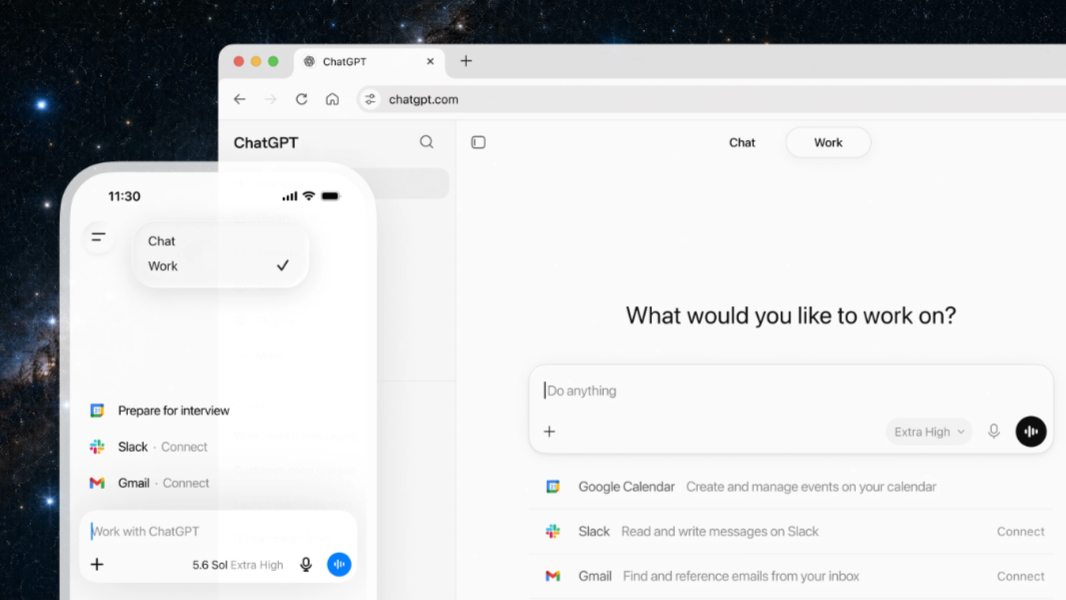
Beyond the model architecture, OpenAI introduced ChatGPT Work, an agent designed to manage multi-step professional projects. By integrating technology from the Codex coding assistant, the tool can interact with files, browsers, and business applications—including Slack, Microsoft 365, Google Drive, and various CRM systems—to execute workflows like financial reconciliations or marketing campaign development. According to the company, users can monitor progress and approve actions as the agent completes tasks.
The release reflects a broader industry shift toward AI that functions as a software coworker
capable of managing long-running projects. To facilitate this, OpenAI has added features such as Scheduled Tasks, which allow for automated reporting, and Sites, a public beta feature that converts project outputs into interactive web applications. Enterprise and Edu administrators retain oversight through expanded controls, including spend limits and a new Compliance API meant to monitor agent behavior.
Enterprise Strategy and Governance
The company is positioning these tools to compete directly with rival offerings by emphasizing benchmark performance and operational efficiency. In testing, OpenAI reported that Sol scored 53.6 on the Agents’ Last Exam benchmark and reached 80 on the Artificial Analysis Coding Agent Index. On the cybersecurity front, the company noted that Sol achieved a 73.5% score on ExploitBench.
Despite these performance claims, the transition to autonomous agents remains a point of industry debate. Faisal Kawoosa, co-founder and chief analyst at Techarc, noted that while organizations are moving toward more pragmatic AI investments, CIOs will continue demanding greater transparency before fully trusting frontier AI systems.
OpenAI reported that its internal red-teaming for the new models involved approximately 700,000 GPU hours of evaluation, which the company claims blocked all attempts to extract protected data during testing.
What to Watch Next
- Availability: ChatGPT Work is available immediately for Pro, Enterprise, and Edu users on web and mobile. Deployment for Plus and Business plans is scheduled over the coming days. The desktop app for Mac and Windows is available globally for all users, including those on free plans.
- Product Consolidation: The standalone Codex app is being sunsetted, with its capabilities integrated into the unified ChatGPT desktop application. The current desktop app will be renamed ChatGPT Classic.
- Competitive Benchmarking: The industry will continue to monitor how OpenAI’s cost-per-performance metrics influence enterprise adoption, particularly as organizations move away from ad-hoc experimentation toward production-grade workflows.
- Feature Evolution: The rollout of Sites and the scaling of computer-use capabilities will be primary indicators of how effectively these agents can replace manual, repetitive desk work across diverse business sectors.
As the company pivots toward end-to-end task execution, the focus for users and administrators will likely center on how these agents balance autonomy with the necessary safety guardrails required for sensitive enterprise data.
How significant is this development?
Contribute your assessment to the aggregated reader intelligence ledger.
Archypedia is dedicated to independent, evidence-backed reporting. This briefing was synthesized from primary source reporting, corroborated across independent newsrooms, and verified against our Editorial Standards.
Transparency record
Evidence behind this report
This report synthesizes 5 distinct sources. Open the source ledger below to compare the underlying coverage.
Prepared under the Archypedia Editorial Policy by the Elena Voss editorial desk profile. AI-assisted tools may support drafting and verification; public accountability remains with Archypedia. Report an error.