Este es el precio del dólar HOY sábado 12 de septiembre de 2026
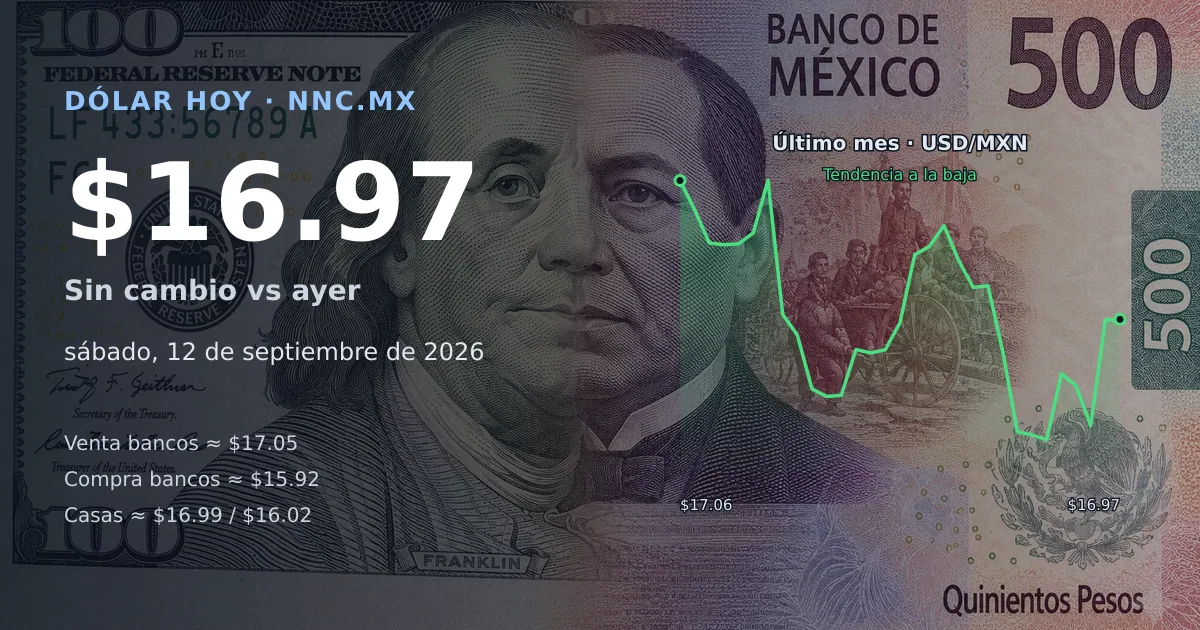
While Banxico's official FIX reference rate holds at 16.9722 pesos per dollar, weekend closures force retail consumers to navigate wide commercial spreads.

While official interbank benchmarks position the Mexican peso comfortably below the psychological threshold of seventeen per dollar, everyday consumers attempting to execute currency exchanges face an immediate financial penalty imposed by retail branch closures and wide commercial spreads. For households, workers, and investors navigating foreign currency transactions on Saturday, 12 September 2026, the calm headline figures obscure a fragmented pricing reality where bank markups and conversion margins create significant transaction friction.
The official reference rate established by the Banco de México (Banxico) sits at 16.9722 pesos per dollar for settling foreign obligations, mirroring the interbank close reported by La Razón and the figure noted by Diario del Yaqui. Yet because traditional bank branches remain closed for the weekend, retail customers cannot access wholesale interbank rates, absorbing instead the widening spreads charged by commercial institutions and digital platforms.
Related YouTube video


Decoding the Gap Between Wholesale Benchmarks and Retail Spreads
The mechanics of weekend currency exchange expose a sharp divide between institutional indicators and public ventanilla prices. According to data compiled across Nnc, major banking institutions offer an average purchase price of 15.92 pesos per dollar while demanding an average selling price of 17.05 pesos. This operational gap — the spread — captures the structural margin retained by financial institutions for providing cash liquidity outside normal business hours.
Authorized exchange houses present slightly tighter margins, averaging 16.02 pesos for purchases and 16.99 pesos for sales, according to NNC.MX. Meanwhile, digital platforms such as Wise report mid-market rates hovering around 16.9725 pesos, according to Diario del Yaqui, offering an alternative for users able to bypass traditional branch networks.
| Exchange Channel / Reference | Purchase Price (MXN) | Selling Price (MXN) |
|---|---|---|
| Banxico FIX Reference | , | 16.9722 |
| Commercial Bank Average | 15.92 | 17.05 |
| Exchange House Average | 16.02 | 16.99 |
| HSBC (Reported Max Purchase) | 16.86 | , |
| BBVA (Reported Min Sale) | , | 17.27 |
Quantifying the Friction on Household Transactions
For families and small-scale operators, these institutional variances translate directly into tangible financial losses. Data highlighted by Diario del Yaqui indicates that HSBC recorded a stronger purchase rate of 16.86 pesos for clients selling dollars to the bank, whereas BBVA maintained a retail selling quote reaching 17.27 pesos for customers acquiring the currency.
This creates a 93-centavo spread variation across competing banking platforms. For a standard transaction of 1,000 dollars, that discrepancy imposes a potential swing of 930 pesos in conversion friction before accounting for additional transfer fees or remittance commissions. Remittance recipients face similar exposure, as conversion margins applied by transfer operators frequently diverge from the wholesale interbank baseline tracked by La Razón.
Macroeconomic Pressures and Federal Reserve Expectations
Diario del Yaqui notes that foreign exchange markets closed out the week reacting directly to fresh United States inflation data alongside mounting anticipation for the upcoming Federal Reserve monetary policy decision scheduled for 15 and 16 September 2026.
Furthermore, Azteca Michoacán emphasizes that crude oil price fluctuations and broader geopolitical tensions continue to shape risk appetite among global investors, keeping currency traders alert to potential volatility vectors as the weekend concludes.
Frequently Asked Questions
What is the difference between the Banxico FIX rate and retail bank prices?
The FIX rate is an official wholesale reference determined by Banxico based on interbank market quotations to settle foreign-denominated obligations within Mexico. Retail bank prices reflect commercial branch operations, including buying and selling averages that incorporate institutional profit margins and weekend risk premiums.
Why do exchange rates vary across different banks on a Saturday?
Because physical bank branches are closed on Saturdays, institutions rely on carryover pricing from Friday's close combined with individual pricing strategies. This creates spread discrepancies, such as a 93-centavo difference between competing banks for a 1,000-dollar transaction.
Institutional Calendar Mechanics and Historical Reference Data
Because Saturday, 12 September 2026, marks a non-business day for traditional banking operations, official registers maintained by the Banco de México list series data as non-operational for the calendar date itself, relying instead on carryover values established during the preceding session, as observed across reports from Periodico Enfoque and Diario del Yaqui.
This structural pause in daily interbank price discovery contrasts with international digital trading platforms and retail currency desks that continue executing transactions against lingering market sentiment. As noted by Azteca Michoacán, the broader valuation of the peso unfolds while market observers monitor external commodities and geopolitical indicators that dictate regional risk appetite ahead of traditional banking reopening schedules.
Corporate treasurers and retail market participants now evaluate whether the incoming stream of macroeconomic indicators will disrupt current trading bands when standard financial operations resume. With foreign exchange markets reacting to recent United States inflation metrics and positioning for forthcoming central bank deliberations, market participants look toward the reopening of traditional banking channels and the subsequent Federal Reserve rate decision to test whether the Mexican peso can successfully preserve its sub-17 valuation under the weight of incoming macroeconomic data.
Archypedia is dedicated to independent, evidence-backed reporting. This briefing was synthesized from primary source reporting, corroborated across independent newsrooms, and verified against our Editorial Standards.
Transparency record
Evidence behind this report
This report synthesizes 6 distinct sources. Open the source ledger below to compare the underlying coverage.
Prepared under the Archypedia Editorial Policy by the Elena Voss editorial desk profile. AI-assisted tools may support drafting and verification; public accountability remains with Archypedia. Report an error.