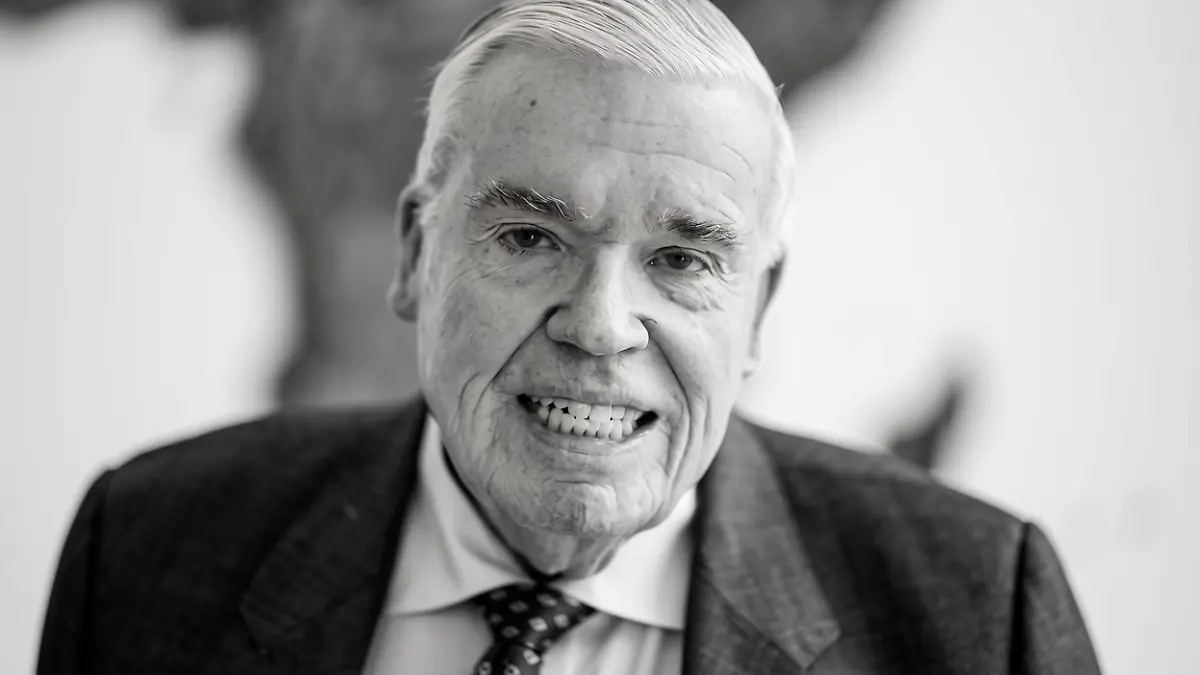
Der HSV trauert um Klaus-Michael Kühne
The billionaire industrialist and logistics tycoon shaped global trade and poured millions into his hometown club, leaving behind a complex legacy of massive philanthropy and unexamined wartime history.

A staggering global economic footprint and a personal fortune estimated in the billions contrasted sharply with a lifelong, deeply emotional and financial fixation on a single hometown football club, Hamburger SV. That duality defined the life of Klaus-Michael Kühne, whose death on 23 August 2026 at age 89 in the Swiss municipality of Schindellegi marks the end of a sprawling corporate era, according to reports from Osthessen News and bundesliga.com.
Kühne built an industrial logistics empire from the family forwarding firm founded by his grandfather August in 1890, expanding the enterprise into a global force with subsidiaries across roughly 100 countries and tens of thousands of workers worldwide, as reported by osthessen-news.de. Yet his immense capital and commanding stakes in global transport — including a controlling majority in Kühne+Nagel, a major position in Lufthansa, and a substantial share in Hapag-Lloyd — coexisted with decades of tax-driven exile in Switzerland, controversial wartime legacy questions, and recurring interventions in regional civic projects in Hamburg, according to Weekend and tagesspiegel.de.
Related YouTube video


His economic ascent required him to step into leadership under a reluctant father who placed him at the helm early. Reflecting on those early responsibilities, Kühne once admitted in an interview with Die Zeit, Zu früh,
adding that he had made many mistakes, as reported by Tagesspiegel. He expanded that heritage into a vast investment web encompassing transport, aviation, and mobility providers such as Flix, alongside industrial chemical logistics at Brenntag, as detailed by weekend.at. Not every wager succeeded; his heavy investment in René Benko’s collapsed real estate empire resulted in a half-billion-euro personal loss after he allowed himself to be drawn in, as he acknowledged to the Frankfurter Allgemeine Zeitung and reported by Tagesspiegel.
Corporate control of this vast machinery rests within Kühne Holding AG, the entirety of which has long been anchored in the Kühne Foundation, according to weekend.at. Because Kühne left no children, governance of the foundation transitions to designated successor Thomas Staehelin, a Basel attorney, alongside surviving spouse Christine Kühne on the foundation council, weekend.at notes.
That corporate fortune was managed from Switzerland, where Kühne and his father relocated in 1969 out of concern regarding the social democratic government of the era, weekend.at reports. Critics frequently argued that he should have paid taxes in Germany rather than operating as an absentee benefactor, yet his financial footprint in Hamburg remained monumental. He poured approximately one billion euros into Hapag-Lloyd to keep the shipping line rooted in his birthplace, funded cultural institutions including the Elbphilharmonie, established a logistics university, and built the luxury hotel The Fontenay
at a cost of €130 million, according to osthessen-news.de and tagesspiegel.de.
Nowhere was his emotional attachment more visible, or more turbulent, than with Hamburger SV. Describing himself as a lifelong fan who watched every match on television, Kühne poured a higher double-digit million-euro sum into the club through loans, equity in the professional football corporation, and funding that restored the historic Volksparkstadion
name to the team's home ground, tagesspiegel.de and Bundesliga report. Yet the club's slide into the second division tested his patience; he frequently criticized sporting management, threatened financial cutoffs after bitter defeats, and did not attend a home match in person for more than eleven years, according to tagesspiegel.de and Bundesliga.
Complicating his philanthropic legacy is the dark history of the enterprise that generated his wealth. During the Second World War, Kühne+Nagel collaborated with the Nazi regime and transported looted goods seized from Jewish households, tagesspiegel.de notes. While other industrial dynasties opened their archives, Kühne steadfastly rejected independent scientific examination of the firm's wartime conduct.
"Für mich ist das Kapitel abgeschlossen, und ich werd’s nicht wieder öffnen. Ungeschehen machen kann man es leider nicht."
Klaus-Michael Kühne, Owner of Kühne+Nagel, via Tagesspiegel
That unresolved history casts a long shadow over his final planned civic contribution to Hamburg: a pledge of up to €340 million to construct a new opera house on Baakenhöft in the city's Hafencity, with a targeted construction window opening around 2030 and completion possible by 2034, tagesspiegel.de reports. Observers and cultural critics, citing international pressure on cultural institutions regarding tainted funding sources, argue that the uninvestigated wartime past of the fortunes funding the project poses reputational risks for the city, according to tagesspiegel.de.
Official corporate data reported by osthessen-news.de and tagesspiegel.de show that Klaus-Michael Kühne entered the family firm in 1958 and assumed the role of chief executive officer of Kühne+Nagel International AG starting in 1975, subsequently serving as chairman of the board of directors from 1992 until 2011, after which he held the title of honorary chairman. Weekend.at noted that his aviation investments deepened significantly when his holding expanded its stake in Lufthansa to over 20 percent.
Key Pillars of the Kühne Legacy
- Corporate Control: The entirety of Kühne Holding AG is anchored in the Kühne Foundation, with governance transitioning to designated successor Thomas Staehelin and surviving spouse Christine Kühne, as reported by weekend.at.
- Hamburg Investments: Contributions include approximately one billion euros to anchor Hapag-Lloyd in his birthplace, millions for the Elbphilharmonie, a logistics university, and the €130 million luxury hotel
The Fontenay
, according to osthessen-news.de and tagesspiegel.de. - The Opera House Pledge: A final promised contribution of up to €340 million to build a new opera house on Baakenhöft, targeted for construction around 2030 and possible completion by 2034, as detailed by tagesspiegel.de.
With his passing at age 89, the foundation council and designated successor Thomas Staehelin face the next step of steering the sprawling philanthropic and corporate structures into a new era without their founding patriarch, while the timeline and execution of the €340 million opera house project remain subject to mounting scrutiny over the uninvestigated wartime past of the company that generated the fortunes funding it, as reported by weekend.at and tagesspiegel.de.
How significant is this development?
Contribute your assessment to the aggregated reader intelligence ledger.
Archypedia is dedicated to independent, evidence-backed reporting. This briefing was synthesized from primary source reporting, corroborated across independent newsrooms, and verified against our Editorial Standards.
Transparency record
Evidence behind this report
This report synthesizes 4 distinct sources. Open the source ledger below to compare the underlying coverage.
Prepared under the Archypedia Editorial Policy by the Elena Voss editorial desk profile. AI-assisted tools may support drafting and verification; public accountability remains with Archypedia. Report an error.