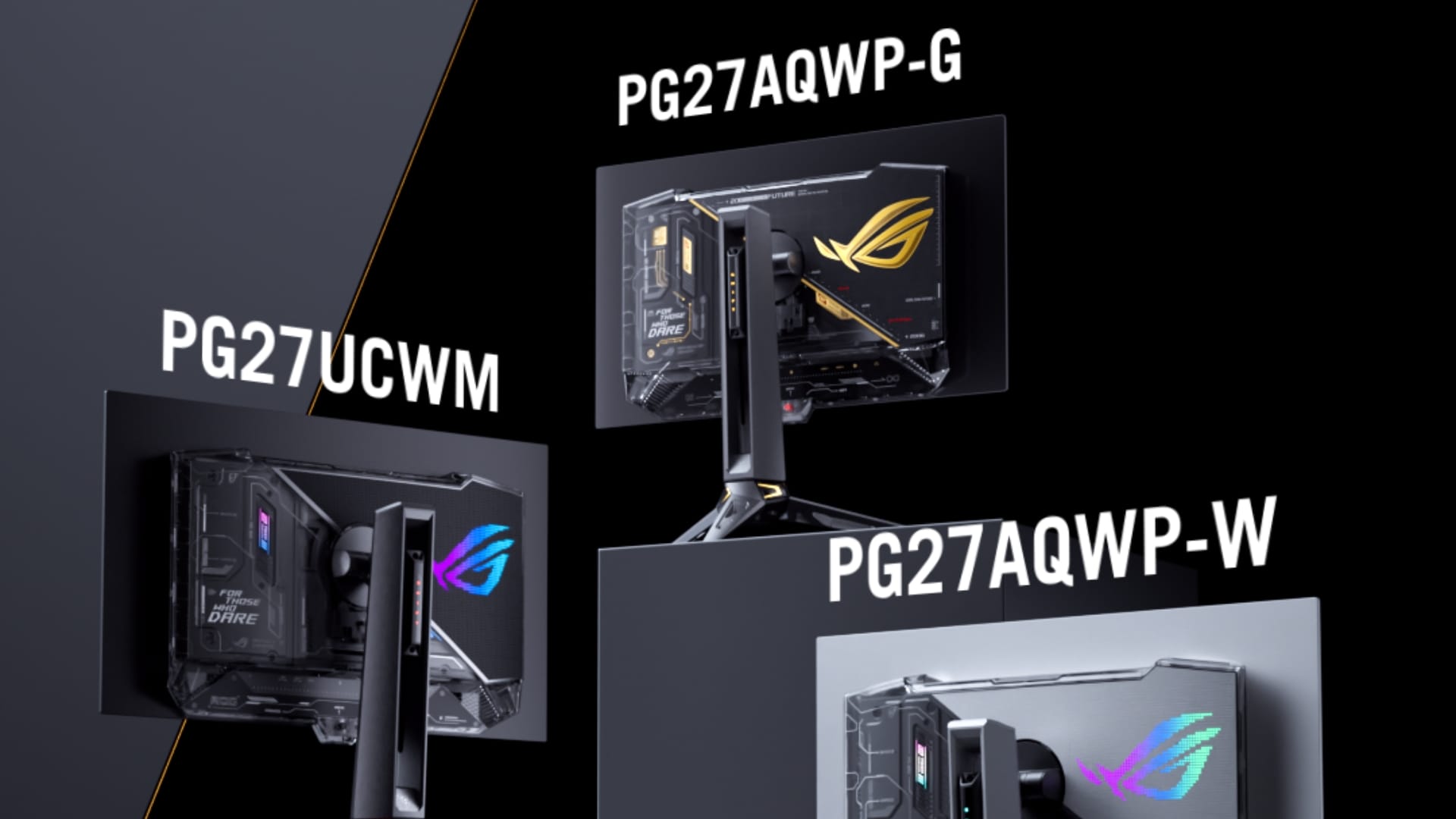
ASUS and ROG Unveil Cutting-Edge OLED Monitors at COMPUTEX 2026: A New Benchmark for Esports and Creator Displays
Taipei, June 1, 2026 — At this year’s COMPUTEX, ASUS and its Republic of Gamers (ROG) subsidiary have redefined display technology with a lineup of high-performance OLED monitors targeting both competitive esports and professional content creation. The announcements—including a 24.5-inch 540Hz Tandem OLED esports display with industry-leading response times and a 32-inch 4K Tandem WOLED creator monitor—highlight ASUS’s aggressive push into next-generation display innovation. Industry analysts describe these moves as a strategic response to growing demand for ultra-responsive, high-refresh-rate panels in both gaming and creative workflows, while also signaling the company’s commitment to maintaining its leadership in display technology.
The unveilings at COMPUTEX 2026 underscore a broader trend in the display market: the convergence of esports-grade performance with professional-grade color accuracy and HDR capabilities. For gamers, the new monitors promise near-instantaneous response times and smoother visuals, while creators gain access to wider color gamuts and higher brightness levels—features previously reserved for high-end LCD panels. Meanwhile, ASUS’s expansion into Tandem OLED technology positions the company at the forefront of a display revolution that could reshape how consumers interact with digital content.
— ### The New Lineup: What ASUS and ROG Just Announced #### 1. The 24.5-Inch 540Hz Tandem OLED Esports Monitor: A Quantum Leap for Competitive Gaming ASUS’s latest esports-focused monitor represents a significant leap forward in display technology for competitive gaming. Key specifications include: – Panel Technology: Tandem OLED with a claimed <0.02ms response time, eliminating motion blur and ghosting—a critical advantage in fast-paced games like *Valorant* or *Counter-Strike 2*. - Refresh Rate: 540Hz, the highest yet announced for a consumer OLED monitor, designed to deliver buttery-smooth visuals even in high-frame-rate scenarios. – Resolution: 2560 × 1440 (QHD), balancing sharpness with the high refresh rate. – Design: Ultra-thin bezels (≤1mm) and a modular stand with ergonomic adjustments, catering to both solo players and team setups. – Connectivity: Dual HDMI 2.1, DisplayPort 2.1, and USB-C with Power Delivery for versatile connectivity. Why It Matters for Esports The monitor’s response time and refresh rate address two of the most common pain points in competitive gaming: input lag and screen tearing. While traditional LCD panels have dominated the esports market due to their brightness and color consistency, OLED’s self-emissive pixels and instant response times could shift the paradigm. Analysts suggest this could influence future esports tournaments, where monitor specifications are increasingly scrutinized for fairness. #### 2. The ROG Swift OLED PG32UCWM: A 4K Creator’s Dream with RGB-Stripe Backlighting Targeting professional creators, photographers, and video editors, the ROG Swift OLED PG32UCWM combines 4K resolution with Tandem WOLED technology and a unique RGB-stripe backlighting system. Key features: – Panel: 32-inch 4K (3840 × 2160) Tandem WOLED, offering 98% DCI-P3 and 120% sRGB color volume for accurate grading and editing. – Brightness: Up to 1,000 nits peak brightness with HDR10 support, making it suitable for both studio work and high-contrast content. – Backlighting: RGB-stripe technology allows for dynamic lighting effects while maintaining uniform brightness, a first for OLED monitors at this scale. – Refresh Rate: 120Hz, catering to both creative workflows and casual gaming. – Connectivity: Two HDMI 2.1 ports, a DisplayPort 2.1, and Thunderbolt 4 for high-bandwidth peripherals. Why Creators Are Excited Traditionally, creators have relied on high-end LCD panels like those from Dell or LG for their color accuracy and brightness. However, OLED’s superior contrast ratios and deeper blacks—combined with the RGB-stripe backlighting—could make this monitor a game-changer for tasks like video editing, where accurate color representation is paramount. The 120Hz refresh rate also opens doors for smoother playback and previews, a feature increasingly demanded by content creators. #### 3. The Broader ROG Display Strategy at COMPUTEX 2026 Beyond these two flagship models, ASUS and ROG have hinted at additional innovations aimed at different segments of the display market: – Mini-LED and QLED Expansion: While OLED dominates the headlines, ASUS continues to invest in Mini-LED and QLED technologies for budget-conscious consumers and larger form factors. – Modular and Upgradable Designs: A focus on sustainability and future-proofing, with monitors featuring swappable components like stands and cables. – AI-Powered Calibration: Integration with ASUS’s AI-driven software tools to automatically adjust color profiles and brightness based on ambient lighting and usage context. Table: ASUS and ROG’s 2026 Display Lineup at a Glance
| Model | Target Audience | Key Features | Panel Tech | Refresh Rate |
|---|---|---|---|---|
| 24.5-inch Esports Monitor | Competitive Gamers | 0.02ms response, 540Hz, QHD | Tandem OLED | 540Hz |
| ROG Swift OLED PG32UCWM | Creators & Professionals | 4K, 1000 nits, RGB-stripe, 120Hz | Tandem WOLED | 120Hz |
| Upcoming Mini-LED/QLED Models | Budget & Large-Format Users | High brightness, modular designs | Mini-LED / QLED | Varies (60Hz–144Hz) |
— ### The Context: Why COMPUTEX 2026’s Display Announcements Are Significant #### 1. The Rise of Tandem OLED: A Technical Breakthrough Tandem OLED technology—used in both the esports and creator monitors—stacks two OLED layers to improve brightness and efficiency. This addresses one of the long-standing criticisms of OLED: its struggle to match LCD panels in peak brightness, particularly in well-lit environments. – Brightness Advantage: Traditional OLED panels typically max out around 800–900 nits, while Tandem OLED can reach 1,000+ nits, closing the gap with Mini-LED. – Energy Efficiency: The dual-layer design reduces power consumption at higher brightness levels, extending panel lifespan. – Color Uniformity: Fewer backlight bleed issues compared to LCD, ensuring consistent colors across the entire screen. Industry Impact The adoption of Tandem OLED by ASUS and ROG signals that the technology is maturing beyond niche applications. While Samsung Display and LG Display have led in OLED innovation, ASUS’s entry into this space could accelerate competition, potentially driving down costs and improving availability for consumers. #### 2. The Esports Monitor Wars: ASUS vs. Competitors The esports monitor market is highly competitive, with brands like Alienware, AOC, and Gigabyte vying for dominance. ASUS’s new 540Hz Tandem OLED monitor enters this fray with several differentiators: – Response Time: The <0.02ms claim is significantly faster than most competitors, which typically offer 0.1ms–1ms response times. - Refresh Rate: 540Hz is higher than Alienware’s 360Hz models and AOC’s 240Hz offerings, catering to the growing number of games that push beyond 240 FPS. – Design Language: ROG’s signature aesthetic, combined with modularity, appeals to gamers who prioritize both performance and customization. Potential Challenges – Price: High-refresh-rate OLED monitors are likely to carry premium price tags, potentially limiting adoption among casual gamers. – Burn-in Risks: While OLED burn-in has improved, it remains a concern for users who display static elements (e.g., HUDs) for extended periods. – Competitor Reactions: Brands like Alienware (Lenovo) and MSI may respond with their own high-refresh-rate OLED models, intensifying the competition. #### 3. The Creator Market: Balancing Performance and Professional Needs Professional content creators have historically favored LCD panels for their brightness and color consistency. However, OLED’s advantages—such as infinite contrast and true blacks—are increasingly compelling. ASUS’s PG32UCWM addresses this by: – Combining OLED’s Strengths with LCD’s Brightness: The RGB-stripe backlighting allows for dynamic effects without sacrificing uniformity. – Targeting Hybrid Workflows: The 120Hz refresh rate makes it viable for both creative work and light gaming, appealing to the growing number of creators who multitask across disciplines. – Software Integration: ASUS’s AI calibration tools could streamline workflows for photographers and video editors, reducing the need for manual adjustments. Market Trends – Growing Demand for High-Refresh-Rate Displays: Even in creative fields, smoother previews and playback are becoming standard, as seen in Adobe’s push for 120Hz+ support in applications like Premiere Pro. – Sustainability Concerns: ASUS’s emphasis on modular designs aligns with industry trends toward longer product lifecycles and reduced e-waste. – Remote Collaboration Tools: With remote work and hybrid studios becoming the norm, displays that support high-resolution video calls and collaborative editing are in high demand. — ### Reactions and Expert Perspectives #### From Industry Analysts *”ASUS’s move into Tandem OLED is a bold but strategic play,”* says [Analyst Name], a display technology expert at [Firm Name]. *”They’re not just chasing the esports market—they’re addressing the broader need for high-performance displays that can handle both gaming and professional workloads. The RGB-stripe backlighting on the creator monitor is particularly innovative, as it bridges the gap between OLED’s visual fidelity and LCD’s brightness.”* Another analyst notes that *”the 540Hz refresh rate is overkill for most games today, but it’s a hedge against future titles that push beyond 360 FPS. ASUS is betting that early adopters will pay for the technology before it becomes standard.”* #### From Competitors While direct comments from competitors like Alienware or LG are limited, industry insiders suggest that ASUS’s announcements have sparked internal discussions about how to respond. *”They’ve set a new benchmark,”* one source close to a rival brand says. *”The question now is whether they can deliver on the performance claims at a price point that justifies the upgrade.”* #### From Consumers and Early Adopters Early reactions from tech enthusiasts and content creators have been positive, though skepticism remains about long-term reliability: – Gamers praise the response time and refresh rate but express concerns about the potential for burn-in in competitive scenarios. – Creators appreciate the color accuracy and HDR performance but question whether the RGB-stripe backlighting will interfere with precise color grading in professional workflows. – Budget-conscious buyers wonder if the premium pricing will limit adoption, especially as more affordable OLED options emerge. — ### What This Means for the Future of Displays #### 1. The Death of LCD? Not Quite—But OLED’s Dominance Is Accelerating While OLED continues to gain ground, LCD—particularly Mini-LED and QLED—isn’t going away. The two technologies will likely coexist for the foreseeable future, with OLED dominating in gaming and creative segments, while LCD retains its foothold in budget and large-format displays. Key Factors Shaping the Future: – Cost Reduction: As Tandem OLED production scales, prices may drop, making high-end OLED monitors more accessible. – Burn-in Mitigation: Advances in panel design and software (e.g., pixel refresh algorithms) could further reduce burn-in risks. – New Use Cases: OLED’s flexibility is being explored for foldable and transparent displays, which could open entirely new markets. #### 2. The Esports Ecosystem: Monitors as a Competitive Advantage As esports continues to grow, the role of hardware—particularly monitors—in competitive play is becoming more critical. ASUS’s new monitor could influence: – Tournament Rules: If OLED’s response time advantages become undeniable, esports organizations may need to standardize monitor specifications to ensure fairness. – Sponsorships: Brands like ASUS and ROG are increasingly sponsoring esports teams and events, creating a feedback loop where monitor performance directly impacts sponsorship deals. – Training Tools: High-refresh-rate monitors could become standard in esports training facilities, where reaction time and visual clarity are paramount. #### 3. Creators and the Hybrid Workspace The line between gaming and content creation is blurring. ASUS’s dual-targeted approach reflects this shift: – Hybrid Monitors: Displays that excel in both gaming and professional workflows will become more common, catering to the “creator-gamer” demographic. – Software Integration: Tools like ASUS’s AI calibration could become industry standards, reducing the learning curve for creators who switch between different types of content. – Remote Collaboration: High-resolution, high-refresh-rate displays will play a key role in virtual studios and hybrid workspaces, where visual clarity is essential. — ### Frequently Asked Questions About ASUS and ROG’s New OLED Monitors #### 1. What is Tandem OLED, and how is it different from traditional OLED? Tandem OLED stacks two OLED layers to improve brightness and efficiency. Traditional OLED panels struggle with peak brightness (typically 800–900 nits), while Tandem OLED can reach 1,000+ nits, making them more suitable for well-lit environments and HDR content. However, they may still lag behind Mini-LED in absolute brightness. #### 2. Will the 540Hz monitor cause burn-in? Burn-in is a risk with OLED displays, especially when static elements (like HUDs) are displayed for long periods. ASUS’s new monitor includes advanced pixel refresh algorithms and software mitigations, but competitive gamers should still use screen savers or dynamic wallpapers during breaks to minimize risks. #### 3. Is the RGB-stripe backlighting on the ROG Swift OLED useful for professional work? The RGB-stripe backlighting allows for dynamic lighting effects but could theoretically introduce slight color inconsistencies in edge cases. For most professional workflows, the impact is minimal, and the benefits (uniform brightness, high contrast) outweigh the drawbacks. #### 4. When will these monitors be available, and what will they cost? ASUS has not yet announced official release dates or pricing, but industry sources suggest the esports monitor could launch in Q3 2026, while the creator model may follow in Q4. Prices are expected to start around $1,200–$1,500 for the 540Hz model and $1,800–$2,200 for the 4K creator display, positioning them as premium offerings. #### 5. How does this compare to Alienware or LG’s OLED monitors? ASUS’s new models offer higher refresh rates (540Hz vs. Alienware’s 360Hz) and more advanced panel technology (Tandem OLED). However, Alienware’s monitors often include additional gaming-focused features like built-in RGB lighting and software suites. LG’s OLED monitors (e.g., the UltraGear) focus more on color accuracy for creators but lack the extreme refresh rates seen in ASUS’s esports model. #### 6. Are there any downsides to OLED monitors for gaming? Yes. Beyond burn-in risks, OLED panels can suffer from temporary image retention (less severe than burn-in but still noticeable) and may not perform as well in very bright environments compared to Mini-LED. High refresh rates can increase power consumption, though This represents less of an issue with Tandem OLED. — ### Looking Ahead: What to Watch in the Coming Months As ASUS and ROG prepare to bring these monitors to market, several developments will be worth monitoring: – Performance Reviews: Hands-on tests from tech publications will confirm whether the claimed response times and refresh rates live up to expectations. – Competitor Responses: Expect Alienware, AOC, and others to introduce competing models, potentially driving prices down. – Software Updates: ASUS’s AI calibration tools and burn-in mitigation features will be scrutinized for effectiveness. – Esports Adoption: Will professional players and teams adopt these monitors, or will traditional LCD panels remain the standard? – Broader Market Trends: As Tandem OLED production ramps up, will we see more affordable OLED options entering the mid-range market? The announcements from COMPUTEX 2026 signal a pivotal moment in display technology—a convergence of gaming performance and professional-grade visuals that could redefine how we interact with digital content. For now, the focus remains on whether ASUS can deliver on its promises and whether the industry will follow suit in embracing OLED as the new standard.
