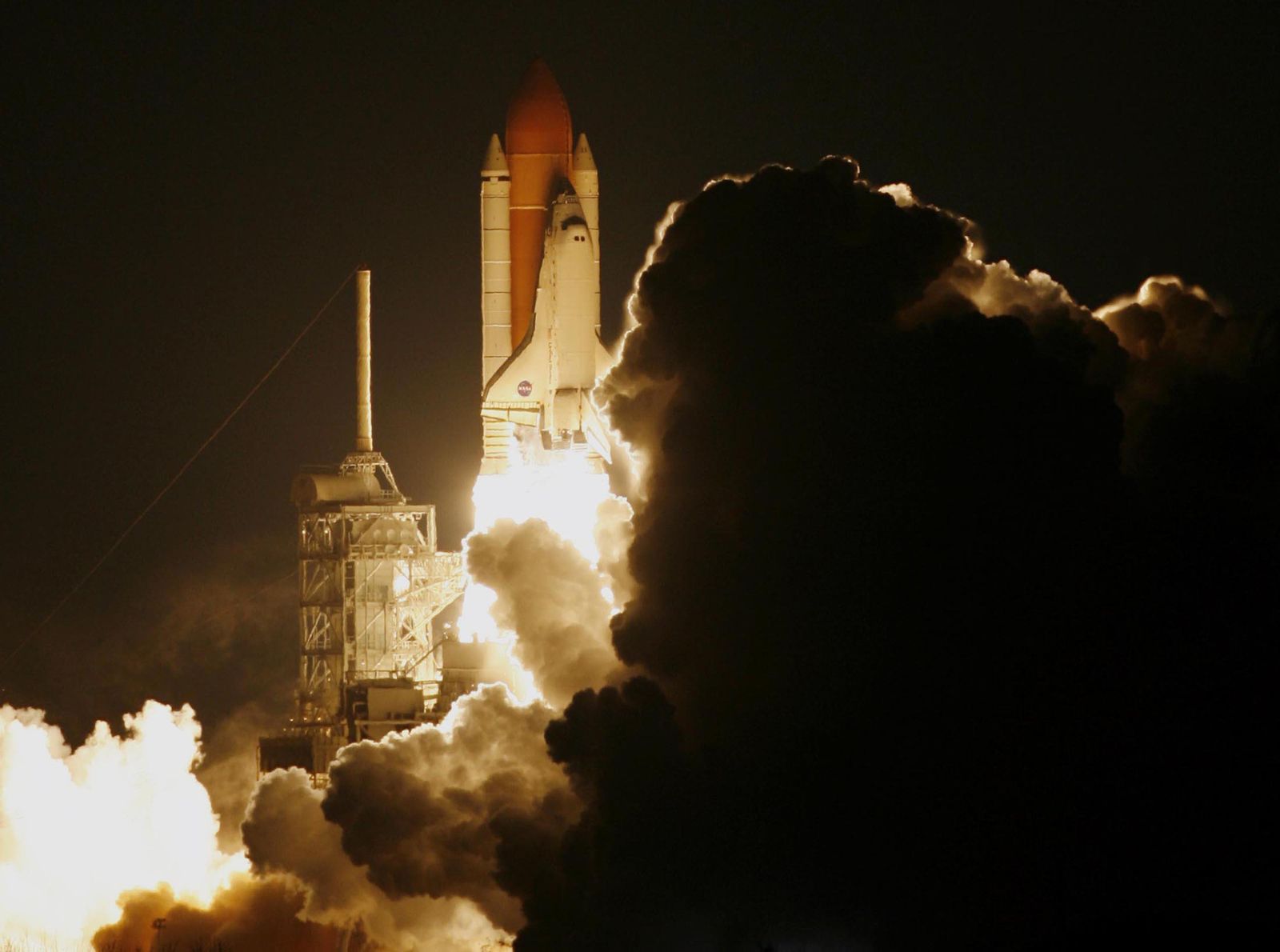
Apollo 12 was struck by lightning twice in the first 52 seconds of flight, filling the spacecraft with warning lights and turning Mission Control’s data into nonsense — until a young controller named John Aaron recognised an obscure failure pattern and calmly sai
On November 14, 1969, the Apollo 12 mission was nearly aborted when the Saturn V rocket was struck by lightning twice within the first 52 seconds of liftoff. The strikes caused a massive electrical surge that corrupted telemetry data at Mission Control and triggered cockpit alarms, a crisis resolved only when flight controller John Aaron identified the failure pattern and directed the crew to flip the Signal Conditioning Equipment (SCE) switch to auxiliary power, according to NASA historical records.
The 52-Second Crisis: Lightning Strikes at Liftoff
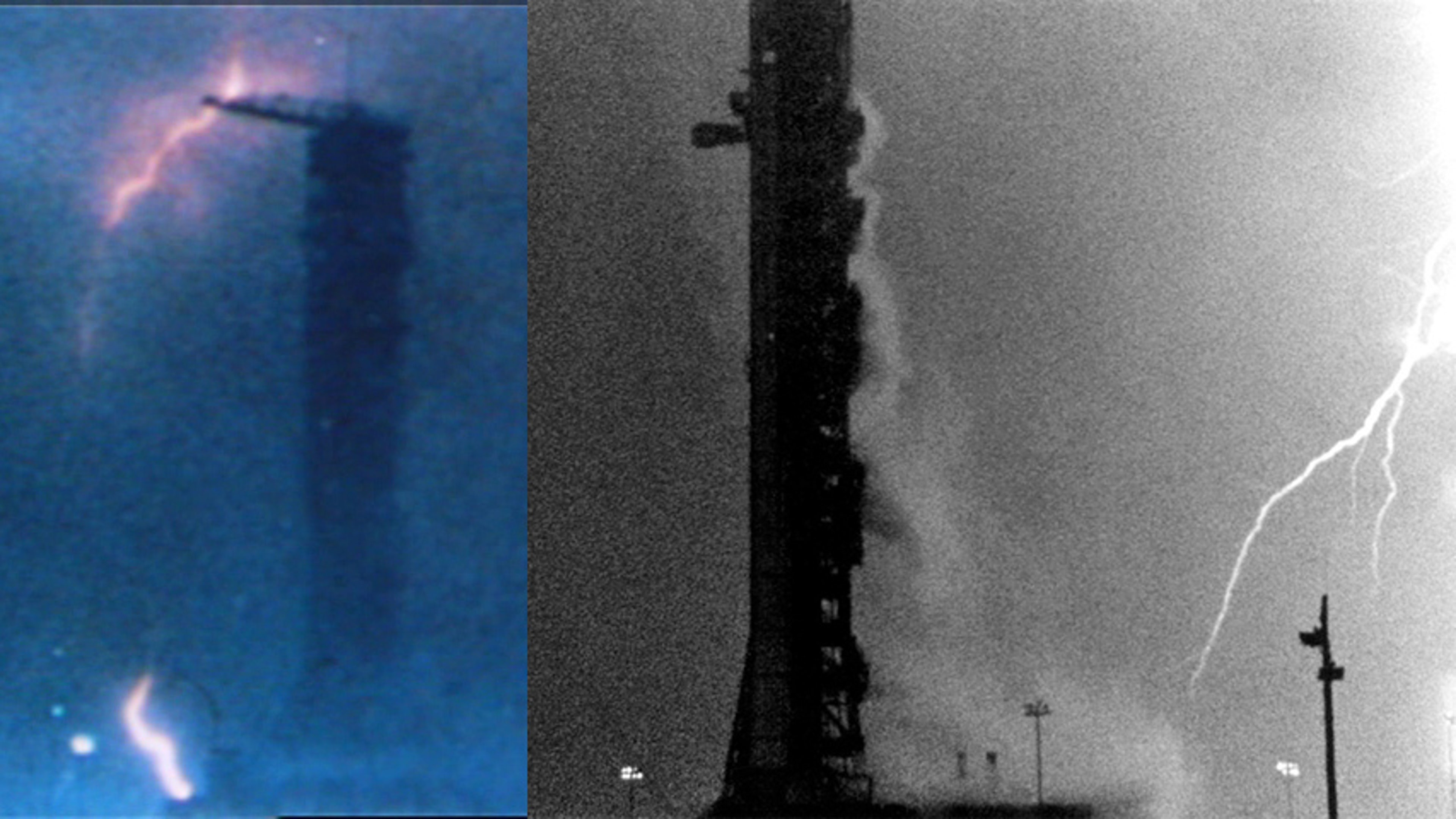
The launch of Apollo 12 from Kennedy Space Center was intended to be a precision mission, focusing on a pinpoint landing in the Ocean of Storms. However, the weather conditions provided an immediate challenge. Shortly after ignition, the vehicle encountered a storm cell. NASA flight logs indicate that the spacecraft suffered two distinct lightning strikes during the initial ascent phase.
The first strike occurred almost immediately after liftoff, followed by a second strike roughly 50 seconds into the flight. These discharges did not cause structural damage to the Saturn V, but they sent a high-voltage surge through the spacecraft’s electrical systems. In the cockpit, astronauts Pete Conrad, Alan Bean, and Richard Gordon saw their instrument panels erupt in warning lights. Simultaneously, the telemetry stream flowing back to the Manned Space Flight Network (MSFN) became unintelligible.
Flight controllers in Houston suddenly saw their screens fill with “nonsense” data. Values for fuel pressure, engine performance, and vehicle attitude began fluctuating wildly or flatlining, making it impossible for the Flight Director to determine if the vehicle was still airworthy or if a catastrophic failure was imminent.
Chaos at Mission Control: The Telemetry Collapse
At the Manned Spacecraft Center in Houston, the atmosphere shifted from routine monitoring to emergency confusion. The telemetry data—the vital signs of the spacecraft—had been corrupted. According to mission transcripts, the data appearing on the consoles was no longer reflecting the actual state of the vehicle; it was electrical noise caused by the lightning-induced surge.
The Flight Director, Gene Kranz, faced a critical decision: whether to abort the mission. An abort during the first few minutes of flight is a high-risk maneuver, but continuing with “blind” telemetry—where the ground crew cannot verify the health of the rocket—is equally dangerous. The controllers were seeing erratic readings that suggested multiple system failures, though the astronauts reported the ride felt smooth.
| Metric | Expected State | Observed State (Post-Strike) |
|---|---|---|
| Telemetry Stream | Stable, real-time data | Erratic, “nonsense” values |
| Cockpit Indicators | Nominal green/steady | Warning lights flashing |
| Vehicle Stability | Controlled ascent | Reported as stable by crew |
| Ground Visibility | Full system monitoring | Near-total data blackout |
John Aaron and the Recognition of the Failure Pattern
Amidst the panic, a young electrical engineer and flight controller named John Aaron, serving as the EECOM (Electrical, Environmental, and Consumables Manager), noticed something specific about the corrupted data. While other controllers saw only chaos, Aaron recognized a pattern he had encountered during simulator training.
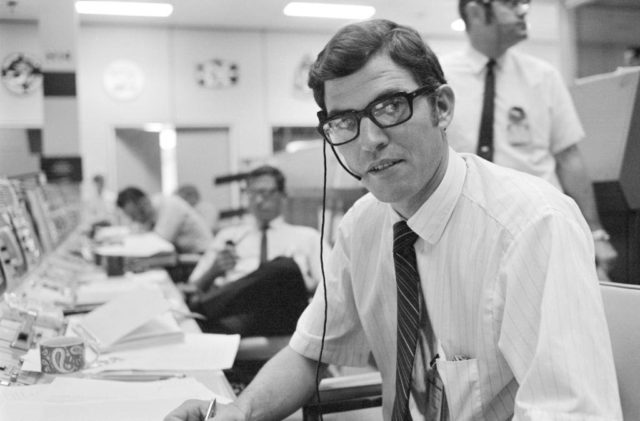
Aaron realized that the lightning strikes had not destroyed the spacecraft’s systems, but had instead tripped the circuit breakers in the Signal Conditioning Equipment (SCE). The SCE was the system responsible for taking raw sensor data and converting it into a format that could be transmitted to Earth. When the SCE failed, the telemetry didn’t just stop; it began transmitting “garbage” data because the conversion process was broken.
This was an obscure failure mode. Most of the training focused on total power loss or mechanical failure, not a specific surge that would “confuse” the telemetry system while leaving the actual spacecraft functions intact. Aaron’s ability to distinguish between a system-wide collapse and a sensing-system failure was the turning point of the mission.
The Command: “SCE to Aux”
With the clock ticking toward a potential abort, John Aaron calmly proposed a solution. He remembered a specific switch in the cockpit designed for exactly this type of contingency. He suggested that the crew switch the Signal Conditioning Equipment from the primary power source to the auxiliary source.
“Try SCE to Aux,” Aaron suggested.
The command was relayed to the crew. Pete Conrad flipped the switch, and almost instantly, the telemetry data at Mission Control snapped back into focus. The “nonsense” disappeared, replaced by nominal readings that confirmed the Saturn V was performing perfectly. The lightning had caused a superficial electrical “glitch” rather than a deep system failure.
This intervention saved the mission from an unnecessary and dangerous abort. By identifying the specific point of failure—the signal conversion rather than the propulsion or navigation systems—Aaron allowed the mission to proceed to the moon.
Key Technical Factors in the Recovery
- Pattern Recognition: Aaron’s familiarity with simulator anomalies allowed him to see a “signature” in the noise.
- System Redundancy: The existence of an auxiliary power path for the SCE provided a physical workaround for the electrical surge.
- Communication Clarity: The ability of the EECOM to communicate a concise, three-word fix to the Flight Director and crew prevented hesitation.
Why the Apollo 12 Incident Matters for Aerospace Safety
The Apollo 12 lightning strike provided NASA with critical data on how high-altitude electrical discharges interact with complex spacecraft. It highlighted a fundamental truth in aerospace engineering: the difference between a functional failure (the rocket stops working) and a monitoring failure (the ground thinks the rocket stopped working).
According to aerospace historians, this event led to a reevaluation of launch weather constraints. NASA became more stringent about launching into thunderstorms, recognizing that while a vehicle might survive a strike, the resulting telemetry loss could force a catastrophic abort decision based on false data.
Furthermore, the incident is often cited in human factors engineering as a prime example of the importance of “expert intuition.” John Aaron did not have a manual that told him “if lightning strikes and data looks like X, flip switch Y.” Instead, he used his deep understanding of the system’s architecture to deduce the solution in real-time.
Comparing the Apollo 12 Incident to Other Spaceflight Anomalies
To understand the severity of the Apollo 12 strike, it is helpful to compare it to other electrical or environmental crises faced during the Apollo era. While the Apollo 13 oxygen tank explosion was a hardware failure that threatened lives, the Apollo 12 incident was an information failure that threatened the mission’s viability.
In the case of Apollo 13, the failure was internal and destructive. In Apollo 12, the failure was external and systemic. Both required “out-of-the-box” thinking from Mission Control, but Apollo 12 demonstrated the danger of relying solely on telemetry. If the crew had not reported a smooth ride, and if Aaron had not recognized the SCE failure, the mission would have been scrubbed based on incorrect data.
| Feature | Apollo 12 Strike | Apollo 13 Explosion |
|---|---|---|
| Cause | External (Lightning) | Internal (Electrical short/Oxygen tank) |
| Primary Crisis | Loss of Data (Telemetry) | Loss of Life Support (Oxygen/Power) |
| Resolution | Switch to Auxiliary Power | Improvisation of CO2 scrubbers/Lunar Module lifeboat |
| Outcome | Successful Moon Landing | Safe return to Earth (No landing) |
The Human Element: Training vs. Intuition
The resolution of the Apollo 12 crisis underscores the tension between rigid procedural checklists and the need for expert judgment. NASA’s training was exhaustive, but the lightning strike created a scenario that wasn’t explicitly mapped in the “if-then” logic of the flight manuals.
John Aaron’s success was a result of what psychologists call “chunking”—the ability to recognize a complex pattern of information as a single, familiar unit. Because he had spent thousands of hours staring at telemetry and simulating failures, the “nonsense” data looked like a specific type of “wrong” to him. This allowed him to bypass the panic and go straight to the architectural root of the problem.
This event reinforced the value of the EECOM role. The EECOM isn’t just a monitor; they are the primary diagnostic link between the machine’s electrical heart and the Flight Director’s decision-making process.
Long-term Impacts on Spacecraft Design
Following Apollo 12, engineers focused more heavily on “hardening” spacecraft against electromagnetic interference (EMI) and lightning. Modern rockets, such as the SpaceX Falcon 9 or the SLS, employ advanced shielding and surge protection to ensure that a lightning strike does not corrupt the flight computer or the telemetry stream.
The “SCE to Aux” moment also influenced how modern flight software handles “bad data.” Today, systems are more likely to flag data as “invalid” or “unreliable” rather than simply displaying erratic numbers. This prevents the “nonsense” effect that nearly led to the abort of Apollo 12, ensuring that controllers know when they are blind rather than being misled by false readings.
Frequently Asked Questions
Did the lightning strike damage the Apollo 12 astronauts?
No. According to mission reports, the astronauts were safe inside the spacecraft. While they saw warning lights on their panels, the hull of the Saturn V and the Command Module acted as a Faraday cage, directing the electrical discharge around the exterior of the craft and protecting the crew from direct harm.
What exactly is the Signal Conditioning Equipment (SCE)?
The SCE is a system that acts as a translator. It takes raw analog signals from various sensors (like temperature, pressure, and voltage) and converts them into a digital or standardized format that can be transmitted via radio waves to Mission Control. When it failed during Apollo 12, the “translation” became garbled.
Why didn’t the mission just abort immediately?
An abort during the first minute of flight is extremely dangerous. It involves firing escape motors and separating the crew capsule from the booster at high speeds. Flight Director Gene Kranz and his team wanted to verify if the spacecraft was actually failing or if only the reporting of the spacecraft was failing. John Aaron’s quick fix provided that verification.
Was John Aaron the only person who noticed the pattern?
While other controllers were analyzing the data, Aaron was the one who specifically linked the visual pattern of the telemetry “noise” to the SCE’s power state. His role as EECOM gave him the specific technical focus on the electrical systems required to make that connection.
How did this event change future NASA launches?
The incident led to more conservative weather launch criteria. NASA became far more cautious about launching during active thunderstorms to avoid the risk of telemetry loss, which could lead to an unnecessary and risky abort during the ascent phase.
