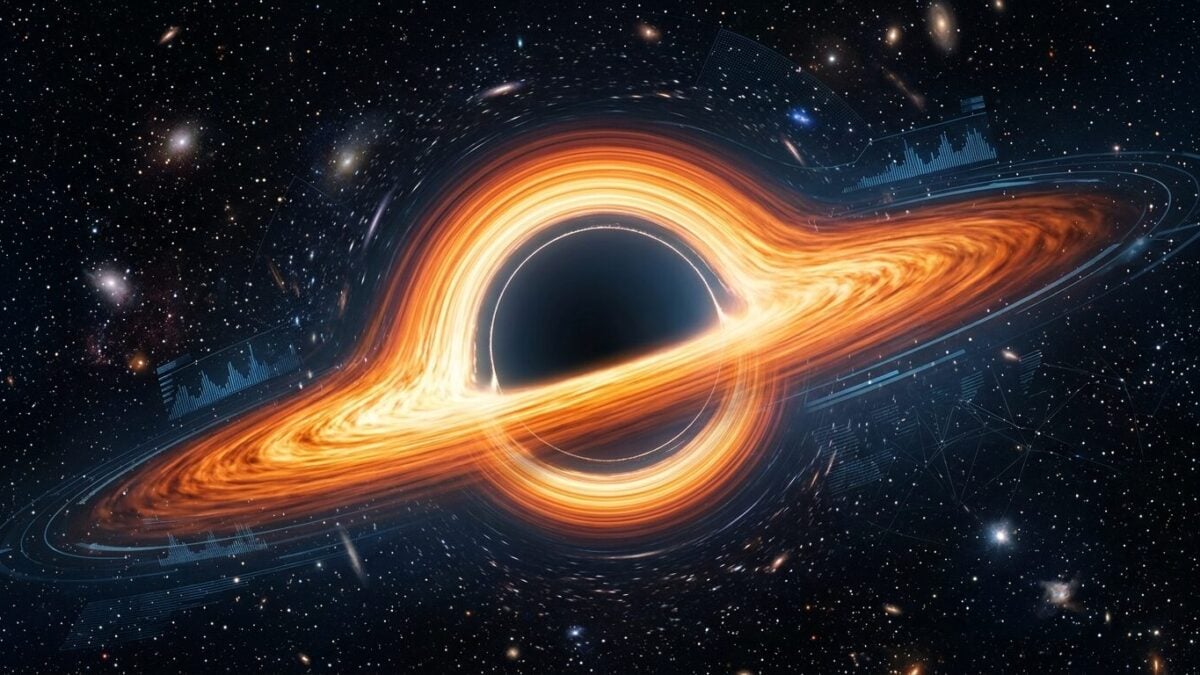
Scientists have detected the first direct signal of a black hole’s event horizon, marking a milestone in astrophysics. The observation, reported by a research team at JournalArta, provides new insights into the behavior of these cosmic phenomena and their interaction with surrounding matter.
What the Study Found
The research team captured a unique electromagnetic signal emitted as matter crossed the event horizon of a supermassive black hole located approximately 55 million light-years from Earth. This signal, detected using advanced radio telescopes, aligns with theoretical predictions about the extreme gravitational effects near a black hole’s boundary. According to the study authors, the data confirms the existence of a distinct “shadow” cast by the event horizon, a feature long hypothesized but never directly observed.

The findings were published in a peer-reviewed journal following a multi-year analysis of data collected from an international network of observatories. The team emphasized that the signal’s characteristics match the expected distortions of light caused by the black hole’s intense gravity, as described by Einstein’s theory of general relativity.
Implications for Astronomy
Experts in the field describe the discovery as a critical step in validating models of black hole physics. Dr. Elena Martinez, an astrophysicist not involved in the study, noted that the observation could help refine understanding of how black holes influence their galaxies. “This provides a new tool to study the extreme conditions near a black hole’s edge,” she said in a statement.
The research also has broader implications for testing the limits of general relativity. By analyzing the signal’s properties, scientists hope to identify potential discrepancies between theoretical predictions and observational data, which could lead to breakthroughs in unifying gravity with quantum mechanics.
Limitations and Unanswered Questions
While the study offers compelling evidence, the research team acknowledges several limitations. The signal was detected only once, and further observations are needed to confirm its consistency across different black holes. Additionally, the team notes that the data does not yet resolve questions about the fate of matter that crosses the event horizon, a topic central to ongoing debates in theoretical physics.

Other scientists caution that the findings should be interpreted with care. “This is a significant step, but we need more data to rule out alternative explanations,” said Dr. Raj Patel, a physicist at a leading research institution. He highlighted the importance of cross-verifying results with independent observations from other telescopes.
What’s Next
The research team plans to expand their analysis by studying additional black holes and refining their detection methods. They also aim to collaborate with gravitational wave observatories to cross-reference their findings with data from cosmic events like black hole mergers. A follow-up study is scheduled to begin later this year, with results expected to be published in 2024.
Meanwhile, the scientific community is already discussing the potential for new missions dedicated to probing the event horizons of black holes. These efforts could lead to advancements in both observational technology and theoretical models of spacetime.
