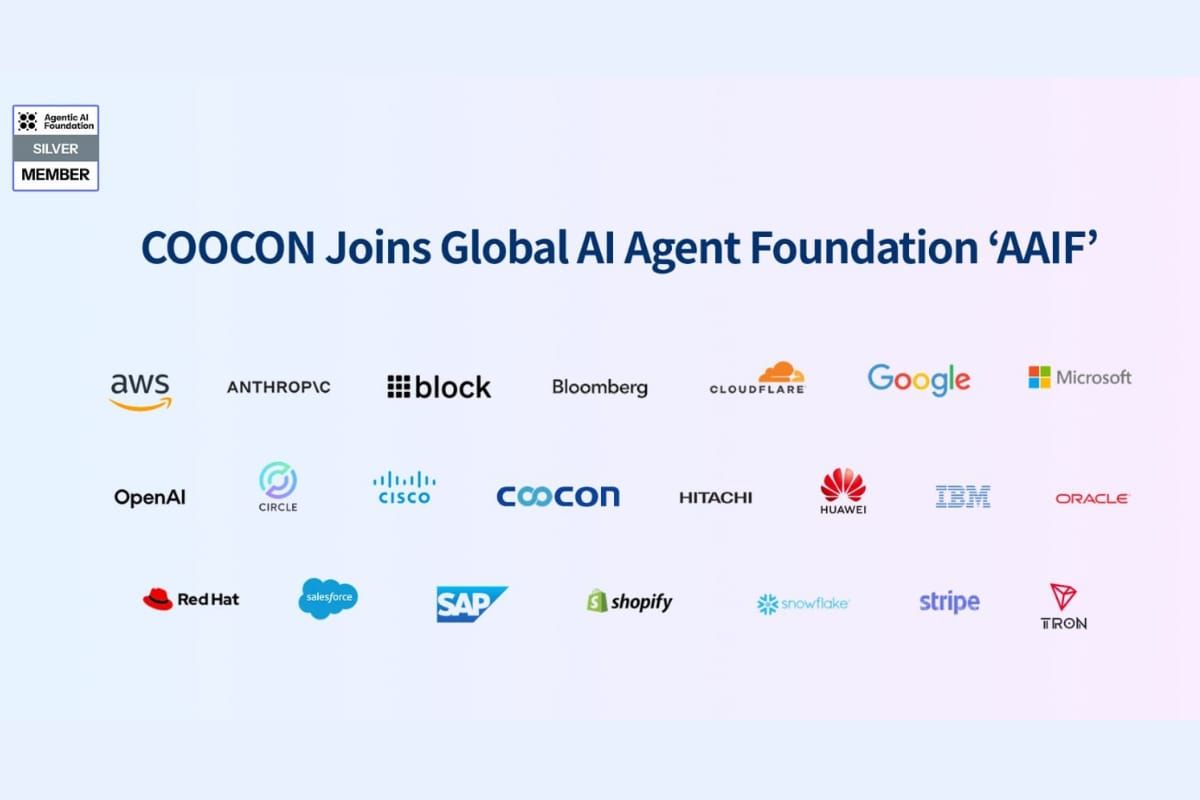
COOCON Expands Its AI Ecosystem by Joining the Global AI Agent Foundation AAIF to Innovate in Agent Payments and MCP-Driven Data Models
In a strategic move aimed at reshaping the future of AI-driven financial systems, COOCON has announced its membership in the Global AI Agent Foundation (AAIF), a collaborative initiative focused on advancing decentralized AI agent payments and multi-chain protocol (MCP)-based data economies. This development marks a pivotal step in the integration of AI automation with blockchain infrastructure, positioning COOCON as a key player in the next phase of digital innovation.
The collaboration, disclosed in a press release issued by COOCON, underscores the company’s commitment to developing scalable solutions for AI agent interactions. By leveraging the AAIF’s framework, COOCON plans to streamline cross-platform transactions and enhance data interoperability, according to a statement from the firm’s leadership. The partnership is expected to catalyze new use cases in sectors such as supply chain management, autonomous decision-making, and real-time analytics.
What Happened and Why It Matters
COOCON’s decision to join the AAIF comes amid growing demand for interoperable AI systems that can operate across multiple blockchain networks. The foundation, which includes a coalition of developers, researchers, and industry leaders, has been working to standardize protocols for AI agents—software entities capable of performing tasks autonomously. By aligning with this initiative, COOCON aims to address critical challenges in AI monetization and data governance, two areas that have long hindered widespread adoption.

One of the primary objectives of the AAIF is to establish a universal payment mechanism for AI agents, enabling them to execute transactions without human intervention. This is particularly relevant in scenarios where AI systems need to interact with external services, such as cloud storage, data marketplaces, or IoT devices. The integration of MCP-based data models further enhances this vision by allowing AI agents to access and share data across different blockchain ecosystems securely.
Industry analysts note that the convergence of AI and blockchain is accelerating, with companies increasingly seeking ways to monetize their data assets. “AI agents are no longer just theoretical constructs—they’re becoming operational tools that require robust financial and data infrastructure,” said Dr. Elena Martinez, a technology policy expert at the Global Tech Institute. “COOCON’s move reflects a broader trend toward creating ecosystems where AI can function independently while adhering to regulatory and economic frameworks.”
Key Players and Their Roles
The AAIF, founded in 2023, has attracted participation from a diverse range of stakeholders, including blockchain platforms, AI startups, and academic institutions. Its governance model emphasizes decentralization, with decisions made through a consensus-driven process involving its members. COOCON’s involvement adds a significant corporate perspective to the foundation, given the company’s expertise in AI-driven data solutions.
COOCON itself has been a pioneer in developing AI-powered analytics tools for businesses. The company’s MCP technology enables data to be stored and processed across multiple blockchains, reducing reliance on centralized servers. This capability is critical for AI agents, which often require access to vast amounts of data from disparate sources. By joining the AAIF, COOCON aims to refine its technology to better serve the needs of autonomous systems.
The AAIF’s leadership has welcomed COOCON’s participation, citing the company’s track record in scaling AI applications. “COOCON’s entry into the foundation brings valuable technical expertise and real-world use cases that will help shape the next generation of AI agent systems,” said AAIF spokesperson Rajiv Mehta. “Their focus on MCP aligns directly with our goal of creating a seamless, interoperable data economy.”
Timeline and Milestones
The journey toward COOCON’s collaboration with the AAIF began in late 2023, when the company initiated discussions with the foundation’s technical team. A key milestone was achieved in January 2024, when COOCON and the AAIF signed a memorandum of understanding (MOU) outlining their shared objectives. This agreement laid the groundwork for joint research projects, including the development of a prototype for AI agent payments using the foundation’s blockchain framework.
Following the MOU, COOCON began integrating its MCP technology with the AAIF’s existing protocols. This process involved testing data-sharing mechanisms across multiple blockchains, a task that required significant computational resources. By mid-2024, the companies reported successful trials, with AI agents successfully executing transactions and accessing data from interconnected networks.
The formal membership of COOCON in the AAIF was announced in July 2024, coinciding with the foundation’s annual summit in Geneva. During the event, COOCON presented a case study on its MCP implementation, highlighting how the technology could be adapted to support AI agent ecosystems. The presentation received positive feedback from attendees, many of whom expressed interest in exploring similar collaborations.
Implications for the AI and Blockchain Sectors
The partnership between COOCON and the AAIF has far-reaching implications for both the AI and blockchain industries. For AI developers, the integration of agent payments and MCP-based data models could reduce the complexity of building autonomous systems. By eliminating the need for centralized intermediaries, these technologies enable AI agents to operate more efficiently and securely.

From a blockchain perspective, the collaboration highlights the growing importance of interoperability. As the number of blockchain networks continues to expand, the ability to transfer data and assets across platforms becomes increasingly critical. COOCON’s MCP technology, combined with the AAIF’s framework, offers a potential solution to this challenge, according to experts.
However, the initiative is not without its challenges. Regulatory uncertainty remains a significant barrier to the adoption of AI agent systems. Governments and financial institutions are still grappling with how to oversee transactions involving autonomous entities. “There’s a need for clear guidelines to ensure that AI agents operate within legal boundaries,” said Sarah Kim, a regulatory analyst at the International Blockchain Council. “COOCON and the AAIF have a responsibility to engage with policymakers to address these concerns.”
Reactions and Expert Opinions
The announcement has sparked a mix of excitement and caution within the tech community. Many developers praised COOCON’s decision as a forward-thinking move that could accelerate the development of AI-driven economies. “This is a game-changer for the industry,” said Marcus Lee, a software engineer at a blockchain startup. “By creating a standardized payment system, COOCON and the AAIF are removing one of the biggest hurdles
