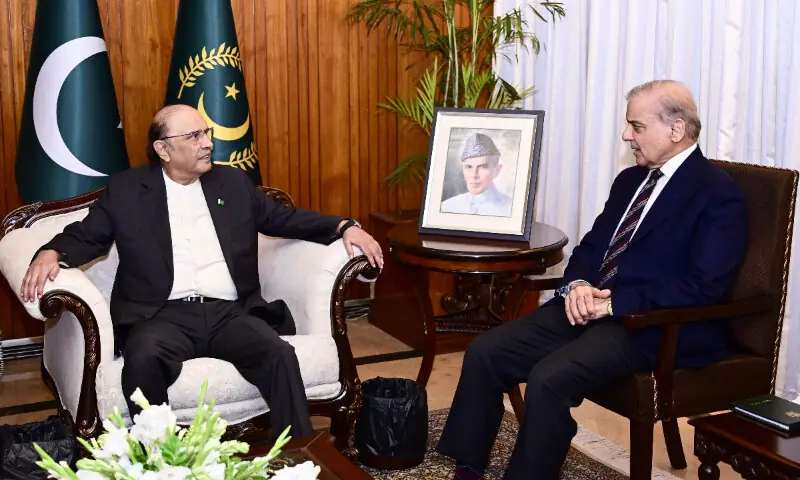
President and PM Align on Budget: Focus on Provincial Rights and Economic Stability
President Asif Ali Zardari and Prime Minister Muhammad Shehbaz Sharif have reached a consensus on the upcoming national budget following a high-level meeting at Aiwan-e-Sadr. The Pakistan Peoples Party (PPP) has signaled its support for the PML-N’s budget proposals, prioritizing economic stability and the safeguarding of provincial rights to ensure a balanced fiscal roadmap.
What happened during the meeting between President Zardari and PM Shehbaz Sharif?
In a critical session held at Aiwan-e-Sadr, President Asif Ali Zardari met with Prime Minister Muhammad Shehbaz Sharif to synchronize their positions ahead of the national budget announcement. According to reports from Dawn, the President utilized this meeting to explicitly emphasize two primary pillars for the upcoming fiscal plan: the protection of provincial rights and the achievement of long-term economic stability.
The meeting served as a diplomatic bridge to ensure that the executive leadership is on the same page before the budget is presented to the legislature. By focusing on provincial rights, President Zardari is signaling that the distribution of resources must be equitable and respectful of the autonomy of the provinces. Simultaneously, the push for economic stability suggests a commitment to curbing volatility and implementing sustainable financial policies.
“The President stressed the importance of provincial rights and economic stability in the upcoming budget during his discussions with the Prime Minister.”
This interaction was not merely a formality but a strategic alignment. In a coalition environment, the President’s input—particularly when representing the interests of the PPP—acts as a critical check and balance on the Prime Minister’s fiscal agenda. The focus on stability indicates a shared understanding that the country cannot afford further economic shocks during the implementation of the new budget.
Why are provincial rights and economic stability central to the new budget?
The emphasis on provincial rights is a recurring theme in Pakistani politics, often centering on the National Finance Commission (NFC) award and the allocation of development funds. When President Zardari stresses these rights, it typically refers to the need for provinces to have sufficient financial headroom to manage their own healthcare, education, and infrastructure projects without excessive reliance on federal whims.

Economic stability, on the other hand, is the overarching necessity for any government facing inflation or debt challenges. For the current administration, stability means creating a budget that can be passed and implemented without triggering market panic or social unrest. This involves a delicate balance between necessary revenue generation (taxes) and the need to protect the purchasing power of the general public.
The intersection of these two goals is where the political tension usually lies. Increasing federal control to ensure “stability” can often come at the expense of “provincial rights.” The fact that both the President and Prime Minister are now aligning on these points suggests a compromise has been reached to satisfy both the federal center and the provincial leadership.
Key Objectives Identified:
- Fiscal Equilibrium: Balancing federal expenditures with provincial needs.
- Resource Distribution: Ensuring provinces receive their fair share of the national cake.
- Market Confidence: Designing a budget that signals stability to international lenders and domestic investors.
- Political Cohesion: Reducing friction between coalition partners through agreed-upon spending priorities.
How the PPP ‘greenlit’ the PML-N budget proposals
The path to a unified budget was not without its hurdles. However, Geo News reports that the Pakistan Peoples Party (PPP) has officially “greenlit” its support for the budget drafted by the Pakistan Muslim League-Nawaz (PML-N). This endorsement came after a series of high-level huddles involving top leaders in Islamabad.
The “greenlighting” process is a vital step in the legislative cycle. Without the support of the PPP, the PML-N-led government would face significant risks of the budget being defeated or heavily amended in parliament. The huddles in Islamabad acted as the negotiating table where specific grievances were addressed and concessions were made.
This support indicates that the PPP is satisfied with the general direction of the PML-N’s financial strategy. While the PPP may have pushed for specific provincial carve-outs or social safety net enhancements, the overall framework of the budget is now acceptable to the party leadership. This alignment effectively removes a major political roadblock, allowing the government to move forward with the presentation of the budget with a secure majority.
| Political Entity | Primary Role in Budget Process | Key Stance/Action |
|---|---|---|
| PML-N | Budget Drafting & Implementation | Leading the fiscal strategy for the upcoming year. |
| PPP | Coalition Support & Oversight | Provided “greenlight” after ensuring provincial rights are addressed. |
| President Zardari | Strategic Guidance | Stressed economic stability and provincial autonomy. |
Addressing the budget rift and the Khyber Pakhtunkhwa (K-P) share cap
Despite the overarching agreement between the President and the Prime Minister, not all tensions have been fully resolved. The Express Tribune reports that while the President and PM have worked to ease the budget rift, concerns remain regarding the share cap flagged by Khyber Pakhtunkhwa (K-P).
The “share cap” refers to the limits placed on the amount of funding or the percentage of resources allocated to a specific province. K-P has reportedly flagged this cap as a point of contention, suggesting that the current proposed limits may be insufficient for the province’s specific needs or are unfairly restrictive compared to other regions.
The rift over the K-P share cap highlights the complexity of federal budgeting in a diverse state. Even when the two largest coalition partners (PPP and PML-N) agree, the interests of individual provinces—especially those governed by opposition parties or facing unique security and developmental challenges—can create friction.
The effort by President Zardari and PM Shehbaz Sharif to “ease” this rift suggests a willingness to negotiate on the specifics of the share cap. By addressing these concerns before the budget is formally tabled, the government hopes to avoid a protracted political battle in the legislature that could undermine the perceived “stability” the President has called for.
To understand more about the dynamics of federal funding, you may find a related explainer on the National Finance Commission (NFC) award useful.
Which budget proposals have the government and PPP agreed upon?
While the full details of the budget remain confidential until the official announcement, sources cited by Minute Mirror indicate that the government and the PPP have reached an agreement on “most” of the budget proposals. This suggests that the vast majority of the fiscal framework—including revenue targets, primary expenditure categories, and key policy shifts—has been vetted and approved by both parties.
The agreement on “most” proposals implies that there are still a few lingering points of contention, likely related to the specific allocations mentioned in the K-P share cap dispute or perhaps specific sectoral subsidies. However, the bulk of the work is complete.
The consensus reached between the government and the PPP is significant because it covers the core economic levers of the state. This likely includes:
- Taxation Frameworks: Agreement on how to increase revenue without triggering excessive inflation.
- Development Spending: General agreement on which infrastructure projects will be prioritized.
- Debt Management: A shared strategy on how to handle national debt obligations while maintaining stability.
- Social Welfare: Alignment on the funding for poverty alleviation programs.
By securing this agreement, the administration has minimized the risk of internal sabotage. The “most proposals” phrasing suggests that the remaining disagreements are marginal and can be handled through standard legislative amendments or post-budget adjustments.
Frequently Asked Questions
What was the main purpose of the meeting between President Zardari and PM Shehbaz Sharif?
The meeting was held at Aiwan-e-Sadr to align the government’s upcoming budget with the priorities of the coalition. President Zardari specifically emphasized the need for economic stability and the protection of provincial rights to ensure the budget is balanced and equitable.
Why did the PPP ‘greenlight’ the budget?
According to Geo News, the PPP provided its support after top leaders met in Islamabad to resolve differences. This “greenlighting” ensures that the PML-N-led government has the necessary legislative support to pass the budget in parliament.

What is the ‘share cap’ issue mentioned regarding Khyber Pakhtunkhwa (K-P)?
The share cap refers to the limits on the financial resources allocated to the province of Khyber Pakhtunkhwa. The Express Tribune reports that K-P has flagged this cap as a point of contention, though the President and PM are working to ease the resulting rift.
Does the agreement between the PPP and the government mean the budget is final?
While Minute Mirror reports that they have agreed on “most” proposals, the budget is not yet final until it is officially presented and passed by the legislature. There are still minor points of contention, particularly regarding provincial allocations, that may require further adjustment.
How does ‘economic stability’ figure into the budget discussions?
Economic stability is a priority to avoid market volatility and ensure sustainable growth. President Zardari stressed this to ensure that the budget does not implement shocks that could destabilize the national economy or lead to further inflation.
