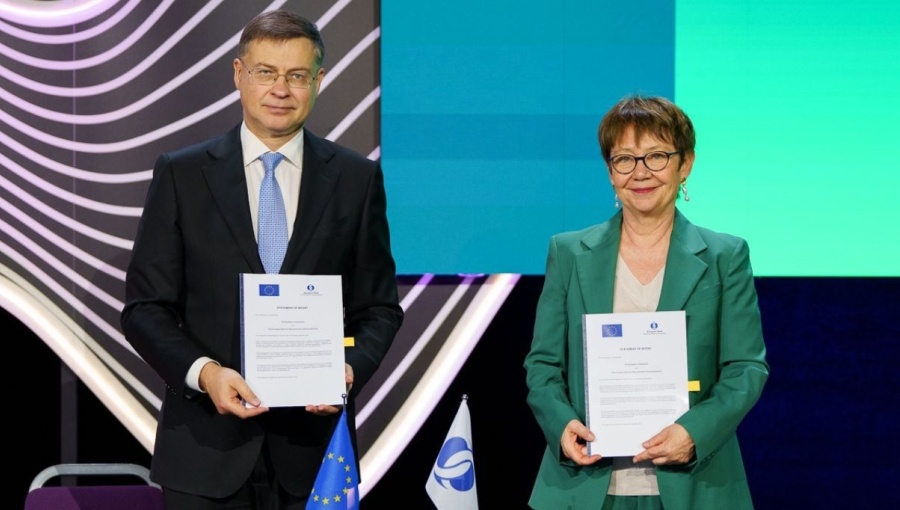
EBRD2026: EBRD, EU Expand InvestEU Support with €478mn in New Guarantees to Drive Green and Digital Growth
In a significant move to accelerate the transition toward a more sustainable and technologically advanced economy, the European Bank for Reconstruction and Development (EBRD) and the European Union (EU) have announced a substantial expansion of their InvestEU support. This strategic scaling includes the deployment of €478 million in new guarantees, a move designed to mobilize private capital and reduce risk for critical infrastructure and innovation projects across the EU’s countries of operation.
The expansion, framed within the broader EBRD2026 strategic trajectory, underscores a deepening partnership between the multilateral lender and the European Commission. By leveraging the InvestEU framework, the two institutions aim to bridge the investment gap in sectors that are essential for long-term economic resilience but often perceived as too risky for traditional commercial lending. This initiative is complemented by a €150 million investment specifically targeted at climate and digital priorities in key regions, signaling a clear mandate to prioritize the “twin transition”—the simultaneous shift toward a green and digital economy.
Analyzing the €478 Million Guarantee Package
At the heart of this announcement is the provision of €478 million in new guarantees. To understand the impact of this figure, It’s necessary to distinguish between a direct loan and a guarantee. While a loan provides immediate capital, a guarantee acts as a form of insurance. It protects lenders against potential losses, thereby encouraging commercial banks and private investors to provide funding for projects they might otherwise avoid.
This risk-sharing mechanism is the engine of the InvestEU program. By absorbing a portion of the first-loss risk, the EU and EBRD can trigger a “multiplier effect,” where a single euro of guarantee can unlock several euros of private investment. In the context of the current economic climate—characterized by volatile interest rates and geopolitical uncertainty—such guarantees are vital for maintaining the flow of capital into emerging markets and transitioning economies.
Strategic Allocation of Funds
The expansion is not a general fund but is steered toward specific strategic objectives. The primary focus areas include:
- Climate Action: Funding for renewable energy, energy efficiency upgrades and the decarbonization of industrial processes.
- Digital Transformation: Support for high-speed connectivity, digitalization of public services, and the growth of the tech ecosystem in underserved regions.
- Sustainable Infrastructure: Modernizing transport and utility networks to meet modern environmental standards.
| Financial Instrument | Amount | Primary Objective |
|---|---|---|
| New InvestEU Guarantees | €478 Million | Risk mitigation to mobilize private investment |
| Targeted Investment | €150 Million | Direct support for climate and digital priorities |
The “Twin Transition”: Why Digital and Green Investments Matter
The emphasis on “digital and green” investments is not coincidental; it reflects the overarching economic strategy of the European Union. The “twin transition” posits that environmental sustainability and digital transformation are mutually reinforcing. For example, smart grids (digital) are essential for integrating volatile renewable energy sources (green) into the power supply.
By stepping up support for these sectors, the EBRD and EU are addressing two of the most pressing challenges facing their countries of operation: the urgency of the climate crisis and the risk of a widening digital divide. The €150 million investment highlight serves as a catalyst, providing the “seed” capital necessary to prove the viability of green and digital projects, which then makes them more attractive for the larger pool of funding unlocked by the €478 million in guarantees.
The synergy between the EBRD’s regional expertise and the EU’s financial guarantees allows for the scaling of projects that are essential for the climate and digital transition, effectively turning policy goals into tangible infrastructure.
Strengthening the EBRD-EU Partnership in Countries of Operation
The collaboration between the EBRD and the EU is a cornerstone of the European Union’s external investment strategy. The EBRD operates as a multilateral development bank, meaning it possesses the local presence, legal expertise, and project pipeline necessary to execute complex investments on the ground. The EU, through InvestEU, provides the financial backing and policy alignment to ensure these investments serve broader geopolitical and economic goals.
This partnership is particularly critical in the EU’s countries of operation, where the transition to a market economy often requires more than just capital; it requires technical assistance, regulatory reform, and institutional capacity building. The expanded support ensures that these countries are not left behind in the global race toward net-zero emissions and digital integration.
Key Drivers of the Partnership
- Policy Alignment: Ensuring that investments align with the European Green Deal and the Digital Decade targets.
- Market Creation: Using public funds to create new markets for green technologies and digital services.
- Regional Stability: Promoting economic growth and job creation in transitioning economies to ensure long-term political and social stability.
For those interested in how these mechanisms function on a broader scale, a related explainer on sustainable finance provides deeper insight into the evolution of green bonds and blended finance.
The Economic Implications of Risk-Sharing and Blended Finance
The use of guarantees is a prime example of “blended finance”—the strategic use of development finance to mobilize additional commercial finance. In many of the regions where the EBRD operates, the “perceived risk” of a project often outweighs the “actual risk.” This leads to a situation where projects that are economically viable and environmentally necessary cannot secure funding because commercial banks are overly cautious.
The €478 million in guarantees effectively lowers the barrier to entry. When the EU and EBRD guarantee a portion of the loan, the risk profile of the project improves, leading to:
- Lower Interest Rates: Reduced risk typically leads to lower borrowing costs for the project developer.
- Longer Loan Tenors: Commercial banks are more likely to offer long-term loans if they have a guarantee, which is essential for infrastructure projects with long payback periods.
- Increased Participation: Small and medium-sized enterprises (SMEs) that lack the collateral for massive loans can gain access to credit.
Addressing Common Misconceptions
When news of large-scale guarantees and investments breaks, several misconceptions often arise. It is significant to clarify these points to understand the real-world application of the EBRD2026 framework.
Misconception 1: Guarantees are the same as grants.
Unlike grants, which are non-repayable funds, guarantees do not provide “free money.” They are a credit enhancement tool. The project borrower is still responsible for repaying the loan. The guarantee only kicks in if the borrower defaults, protecting the lender.
Misconception 2: Here’s only for large-scale government projects.
While large infrastructure is a key component, the InvestEU framework is specifically designed to support the private sector. A significant portion of these guarantees is intended to help private companies innovate in green tech or scale their digital operations.
Misconception 3: The funds are spent immediately.
Guarantees are “contingent liabilities.” The €478 million is not spent in a single lump sum; rather, it is a ceiling of risk that the EU and EBRD are willing to assume. The actual cash outflow only occurs if projects fail, meaning the funds can support a much larger volume of active loans than the face value of the guarantee.
The Road to 2026 and Beyond
The “EBRD2026” designation suggests a strategic window of implementation. By setting a target horizon, the EBRD and EU can measure the effectiveness of these guarantees in terms of actual carbon reduction and digital adoption rates. This period will likely see a shift from “pilot projects” to “systemic scaling.”
As the world moves closer to 2030 climate targets, the pressure to accelerate the transition increases. The current expansion of InvestEU support is a recognition that public funding alone is insufficient to meet these goals. The only way to achieve the necessary scale of investment is to make the private sector a primary actor in the green and digital transition.
Observers should watch for the specific “key regions” where the €150 million investment will be deployed. These regions will likely serve as blueprints for how the larger guarantee package is rolled out across other countries of operation. Success in these areas will provide the data needed to further refine risk-sharing models and potentially attract even more private institutional investors, such as pension funds and insurance companies, into the sustainable development space.
For further reading on the geopolitical aspects of these investments, see our analysis of EU investment strategies in emerging markets.
Frequently Asked Questions
What is the main goal of the EBRD2026 InvestEU expansion?
The primary goal is to mobilize private investment for green and digital projects in the EU’s countries of operation. By providing €478 million in guarantees and €150 million in targeted investments, the EBRD and EU aim to reduce risk for private lenders and accelerate the “twin transition” toward a sustainable and digital economy.

How do the €478 million in guarantees actually work?
These guarantees act as a safety net. If a private lender provides a loan for a green or digital project and the borrower defaults, the guarantee covers a portion of that loss. This encourages banks to lend to innovative or higher-risk projects that are essential for climate and digital goals.
What is the “twin transition” mentioned in the report?
The twin transition refers to the simultaneous pursuit of green (environmental sustainability) and digital (technological modernization) goals. The EBRD and EU believe that these two transitions are interdependent—for example, digital tools are required to manage renewable energy grids efficiently.
Who benefits from this new funding and guarantee package?
The beneficiaries include private enterprises, SMEs, and infrastructure developers in the EU’s countries of operation. By lowering the cost and risk of borrowing, these entities can more easily implement energy-efficient technologies or digital upgrades.
Is this funding a gift to the countries involved?
No. The guarantees and investments are not grants. They are financial instruments designed to facilitate loans and investments that must be repaid. The goal is to create economically viable projects that can eventually sustain themselves without public support.
